

Deprecated: mb_convert_encoding(): Handling HTML entities via mbstring is deprecated; use htmlspecialchars, htmlentities, or mb_encode_numericentity/mb_decode_numericentity instead in /var/www/html/wp-content/plugins/super-cool-ad-inserter/inc/scaip-shortcode-inserter.php on line 37
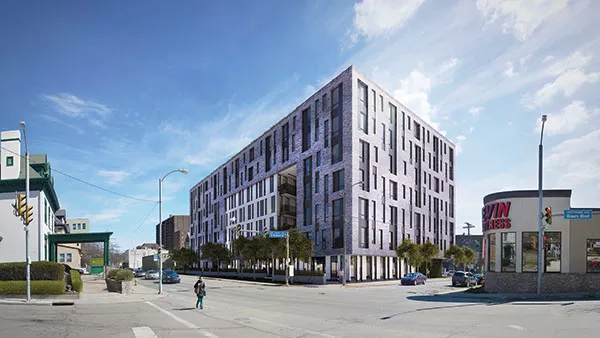
Pittsburgh is about to get a very nice mixed-use building for multi-unit housing and retail on Baum Boulevard, in Friendship. The Vitmore (whose developer is Vitmore LLC) is a seven-story, 103-unit project, designed by Workshop/APD architects of New York. Its combination of community support, sustainable amenities and high-quality architectural design is making it an exception among Pittsburgh real-estate developments, many of which have lacked some or all of these attributes.
Please, everybody, try to act normal.
For its part, the city’s Planning Commission reacted effusively, full of praise and unexpected pleasure. Commission head Christine Mondor commented, “The architects laid out very clearly both private amenities and public benefits. It went beyond what was laid out in the criteria” of the Baum Centre Overlay District Guidelines, which provide minimum standards for the area. Such overachieving designs should appear all the time — not leave us thinking that the commission had never really seen a decent building design before. Maybe they haven’t.
Pittsburgh is experiencing a building boom, but so much of it is bad. The Yards, in the Strip, by Oxford Development, is all cheap materials and grudgingly small fenestration in an underdeveloped façade. Whatever the landscape amenities might be, the architecture is just awful. Likewise, the apartments called Skyvue 3333 Forbes, in Oakland, are some of the worst architecture the city has seen in recent memory. This frantic agglomeration of hackneyed and mishandled motifs is a desperate but failed effort to make this beast look somehow less monstrous than it really is. For this we lost the Allegheny County Health Department, a building whose admirable restraint and dignity clearly made no impression on the architects of Skyvue. How this thing passed the Planning Commission is a mystery. Meanwhile, the housing at Bakery Square is by turns too large, too cheap and too unimaginative.
If Pittsburgh is going to engage best practices and international standards, then architectural design needs to be part of the equation. It’s as easy as keeping up with quality design journals, domestic and foreign, then holding our favorite local developers to such standards, instead of letting them fall short time after time. But Pittsburgh seems to be too busy patting itself on the back to realize that good architecture does not stop with a few environmentally sustainable features here or some community involvement there. Those things are necessary but not sufficient. We have zero-energy buildings, which are admirable, but you couldn’t pick them out of a lineup. And we are too busy having Sally Field-esque “You really like me” moments with inconsequential hipster blogs instead of getting serious about good design (among our other our perennial needs for critique and improvement).
So it was actually a great and necessary pleasure a few months ago when Mondor called out U.S. Steel for the anonymous and undercooked suburban-office-park design that they unveiled with such fanfare for the old Civic Arena site.
Suddenly, a public figure, with actual credentials and responsibilities to pass judgment on architecture, was doing so. In the ensuing flurry of activity, a few design changes on the order of rearranged deck chairs were proposed, but were neither convincingly posted, published or debated. Now, U.S. Steel is announcing layoffs by the thousands. Frankly, we’d be better off if this forgettable design were forgotten.
In this context, the Vitmore seems rather miraculous, when it is in fact simply good. Make your bloated floorplate as huge as possible in the lamentable but common local practice? No. The architects carved a portion of the center of the building out for light and air. “We felt we’d get a good public amenity from [that],” says architect Andrew Kotchen, in a phone interview. Complain about how hard it is to make money with decent design in the Pittsburgh market? No. “The numbers are completely different than New York, but we had a desire and interest in achieving a high level of design while being mindful of the budget.” Take your unfinished, context-free construction documents and present them to the planning commission? No. “The planning commission seemed to like the quality of our presentation.” Throw two colors of Dry-vit, add a few balconies and call it a day? No. “I think we did well with the overall design of the project and the skin of the project. Creating a big box is not always an easy thing.” Indeed, among the building’s many features, this compositional sense is especially balanced — fresh and rhythmic while maintaining neighborliness.
Kotchen is quick to credit a team starting with the developer and including Moshier Architects locally. “I don’t think we are doing anything that novel,” he says. “Study the site, study the conditions, look at the program.”
They seem like they do this all the time. Why the hell don’t we?
This article appears in May 13-19, 2015.





For a city that has a renowned architecture school, the design of the newer buildings here is just tragic. Do we really need yet another basic block structure, ugly like the airport, or the ubiquitous pergola style buildings that permeate the South Side, North Side and, sadly, everywhere else? Would be nice if the architects has some design sense and were creative — and not just copycats.
“Good enough is not Good enough” was the rallying cry from Mayor Peduto at the P4 conference; Every public official needs to take the time to read this and take time to understand make sure subsidies and incentives as well their bully pulpit are leveraged for better design. Oxford in particular must be called out. Trek and Mosites show that it can be done. Project proformas (cost per SF and public subsidies) can reveal much and need to be opened up to pressure better design. Of course hiring better architects and giving them the resources would help ;).
another building that very few will be able to afford living in … and boxy/ugly and un-inspired looking, to boot .
While I’m encouraged by the collective mentality of the new members of the planning commission, their actions so far give me pause. In public meetings they’re willing to push back against bad architecture/development with pointed questions and suggestions, but when the vote comes, they capitulate. I can’t wait for the group to put its foot down on a project with a definitive “no”.
Arbitrating good taste is not a simple matter. When plans come before the Planning Commission with odd amenities, such as the recent shell of sheet metal with round holes of varying sizes all over it, the most effective thing might be to simply ask, “Are the holes so the pigeons can land and better poop upon the windows?” When yet another building (and another and another) comes through with concrete block, corrugated metal, and a couple bricks, just ask, “What is this style called? It seems so Third World.”
And when yet another building – especially a planned residential apartment building – asks for three or four lit signs, each larger than the other, mounted on various places also against Code, and all are at least thrice the Zoning Code limit, just say “no.” Variances should only be granted to address some hardship to the property, not some greed or selfishness on the part of the owner.
Another note – why are architects and real estate speculators still designing individual homes that are not accessible to folks with disabilities? Why should a brand new home have to be retrofitted to be accessible?
We can do better on all of this. We know some great architects.
I would love to know who developed the idea that apartments at Bakery Square are too cheap. The buildings are unimaginative, but it’s a far stretch of the imagination to say that $1,295 a month is too cheap for a 500 square foot studio and $2260 is too cheap for a two bedroom apartment.
Walnut Capital designs the most ugly, concrete, bland buildings in the city. A few flower pots or trees on the sidewalk would make a world of difference. Walnut Capital over prices all of their properties and units too.
Developers keep hiring the same horrible architect which is Strada. No vision and boring none of their work stands out and very bland colors. All their work looks the same.
Kudos to Charles Rosenblum on his current article (Building Busts) and kudos to Pittsburgh City Paper for having an architecture critic who so impressively covers issues relating to our built environment. Pittsburgh is having a building boom without the city planning needed to demand better quality design, among other things. To add insult to injury much of the development is happening at the cost of older buildings that were built to last and incorporated better design principles and quality materials. Today’s building materials and design are mainly used to maximize profits for developers and whether these buildings will last 20-50 years is unclear (thereby canceling any sustainable benefits when they go to the landfill). Thanks to Charles for speaking up and naming names. I hope this inspires our leaders – if not the developers – to demand more and abandon the “any development is good development” credo that has been in place for so many years.
Thanks for this, Charles.
I’m glad that city planning has been so pro-development. That fact has allowed the city’s economic and cultural growth to spur a building boom. But our architects aren’t making it worthwhile.
The types of buildings we are seeing are far less than what the city deserves. For a place with a history of collapse, it pains me to see this level of nearsightedness. It was a misguided vision that filled downtown with department stores, ignorance that put towers in East Liberty, and now negligence that’s lining Penn Avenue with Alucobond and Dryvit.
This stuff should be better. And not just better for now, but better for the next 50, 100 years. Do we think about what some of these building will look like in 20 years? or whether they will be standing in 50? Their aesthetic role within our urban fabric is, at best, unclear and, at worst, debasing. Their energetic agenda is that of throwaway objects. They are disposable cameras; they take pretty pictures, but then we toss then. I am no classicist, but will we never see another Union Trust, a PAA? Sadly, one of the best civic buildings this city has produced in the past 20 years doesn’t have a roof and we play baseball inside it.
This city is full of great architects. Yeah, the budgets are tight. Yeah, it’s not New York. But don’t we harp on the merit of constraints? Can’t we build well within them? “I have never been forced to accept compromises but I have willingly accepted constraints.” Charles Eames made it work.
City planning exists as a check against the motivations of developers; they have license to speak on behalf of the community. I’m glad to see them taking a stance about the future of this city. Our architects should follow in kind. The work they do matters for Pittsburgh’s future. Let’s put on our Big City Pants and do something of meaning.
I think we need to stop and realize how budget-constrained developers are in this region. Pittsburgh is filled with old, beautiful architecture that could never be built in today’s world by a private developer expecting a reasonable profit without considerable subsidies.
Furthermore, Pittsburgh suffers from a 30+ year development glut that has directly led to an affordable housing problem. Class A product has not been rolled out and depreciated into more affordable Class B/C product and developing affordable housing is, again, incredibly difficult without significant public subsidy.
Look at what the going rate for a unit at Baumhaus (Vitmore) is. Sticker shock? Is that what we want more or in this city? We already have so many areas complaining about gentrification and affordability and now we are going to pressure developers to either only deliver extremely expensive products or rely on outrageous amounts of tax money? What we need is to grease the wheels of development and get the city back to a state of growth. We have finally stopped bleeding population. Not is not the time for a tantrum. Now is the time to buckle down and turn the wheels of progress to bring Pittsburgh into the modern world and benefit EVERY citizen. Developers are not inherently evil. They act inside of the economic and regulatory constraints put upon them. Pittsburgh NEEDS developers. Without them, we will never achieve affordability, in-migrant desirability, and the kind of sustained economic renaissance this city as a whole has been pursuing for at least two decades.
Before you complain and condemn, I would advise you to look for the why’s and how’s and, if you can, walk a mile in a developer’s shoes. They are not as cushy as you might think. If it was easy, everyone would do it. If creating designs that flew through the EXTREMELY painful approval process was a simple matter, why would an experienced developer do anything but that? Because it is extremely difficult in today’s market. Your arguments sound great, but I assure you that they don’t hold water unless you want all new development to fetch rents in the stratosphere because anything less and the developer would be bankrupt. Good luck with that. For my money, I say keep it rolling and let’s make Pittsburgh great again … together.