

Deprecated: mb_convert_encoding(): Handling HTML entities via mbstring is deprecated; use htmlspecialchars, htmlentities, or mb_encode_numericentity/mb_decode_numericentity instead in /var/www/html/wp-content/plugins/super-cool-ad-inserter/inc/scaip-shortcode-inserter.php on line 37

Video by Ashley Murray
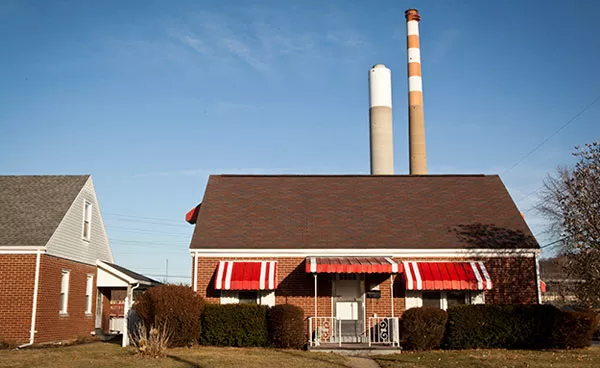
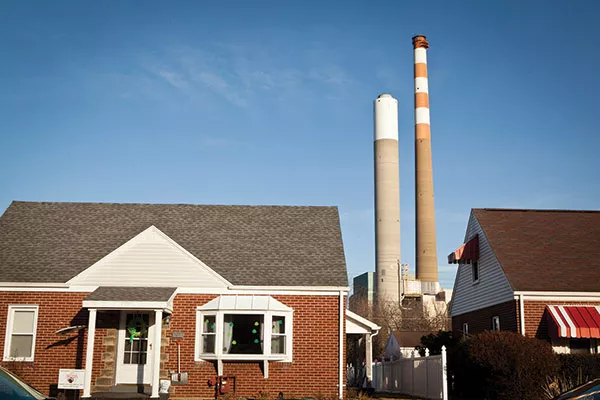
On the first warm and sunny day this March, cooped-up residents of Springdale emerged from their homes, ready for spring. In the otherwise unremarkable small town, two power-plant smoke stacks loom above, the defining characteristic of the place. You can hardly avoid seeing them against the clear, blue sky.
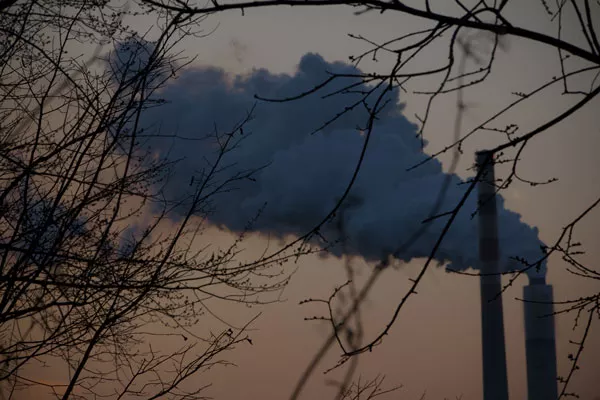
Likewise, the plume of smoke that has come from the 82-acre Cheswick Generating Station since 1970 has helped define residents’ lives.
“From what I’ve seen, it’s a lot cleaner than it used to be,” said Dave Cuiffi, who lives two miles away. Cuiffi was crouched on the ground, fixing a client’s winter-worn front sidewalk. He says he was a heavy-equipment operator when the plant built its new scrubber — a technology that removes harmful sulfur-dioxide emissions before exhaust is blown through the stack. “It used to emit a lot of brown smoke out of the original stack. Now it’s a lot cleaner, white smoke out of the new stack.” The white smoke Cuiffi sees is the water vapor and steam produced by the plant’s scrubber.
His client, an older woman whose house overlooked the plant from the hillside, had her own take on the pollution. She expressed disgust at having to re-paint her home. “This house used to be white,” said the woman, who wouldn’t give her name.
The NRG-owned plant’s emissions are also at the heart of a discussion over its operating permit, which expires in December. While the plant is satisfying its federal emissions requirements, activists say those limits are too high and need to be tightened.
“The stuff they’re emitting isn’t illegal, according to the permit,” says Randy Francisco, of the Sierra Club. “It’s atrocious.”
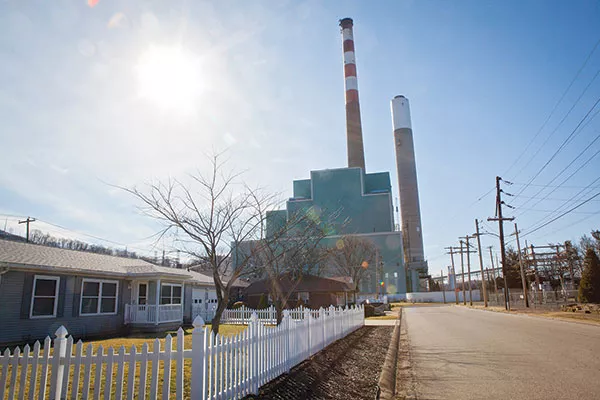
The coal-fired Cheswick Generating Station, which employs 105 people, is located 16 miles northeast of Downtown Pittsburgh, in Springdale, but is named for its neighboring borough. The plant has the capacity to produce 565 megawatts, enough to power more than 400,000 homes. NRG doesn’t specify exactly how often the plant operates — only that it doesn’t typically run at full capacity. It’s outfitted with “environmentally responsible” and “state-of-the-art” technology, according to, respectively, both NRG and environmentalists. Where those parties disagree is on whether the scrubber and another emissions-reducing technology — a Selective Catalytic Reduction (SCR) system, for nitrogen oxides — are running all of the time.
NRG’s scrubber permit with the Allegheny County Health Department (which enforces federal emissions law) says that if the plant is operating, the scrubber must run. And NRG company spokesperson David Gaier says that the way the scrubber is configured in the new stack, there’s no way to bypass it.
But critics say the plant could be achieving better results. Based on recent trends, they wonder if all measures are being taken to reduce emissions.

Separate from its scrubber, the plant is free to either run its SCR or buy pollution allowances via a cap-and-trade-type system regulated by the state and the Environmental Protection Agency.
But as it stands, the permit numbers themselves are “way too high,” says Tom Schuster, senior campaign rep for the Sierra Club in Pennsylvania and New Jersey. Meanwhile, NRG’s Cheswick permit is part of a larger fight over air quality in the county and the region.
The EPA targets sulfur dioxide (SO2) and nitrogen oxides (NOx) because of health risks they pose. Sulfur dioxide can form sulfur oxide compounds, or SOx, in the atmosphere, which can form particulate matter, or soot, which can “penetrate deeply” into the lungs, and is implicated in lung and heart disease. Nitrogen oxides and nitrogen dioxide gasses, commonly referred to as NOx, form ozone compounds in the atmosphere and irritate the respiratory system, specifically inducing asthma complications.
The pollutants are regulated by the Clean Air Act. Since the early 2000s, Allegheny County has been charged with enforcing the EPA’s permit for emissions standards every five years for major polluting sources.
Currently, the Cheswick plant is permitted to emit more than 33,000 tons of SO2 per year, or nearly one-and-a-half pounds per mmBtu — a heat-input rate measurement (one million British thermal units) that allows big and small plants to be compared more equally. Since the scrubber was installed, the plant’s numbers have been well below that limit. But Schuster says that the plant’s limit is simply too high.
“Basically, [the limit is] what you would see on a non-scrubber plant. We want to make sure we’re protecting the community,” Schuster says.
Schuster and the Sierra Club are advocating for 0.07 pounds per mmBtu.
“The plants with this equipment should be going as low as they can,” Schuster says.
Sulfur-dioxide emissions from the plant took a nose-dive during 2011-2012 — from just over 9,000 tons (or 0.7 1bs/mmBtu) to just under 2,000 tons (0.15 lbs/mmBtu). This was the year the scrubber technology became fully operational — possibly why Cuiffi sees a different color “smoke” now. Pre-scrubber rates hovered in the 30,000-45,000-ton range. But the 2013-2014 numbers show an uptick, from 0.1144 lbs/mmBtu to 0.2902 lbs/mmBtu — not anywhere near pre-scrubber rates, but nearly double the lowest numbers achieved by the plant in 2013. Another pollutant from the plant on a slight upswing is nitrogen oxides — from just over 2,500 tons (0.2608 lbs/mmBtu) in 2010 to just over 6,000 tons (0.3821 lbs/mmBtu) in 2014.
Company spokesman Gaier says the higher sulfur-dioxide levels lately are due to the higher-sulfur coal they used in 2013 and that NOx levels have remained “pretty much flat.” But Schuster is worried about the increase since 2010 that EPA data show.
Currently, NRG can buy emissions allowances for certain pollutants, including NOx, under the Cross-State Air Pollution Rule, which manages more than 30 Eastern states operating under one cap. Pennsylvania divides its own cap allowance between major polluting sources. Sources emitting below the cap create allowances for themselves, or buy, sell or trade them.
NOx is considered a “transported emission,” meaning it can blow far from its source. EPA created this provision because Northeastern states were getting the brunt of pollution that they didn’t even create.
NRG would not share records of allowance transactions. “Emissions trading is a commercial matter and constitutes proprietary information that we cannot discuss for competitive reasons,” Gaier said via email.
The Pennsylvania Department of Environmental Protection said that while emissions data is a matter of public record, SCR usage is not.
“Generally, the more an SCR is used, the lower the NOx emissions. The emission rates observed from Cheswick in 2014, as retrieved from EPA’s Clean Air Markets database, would suggest that SCR was used less frequently,” the DEP says.
While NOx is a “transported pollutant,” EPA acknowledges that there are consequences for local populations. Schuster says he worries about whether the trading rule works for people living around the plant.
“What [happened was] a lot of these plants installed this equipment because of the trading systems, and figured, ‘We can reduce our emissions and won’t have to buy allowances,'” Schuster says. “What they found in the last few years is that allowances are dirt-cheap and they’re just buying what they need. The problem is that it doesn’t help Allegheny County residents who have to breathe the air.”
The DEP says that new EPA rules in 2015, which company spokesperson Gaier says it will begin complying with this April, will make it “more expensive to purchase allowances for compliance demonstrations.”
In 2013, the county’s air monitor upwind of the Cheswick plant — about 12 miles up the Allegheny River in Harrison Township — recorded ozone levels above EPA standards. And for the six years preceding the health department’s 2013 air-quality report, the Harrison monitor clocked the highest average ozone in Allegheny County.
The health department notes that NOx levels from the Cheswick plant and ozone levels at the Harrison monitor are two separate things. But NOx is “a precursor to the formation of ozone,” according to EPA. “Without NOx, you don’t have ozone,” Schuster says.
The county is in its own predicament on ozone, as the EPA considers lowering the standards from 0.075 parts per million to 0.070 or less.
That brings things back to the SCR. “When the new standard is promulgated, that requirement [of whether the plant must run its SCR] will be reviewed to see if it’s needed to run all the time in order to bring us into attainment,” says Allegheny County Health Department deputy director Jim Thompson.
Allegheny County is already out of compliance on a number of EPA standards, including fine particulate matter, SO2 and ozone levels.
On fine particulate matter — solid particles smaller than 2.5 microns that can get into your lungs — the county faces a huge challenge. Because the monitor closest to the U.S. Steel’s Clairton Coke Works registers non-compliant levels of PM2.5, the entire county has been declared as nonattainment by the EPA.
The ACHD and the state’s DEP are now drafting plans to bring the county into attainment on SO2 and ozone standards. Thompson says the county is on track to be able to comply with fine particulate matter by the end of this year.
Schuster says if the permit numbers for Cheswick aren’t brought into check, a similar situation could arise from its emitted pollutants — particularly SO2.
“Their emissions from 2014 were almost double what they were in 2013. … [I]f that trend was to continue and their permit didn’t get tighter, it’s possible that they could be causing nonattainment,” says Schuster.
The Sierra Club is not the only body organizing around the Cheswick plant’s emissions. Unrelated to the Sierra Club’s efforts, in 2012, two residents sued on behalf of every resident living within a mile of the plant on the grounds that particulate matter landing on residents’ property amounted to a nuisance and trespassing. While a lower court sided with the plant, a federal appeals court overturned the decision in 2013, stating that even if the plant complies with its permit, that doesn’t prevent residents from filing suit. The U.S. Supreme Court denied review of that decision. The case is still pending.
Meanwhile, Schuster and others say they’re asking the health department to get the permit numbers lowered now while they have the opportunity. NRG has to submit an application for renewal in June, and the health department says it will hold a public-comment period before the permit is issued.
“I think that it’s the coal plants that represent the lowest-hanging fruit, particularly Cheswick and other plants that already have the installed equipment,” Schuster says. “I think we need to have them pull their own weight with respect to lowering smog and protecting everyone’s health.”
This article appears in Mar 18-24, 2015.






So why do we put up with this when there are creative artists willing to create LAND+ART = CLEAN ENERGY (p.55 of the same issue!)? Because so far LAND + ART has not actually built any projects and because it would take 2,000 of the largest projects proposed-but-not-yet-built to equal 1 Chiswick.
City Paper: thanks for doing those interviews and creating that video.
I vote for tightening the pollution standards on this plant. The article says that Allegheny County is out of compliance on particulates, sulfur dioxide, and ozone, and this plant is a big producer of those, so that’s enough justification right there.