

Deprecated: mb_convert_encoding(): Handling HTML entities via mbstring is deprecated; use htmlspecialchars, htmlentities, or mb_encode_numericentity/mb_decode_numericentity instead in /var/www/html/wp-content/plugins/super-cool-ad-inserter/inc/scaip-shortcode-inserter.php on line 37
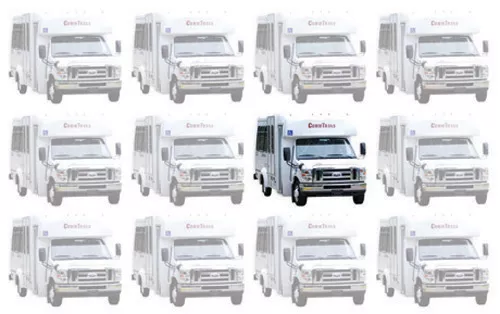
Bob Lichtenfels wasn’t used to having public transit of any kind — let alone paratransit specifically designed for people living with disabilities — in his small hometown in Indiana County.
“I came here for my independence,” says Lichtenfels, who is blind and came to Oakland in 1992 to attend the University of Pittsburgh. “I want to do things for myself. I don’t want to have to ask anyone for help.”
Lichtenfels, president of the Golden Triangle Council of the Blind, now lives in Mount Lebanon with his wife, who uses a wheelchair, and infant daughter. The family relies on ACCESS — Port Authority’s advanced-reservation, shared-ride program for seniors and those with disabilities — for just about everything: medical appointments, church, social events and work. ACCESS’s level of service, he says, is a large part of why they stay in the city.
“We only use buses and ACCESS,” says Lichtenfels. “But the buses don’t go everywhere.”
For a lot of riders with disabilities, ACCESS picks up where the bus system can’t help. Anyone can use it, but it’s especially critical to those who have a disability that prevents them from using the bus, or getting to and from a stop, and it’s available at a discounted rate. It also picks up where remaining transit options are limited: There are, for example, only four ADA-accessible taxis in the county.
But Lichtenfels’ mobility — and his independence — could be in jeopardy under a 35 percent service reduction proposed by the Port Authority of Allegheny County last week to solve a mounting budget deficit. In addition to the proposed elimination of 46 bus routes, severe reduction to the remaining lines, layoffs of up to 500 employees and the closure of at least one operating division, the transit agency has also proposed a massive service reduction and fare increase for ACCESS.
Such deep cuts to ACCESS are a first, and advocates fear the impacts on an already vulnerable community.
“Imagine what it would be like to not be able to leave your house for any reason, or to be only able to leave your house during working hours and weekdays,” says Lucy Spruill, director of public policy and community relations at United Cerebral Palsy/Community Living and Support Services, in Oakland. “It’s going to be like being on house arrest.”
In addition to providing transportation alternatives to human-service agencies, ACCESS offers two main programs: one for riders over 65, funded by the Pennsylvania Lottery, and one for riders with disabilities, known as the Americans with Disabilities Act (ADA) program, which is funded by the Port Authority of Allegheny County.
While the senior program could face a fare increase and some reduction in service hours, the current service area would remain intact. Riders with disabilities, however, aren’t so lucky.
Currently, Port Authority offers door-to-door service via ACCESS between any two points within Allegheny County and up to 1.5 miles into neighboring counties to comprise a 780-square mile service area. Under the proposal, that service area would shrink down to the federal minimum, which only requires the transit agency to offer paratransit rides that start and end within three-quarters of a mile of an operating bus route.
But Karen Hoesch, executive director of ACCESS Transportation Systems, says that’s only part of the problem. If a bus route operates on weekdays, but not on the weekend, then there will also be no ACCESS service on the weekend. And with the proposed elimination of 46 routes and a reduction in many others, that will leave a lot of people in need, and out of luck.
More than 1,200 ADA-eligible riders with disabilities live outside of the proposed service area. Of the nearly 1.7 million trips ACCESS now provides annually, it’s estimated that nearly 300,000 will no longer be provided to seniors and ADA riders. Riders could still get ACCESS beyond the three-quarters of a mile area, but at a fare rate nearly 10 times higher, making the option out of reach for many with disabilities.
Operating hours would also be affected. Currently, the program is available from 6 a.m. to midnight daily. Under the proposal, it would run the same days and hours as bus routes, and most of the service would end at 10 p.m., save for the handful of bus routes that operate later.
“There are people who work until 11 [p.m.] or 12 [a.m.] who would lose their jobs. … [N]o one could go to a Pirates game at night, no one could go to an evening Cultural Trust event Downtown,” says Spruill. “It would be a very bad quality-of-life change for people.”
Many human-service agencies and events are also deliberately located on ACCESS lines; the Golden Triangle Council of the Blind, for one, holds its monthly meetings Downtown at the Department of Human Services, which is served by both ACCESS and the fixed-route system. At UCP/CLASS, Spruill says dozens of clients visit the agency using ACCESS.
Port Authority has always offered more ACCESS service than required by legal standards, and advocates say that has made it an attractive city for those with disabilities. Lichtenfels, for one, says he moved his family back to Pittsburgh from Orlando because of paratransit service.
“People from all over the world come to Pittsburgh to look at the ACCESS system,” says Port Authority CEO Steve Bland. “It is unique. If that starts to erode, that’s a real shame.”
Since 1979, Allegheny County has had an ACCESS program, even though federal requirements under the Americans with Disabilities Act mandating paratransit weren’t in place until the mid-1990s. Even when ADA passed, Port Authority continued to offer service beyond the minimum requirements.
ACCESS costs the Port Authority about $25 million a year, and has escaped service cuts on three previous occasions. But facing a budget deficit for the coming year of $64 million, PAT officials say they are left with few options.
“We’re running out of things to cut,” says Bland. “We 100 percent don’t want to do this. It’s not right.”
But allows, Hoesch, the ACCESS director, “When you’re looking at service cuts of this extent, I think it’s only fair that everything is on the table.”
The cuts also won’t just affect riders. About 800 people — from drivers to telephone operators — are employed by six private companies that provide services to ACCESS. Hoesch says layoffs will be inevitable.
And for those left with service, they’ll have to pay more out of pocket. Currently anyone can use ACCESS and simply pay the full fare, which starts at $16.80 one way (and would jump to $23.00 under the proposal). But for those who qualify, up to 85 percent of the fare can be subsidized by the state lottery and PAT, leaving ADA and senior riders to pay the remainder out of pocket on a scale that fluctuates based on location. Senior riders could see fare hikes up to 93 cents, while ADA riders could pay as much as $1.20 more.
Advocates worry that riders won’t be able to absorb the cost because they’re already at an economic disadvantage. “People with disabilities are, in dollars and cents, the poorest subsection of the country,” Spruill says. According to the federal National Council on Disability, only 32.8 percent of working-age people with disabilities are actually in the workforce, and their income, on average, is one-third less than the income of non-disabled workers.
But advocates say the cost of the service reductions go beyond the wallet.
“A fare increase is always hard, but at least you still have an option,” says Hoesch. “If you lose your service, you’ve got nothing.”
Transportation officials say the only way to avoid the pending cuts is for state lawmakers to enact a package of transportation bills awaiting action in Harrisburg. Riders, they say, need to start lobbying for the funding options now.
“At this point, it’s up to the customers to advocate for all of the transit system,” says Hoesch. “Because we all rise and fall together.”
The Port Authority of Allegheny County will accept public comments on the proposed service reduction, from Feb. 5 through March 9. Submit comments online at www.portauthority.org, or by mail to: Port Authority Fare & Service Proposals, Heinz 57 Center, 345 Sixth Ave., Floor 3, Pittsburgh, PA 15222-2527. A public hearing will be held from 8 a.m. to 8 p.m. on Wed., Feb. 29, at the David L. Lawrence Convention Center, Downtown. Individuals wishing to testify may pre-register by calling 412-566-5437.
This article appears in Jan 25-31, 2012.





None of this is PAT’s fault. The state has dropped the ball on funding mass transit. Fairy tale ideas like privatization (didn’t work here, that’s why we have a public authority – hasn’t worked anywhere in the world) are a waste of discussion. This issue is – are people going to put up with this? I know I’m not.
I fail to see a problem here. My husband and daughter are both home-bound due to disabilities and because ACCESS is completely useless in their current state, cuts to services will have no impact on them. The reality is if they relied on ACCESS to get to work, they would be fired within the 1st week. When they need to go to the doctor, they need to beg, borrow and steal to get a ride from friend or family because ACCESS either doesn’t show up, shows up 3 hours after the appointment is over, or they just decline the request at the time of call. The people who have moved here to benefit from ACCESS must be sorely disappointed.
How can PAT possibly be blameless in this issue? Did Allegheny County really need a $500 million hole under the Allegheny River? PAT was having trouble supporting their system long before the tunnel fiasco. However, because it was “federal money” they refused to say no. So, even though the tunnel was ‘built’ with our tax money, PAT still has to ‘support and maintain’ their infrastructure. How many businesses without some plan to suupport them? Now they have another tunnel, a little used route and more facilities to support. Except to attend an occassional sporting event at one of the stadiums, how much use is the north shore tunnel really going to get? Does anyone really believe that the ridership will support the ‘T’ route to the north side?
PAT needs a system that is convenient and efficient for riders and also supports travel within the county without having to travel into Downtown Pittsburgh. Their system has never been convenient for travel anywhere except into the City. Ridership, along with revenue, would increase if the system was convenient to use. Until that happens, PAT will continue to cost everyone more and more for less and less.
I see ACCESS vans transporting the elderly & disabled on a daily basis in neighborhoods in & around the South Hills. If there is 1 person being denied Access Services that they truly need….well that is 1 too many in my book!!! Cutting services to the most vulnerable people who rely on them is reprehensible to say the least! I hate those who play the “Blame” game & sincerely hope that instead of arguing fault, decision makers will choose to do the RIGHT thing & add more services instead of cutting them!
ASK SOME OF THE ELDERLY ABOUT ACCESS, ITS NOT WHAT IT SET UP TO BE, IT IS NOT A GOOD SERVICE FOR THE ELDERLY, I DO ALL I CAN NOT TO RIDE THEM, AND I KNOW A LOT OF ELDERLY THAT WONT RIDE THEM AT ALL!