

Deprecated: mb_convert_encoding(): Handling HTML entities via mbstring is deprecated; use htmlspecialchars, htmlentities, or mb_encode_numericentity/mb_decode_numericentity instead in /var/www/html/wp-content/plugins/super-cool-ad-inserter/inc/scaip-shortcode-inserter.php on line 37
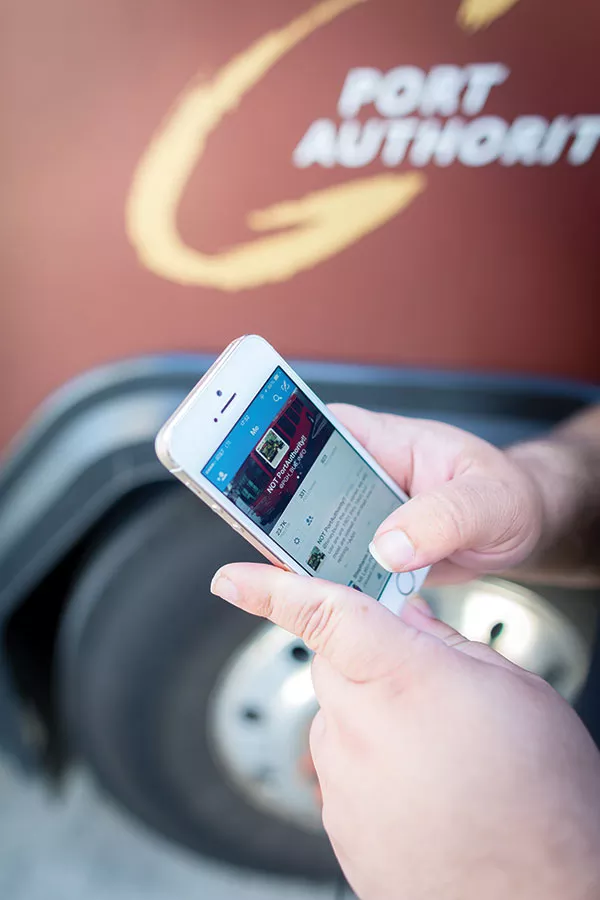
Andrew’s idea of prime Downtown real estate is a crowded rush-hour bus stop. It doesn’t have much of a view, and every few minutes a bus belching diesel fumes roars past. But he’s too busy to let any of that bother him.
“It’s a really good spot for transit-spotting,” he says, his face buried in a pristine white iPhone 5s.
Settled into a green fold-up captain’s chair at Fifth Avenue and William Penn Place, he cranes his neck to watch a 71D Hamilton pull away across the street.
“There are people who mock me for the chair, but if you’re at a bus stop, and it’s hot, you want a seat,” he says. His fingers race across his phone, which tells him the bus is running six minutes late.
He pauses, unsure if it’s worth inputting the 71D’s tardiness into Tiramisu, an app that lets riders track buses with information gathered from other users. Buses often run behind schedule during rush hour, and six minutes isn’t that late. But as he’s done thousands of times before, Andrew decides more information is better than less, and plugs the update in.
It hardly seems like subversive activity, but Andrew requested that his last name be withheld from this story due to tensions with the Port Authority and “unforeseen repercussions [from] people who don’t like the service.” The agency has claimed that at times his “customer service” has bordered on impersonating transit workers.
Nevertheless, for the past decade, Andrew, now 26, has spent much of his day tweeting and answering phone calls about basic scheduling information and service disruptions. He doesn’t have another job — he uses the public assistance he gets to take care of Internet and phone costs, but he’s quick to point out his lifestyle is hardly lavish: He lives in subsidized housing in Penn Hills and often doesn’t have enough money to even afford a monthly bus pass.
The information he provides is the center of “Mobile Bus Information Hotline” — an all-purpose phone number (412-759-3335) and Twitter account (@PGH_BUS_INFO) that he runs after the evening rush into the early morning hours when Port Authority’s own customer-service center is typically shut down.
Port Authority has lagged behind larger transit agencies in providing real-time information about delays and other disruptions. “There’s definitely a demand for it,” Andrew says, proudly adding that he’s fielded roughly 30,000 calls; as of press time, his account had sent out nearly 24,000 tweets and had 924 followers.
But technological changes at Port Authority could force Andrew to change the focus of his operation. The agency has installed an automated phone system that gives out scheduling information during off hours. And by year’s end, Port Authority plans to completely launch real-time tracking — allowing anyone with an Internet connection to track Port Authority’s 700-bus fleet.
For as long as he can remember, Andrew’s dream was to work for Port Authority.
When classmates talked about wanting to be police officers or firefighters, he recalls, “I was the oddball because I told everyone I wanted to drive a bus or trolley.”
His family didn’t have much money, so almost all the traveling he did was on public transit. “I had a very hard childhood growing up, [and] one of my escapes would be to just ride the buses and trolleys,” he says.
“He started talking to the bus drivers when he was a kid,” recalls Colleen Dearolf, Andrew’s mother. “I would notice he was over by the drivers watching what they do.”
He collected schedules, gave bus drivers nicknames — “old man Allentown” — and would often help strangers navigate the system.
As time wore on, it became clearer that a job at Port Authority might not be in his future. To get a job “you need to have a high school diploma or GED equivalent,” says Andrew, who says he went to Pressley Ridge but never ended up getting a diploma. (The school declined comment, citing privacy laws.) “You’re also going to need a driver’s license, and I’ve just never had anybody teach me, or had the money for it.”
Sometimes, he’d dress up in a Port Authority operator’s uniform — and during this year’s Pittsburgh Marathon, he was “behaving as if he was a member of our road operations department and telling drivers where to go that day,” according to Port Authority spokesman Jim Ritchie.
Andrew calls the marathon incident a “misinterpretation” — he had previously agreed to stop wearing the uniform — and changed the heading of his Twitter account from PGH Bus Help to “NOT PortAuthority!!”
“He can be a good guy, but he also has his moments,” Dearolf says.
For Andrew, running a transit hotline became the next best thing to actually working for the agency. He started “back when Port Authority was making dramatic cuts to service,” Andrew says. “It’s not like Port Authority was going to pick up the slack.”
In the mid 2000s, when Andrew was launching his hotline, Port Authority mostly got information to riders through its website, Ritchie says. It was a time before cell phones — let alone smart phones — were ubiquitous. When there were service disruptions or changes, riders were often left in the dark.
“It was a huge challenge,” Ritchie says. “To this day we still lack that technology out on the street when we have a change like that.”
To Andrew, starting the hotline that operated mostly during off-hours seemed like a public service. It started as “just a phone number I answered when I wasn’t in school or wasn’t working,” Andrew says. He distributed the number to transit riders and wrote it inside of bus schedules. “Within the first three months, it went from being a hobby to going over the [cell-phone] plan” he shared with his mom, Andrew says.
Dearolf confirms she “had to get rid of the phone for him because it was too expensive.” Andrew started using whatever money he had on hand to pay for his own phone, though most of his attention now centers on updating his @PGH_BUS_INFO Twitter account — since phone-call volume has become “highly variable.” In fact, he received no phone calls on a recent Tuesday afternoon.
And when he’s not scraping together money for rent, his disability and welfare assistance are spent keeping the operation afloat. “As much money as I can spare goes into the hotline,” he says.
On this particular Tuesday afternoon, Andrew’s phone is about to run out of power, and he’s stranded on a P76 headed to North Versailles, where he plans to get a money order for his landlord. He spits into a Gatorade bottle — a necessity after a tonsillectomy years ago that seemed to kick his salivary glands into overdrive. “If my phone dies, that’ll put me out of commission,” he mumbles, rifling through his backpack.
“Bingo!” he says, pulling one of his three backup chargers out of his bag. “The day — and the public — are saved.”
It’s just in time: Out of the corner of his eye, Andrew spots a broken-down bus alongside the East Busway. Within seconds he tweets, “A P12 Bus is broken down in Wilkinsburg and will be out of service! Expect delays! (via Transit Spotter ) ^AAH.”
Since he can’t be everywhere at once, information is always incomplete, though he says, “Something is better than nothing.”
Andrew says there are about 25 other people who help staff the hotline, which is why he tries to make sure each tweet is signed with the initials of the person who tweeted. (He declined several requests for interviews with other hotline staffers.)
Aaron Steinfeld, for one, argues there’s value in the information Andrew provides, even if it’s incomplete. He’s a professor at Carnegie Mellon University’s Robotics Institute — and part of the team that helped develop the Tiramisu bus-tracking app.
“Real-time information,” Steinfeld explains, has “a significant impact on rider perception about transit service,” since one of the biggest rider frustrations with transit is its unpredictability.
And every time Andrew tweets about a disruption, or enters a bus into the Tiramisu app, he’s reducing that uncertainty — even if it’s only at the margins.
“From a macro perspective, what [Andrew] is doing is very valuable,” Steinfeld says. “There’s a demand and interest in people sharing their experiences on transit.” And even though “Port Authority does provide information [on] its website, [they’re] very short-staffed when it comes to [real-time] information.”
From Port Authority’s perspective, “We think [the hotline] is fine as long as the information’s accurate,” says Ritchie, who declined to say whether the agency thinks @PGH_BUS_INFO meets that criterion.
Port Authority is “making good use of the social media they have,” says Stuart Strickland, a transit advocate and follower of Andrew’s Twitter presence. “But the need for transit information is an order of magnitude higher than what Port Authority is providing.”
Andrew’s value to the community, Steinfeld adds, isn’t just based on random data points: “He’s clearly an expert on the local transit system,” and facilitates discussions on transit issues.
As Port Authority rolls out a $1.8 million real-time bus tracking project and begins to install electronic displays at high-volume stops, the value of Andrew’s twitter account may increasingly depend on people like Daniel Little, who uses it mostly as a forum for discussing issues like restoring streetcar service, or asking when a particular line was discontinued.
Little says there should be more conversations about transit, but other than @PGH_BUS_INFO, “I don’t necessarily know where those conversations are taking place.”
Still, Andrew isn’t particularly worried about Port Authority’s push for real-time information disrupting his operation — and suggests that people without smartphones are more than welcome to call in for real-time information. “There are going to be people who are left out,” he says. “Technology doesn’t cater to everyone.”
This article appears in Jul 9-15, 2014.





Somebody teach this guy about Kickstartr.
You do realize kick starter and the like are 1 time only things and have catch 22’s. Also how likely do you think people are to actually put money into Transit related stuff outside of bus fare or passes?
“Andrew requested that his last name be withheld due to tensions with the Port Authority….”
And then a few paragraphs later, you reference his mother — by her FULL NAME. As in her last name.
A quick Google search confirms…
That’s kinda uncool, no?? :-