

Deprecated: mb_convert_encoding(): Handling HTML entities via mbstring is deprecated; use htmlspecialchars, htmlentities, or mb_encode_numericentity/mb_decode_numericentity instead in /var/www/html/wp-content/plugins/super-cool-ad-inserter/inc/scaip-shortcode-inserter.php on line 37
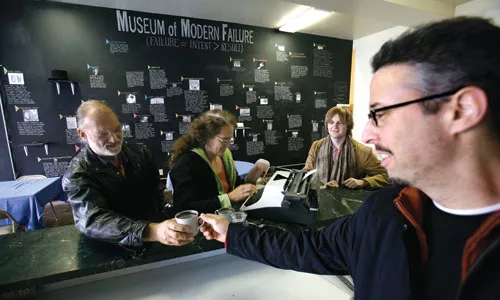
The Museum of Modern Failure looks like an old-fashioned malt shop: There’s a simple bar, a row of narrow stools, dusty wooden floors and a couple of tables. The prices are almost turn-of-the-century: Six cents for a cup of coffee, plus some pennies for cream and sugar.
As you hunch over your Fair Trade java, you can also peruse the “museum”: a black wall with graphics and chalk-written “failures.” The curators have a broad definition of failure, from technological disasters (the Hindenburg, the Titanic) to unpopular inventions (Segway, Firestone tires, Comanche helicopters, the DeLorean) to cultural flops (Milli Vanilli, Ebonics, the mullet).
The Museum is a class project. The class is Art 301, “Art in Context,” at Carnegie Mellon University. The contributors are undergraduate students.
If building an at-cost café seems a little more ambitious than a term paper, consider the museum’s longevity: The idea was brewed up in early September, and the museum will expire with the semester, in late December.
“The basic structure of the class,” says the instructor, Jon Rubin, “is that each semester, we find a different storefront in a different neighborhood of Pittsburgh and create a project, starting from scratch, that is based on the context of the place.” The context could be the storefront, neighborhood demographics or culture — whatever the group decides.
In this case, the concept came from Rachael Brown, a 22-year-old creative-writing major. She noticed that the store, located at 2628 E. Carson St., had a “history of failure” — thanks in part to SouthSideWorks, the chain-retail mecca located directly across the street. The most recent failure was Bookends, a used computer store operated by the adjacent Goodwill, where old Epsons and educational CD-ROMs had failed to keep the business afloat.
“I just find it really humorous that blunders aren’t what we celebrate in museums, just big successes,” Brown explains.
What about the Holocaust Museum?
“The Holocaust Museum is more of a tragedy, not a failure.”
This answer just opens up more questions. What’s the difference between tragedy and failure? Is the Iraq invasion a failure? Who decides what failure is? What ends up written on that black wall? What fails to fail?
“These are the kinds of discussions we have here,” Rubin says.
Rubin, 44, is originally from Philadelphia and a long-time San Franciscan. He moved to Pittsburgh a year ago to teach at CMU, where he founded Tent Show, a “roving institution” that builds creative installations around town. More involved than a typical college group project, Tent Show has taken on a creative life of its own — Art in Context is more than just an elective. And Rubin has deftly learned how to manage funding: CMU pays the museum’s rent. Meanwhile, Rubin’s students volunteer as baristas (the café part is known as Break Even Coffee), earning only tips (what is 15 percent of six cents?). The coffee pots and filters are all donated, and the mugs and spoons will be resold in December. The café was the dream of 20-year-old Brittanie Wine, whose proposal won a class vote.
“It’s all a giant collaboration,” Wine says modestly. “Originally it was my proposal, but after it got moving, I don’t take any more responsibility for it than anybody else.”
Indeed, the students brim with enthusiasm, contributing their diverse skills: Mark Cullen, a 20-year-old guitarist, will compose songs based on local failures — all anonymously written by Break Even customers. (The model failure on display came from a teacher, whose student claimed in writing to be a “perfectoinist”). The failures are being kept a secret until Cullen performs the songs this Friday night (Nov. 9).
True to their inspiration, the songs “don’t have to rhyme,” Cullen says.
The museum’s short lifespan means low commitment and a fresh start in January — an entirely new project, created by an entirely new class. But will they miss the museum?
“Oh, yeah,” Rubin exclaims. “This has been great.”
You might even call it a big success.
This article appears in Nov 8-14, 2007.




The first set of Failure Songs featuring Rachael Brown and me, will take place at 9:30PM Friday night at 2628 East Carson St. in the Museum of Modern Failure.
The second set will feature several local acts also drawing on the personal failures that were submitted anonymously, and will take place on Friday the 16th at 9:00PM.
I give my sincere “Thank You” to professor Jon Rubin. Teaching is a very difficult profession. Teaching young adults to go beyond the realms of a textbook is miraculous. 3D Creative thinking is an ingenious way to get across the importance of art, especially the art of self-expression.
What better way to reverse the karma of a location then to permit it to exist and thrive doing what it has predominantly done in the past? It may never house a failed attempt of anyone ever again! The concept is energetic and of course original. Brittanie Wine came forward with her dream, and obviously convinced her classmates that it had merit. They decided to have a café. Rachael Brown looked at the buildings history, location and probably the possibility of its ability to succeed given who its neighbors are. She merged the two and gave it her creative vision. A very intuitive vision I might add. That alone is a work of art.
Failure is the “boogey man” that prevents many a great idea from ever seeing the light of day. Creating an optimistic environment to express failures takes them out of the dark and eliminates the power of fearing to fail. This project has got to give everyone that comes in contact with it a new (or renewed) encouragement to re-evaluate those things they may have put off for fear of failing. Just reading the article has encouraged me.
We should all learn from our failures not be ashamed of them. They are a part of life!
I live in Baltimore, too far away to have been at the revealing performance, November 9th. I hope someone posts a comment about it. One thing for sure, it had to be a success. From what I’ve read, can you fail in a place that hails failures?
My congratulations to the fall Art 301, “Art in Context” class on your project. From my view, your collaborative effort deserves an “A”.