

Deprecated: mb_convert_encoding(): Handling HTML entities via mbstring is deprecated; use htmlspecialchars, htmlentities, or mb_encode_numericentity/mb_decode_numericentity instead in /var/www/html/wp-content/plugins/super-cool-ad-inserter/inc/scaip-shortcode-inserter.php on line 37
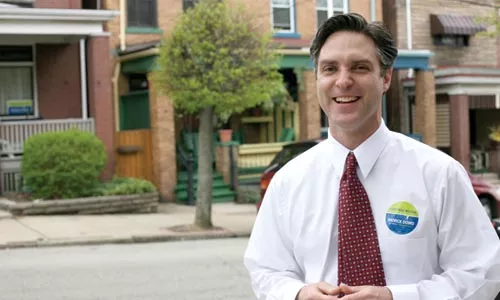
The race for District 7 pits a name-brand incumbent against a brash newcomer.
In one corner is incumbent Len Bodack Jr. whose father and namesake was the former chair of the Allegheny County Democratic Party and a long-time state legislator. In the other stands political upstart Patrick Dowd, a private-school teacher from Highland Park seeking to trade his one term on the Pittsburgh Public Schools board for a seat at city council.
For someone who boasted that he started working the polls for his dad at age 5, Bodack has kept a low profile so far. His campaign office is a small, unmarked room above his district office in Lawrenceville. (The district also includes Friendship, Highland Park, Morningside, Polish Hill and Stanton Heights, and parts of Bloomfield, Garfield, East Liberty and the Strip District.) While Bodack’s campaign signs are visible around the district, the candidate himself often is not.
Bodack read from a script at the candidates’ first — and last — joint appearance, a Feb. 28 forum before a largely pro-Dowd audience at Highland Park’s Union Project. Since then, Bodack has turned down Dowd’s requests to debate. Meanwhile, Dowd has issued several position papers addressing a range of topics, from political patronage to environmental issues.
Bodack has name recognition, and at the end of 2006 was sitting on a war chest of $53,000. He also has considerable currency in Lawrenceville, District 7’s most populous neighborhood. Bodack’s district and campaign offices share the same roof as Lawrenceville United, a powerful neighborhood-development group. (The building is owned by Bodack’s father.) Bodack claims credit for helping secure a federal Weed and Seed grant for LU’s crime-prevention efforts. Ordinarily, says Bodack, infighting among various Lawrenceville groups might have risked disqualifying the neighborhood from receiving the highly sought-after crime-fighting grant. But “I bring people together to build consensus,” says Bodack.
“My job is to take care of people’s business for them,” he adds. “I listen to the people and address their needs as much as I can.” Among the accomplishments Bodack points to: more dollars being spent to demolish abandoned homes, which might otherwise turn into drug havens, and expanded police patrols. He also notes that during his time on council, fiscal crises have given way to a 2007 budget with no structural deficit.
Such efforts are paying political dividends. Loretta Millender, a retired nurse and life-long Lawrenceville resident, says Bodack fixed a traffic sign near her church on Ligonier Street. “We were trying to get it fixed for 15 years,” says Millender over a recent happy-hour beer at Butler Street tavern Hambone’s. “We know we can call on him.”
Though Bodack may appear a juggernaut, in 2003 he barely won the office, winning a three-way primary race with less than 40 percent of the vote. That same year, meanwhile, Dowd unseated another local political fixture, school-board member Darlene Harris. Dowd tapped into voter disaffection about fractiousness on the board, to beat the endorsed Harris (who has since moved on to City Council District 1, where she also faces a re-election effort).
In this campaign, Dowd has been churning out position papers that focus on issues such as encouraging investment in abandoned homes, rather than demolishing them. Other proposed reforms include a referendum on term limits for local offices, and establishing a city director of sustainability, charged with reducing the city’s energy use.
The main question, says Dowd, is, “How can we better provide services to citizens? We need to take the system away from patronage and drive the city toward performance.”
That message resonates with younger residents. “Pittsburgh has changed a lot — with a lot of great energy and great people. They need to have politicians that reflect that new energy,” says John Riegert, an artist who bought a house in Lawrenceville in 1999 to raise his young family. “Just having the old guard, doing the same old thing, doesn’t cut it.”
Dowd admits “This is a very, very tough campaign,” in part because of Bodack’s refusal to debate. Dowd has taken to calling his opponent “Boduck” in campaign statements. But when such name-calling didn’t work, Dowd fired his last salvo: a request made under the state’s “Right to Know” law that asks Bodack to offer detailed spending records for his office. The request suggests, none too subtly, that Bodack may be inappropriately using city staffers for campaign work.
Bodack had not responded to the request by deadline.
This article appears in May 3-9, 2007.



I started my life in Lawrenceville, eventually did the ‘suburbs’ in the late 50’s, left town for college and career and returned in ’02. Upon my return I made the decision to live in the city…not the suburbs.
Since moving back, I noticed that things haven’t changed all that much. At first I thought how ‘Mayberry’ that was but then I realized that progress had not been made. Once nice neighborhoods had slipped in their appeal and city services were lacking or were simply ignored in lieu of more ‘influential’ parts of town.
Lawrenceville has and is proceeding through change, but it seems to be most successfully in the 9th. ward where Mr. Bodacks offices and real estate empire exist. The 10th ward is also Lawrenceville…the ward that I grew up in. Sure, there is some progress but not as much as its neighboring ward.
It seems that not only jobs are the only thing that the Bodack family gives to family and cronies. It appears that he likes to be in an urban rennaisance while the remainder of his turf remains lacking.
As quaint as it was to see that not much had changed, I am more determined than ever to push for change. And if that cam come through the efforts of Mr. Patrick Dowd, then so be it.
The fact that Mr. Bodack has refused to debate as well as refuse to deliver on requested documentation just shows that the ‘good old boys’ system is attempting to cling to the present.
Why not leave your office, Mr. Bodack, go downstairs and bowl a few at the Arsenal lanes and leave progress to the progressive.
This just the type of divisive attitude that held our community back for many years. Dealing with the dynamics of a large community with varying needs takes skill and knowledge. While the writer is correct in saying that Central Lawrenceville is the most healthy part of the community, I would have to add that Lower Lawrenceville which includes Doughboy Square is coming along nicely as well.
While cahllenges remain in Upper Lawrenceville that part of the community is showing signs of turning in the right direction also. This is due mainly to a concerted effort between the Councilman and the commuity groups to eradicate delapidated alleyway housing that has served to enable pockets of poverty to exist and provide places for those to sell illegal drugs and conduct illegal activity.
Balancing the diverse needs of an emerging community requires that all issues in all parts of the community are being addressed. And while the needs vary and the solutions differ, it all must be done in a context to better the entire community.
The many people that are involved in community clean-ups, planning, public safety block watches,marketing,tree tendering, gardnering, and graffiti removal, understand this.
Our community works together to accompish goals, I can only assume the writer is part of the old regime when different wards in Lawrenceville use to compete for Mayor Murphys morsels thus pitting neighbor against neighbor. Thankfully those days are well in the past and Bodack played a significant role in making that happen.
Councilman Bodacks spending is on his website, and he did debate Dowd at the Union Project on February 28th.