

Deprecated: mb_convert_encoding(): Handling HTML entities via mbstring is deprecated; use htmlspecialchars, htmlentities, or mb_encode_numericentity/mb_decode_numericentity instead in /var/www/html/wp-content/plugins/super-cool-ad-inserter/inc/scaip-shortcode-inserter.php on line 37
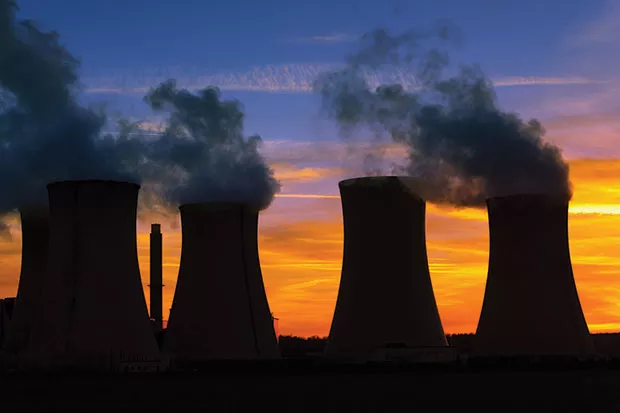
One long-running disagreement about the environment isn’t the familiar fight between people who understand that human-caused climate change is real and people who deny it. Rather, it’s between folks who contend that keeping the planet livable requires us to use nuclear energy, and those who say “no way.”
Many pro-nukes types are scientists. In 2015, for instance, a group of 65 biologists wrote an open letter to the Brave New Climate blog, encouraging increased reliance on nuclear energy to protect wildlife and the environment. Nuclear power plants, they note, emit no carbon dioxide or other greenhouse gasses, and take up relatively little space for the power they produce. One biologist told England’s The Independent that a commitment to grow nuclear energy needed to be part of “a full, global-scale assault on fossil fuels.” The Union of Concerned Scientists calls nuclear “an important low-carbon energy source,” albeit one that needs to be made safer.
Opponents of nuclear energy say it’s still too dangerous. They recall the 2011 disaster in Fukushima, Japan, where an earthquake and tsunami led to a meltdown. Spent uranium, critics add, remains lethal for millennia. “Nuclear is no solution to Climate Change,” argues the Sierra Club on its website, “and every dollar spent on nuclear is one less dollar spent on truly safe, affordable and renewable energy sources.”
Still, perhaps paradoxically, the nuclear advocates in this debate are also climate warriors. Most experts agree that to check global warming, we must cut global carbon emissions by 80 percent by 2050. Most green types want to do it by using less energy, and getting what we do need from renewable sources, like sun and wind. But at March 2017’s Pennsylvania Environmental Council conference here called Achieving Deep Carbon Reductions, several speakers argued that decarbonizing the economy that rapidly isn’t possible without nuclear; renewables, they say, can’t be scaled up fast enough. Many speakers advocated preserving generation from existing nuclear plants while exploring the potential for advanced nuclear reactors.
Seems doable. France gets 75 percent of its electricity from nuclear, and countries including Belgium and Sweden get one-third or more. The U.S., historically the world leader in nuclear, gets only about 20 percent, a share unchanged in three decades.
However, while China has begun operating more than 30 new reactors since 2002 (according to the World Nuclear Association), in the past 20 years only one new nuclear plant has opened in the U.S., and prospects for adding to the total of 100 are scant. Cranberry-based Westinghouse went bankrupt last year following construction delays and cost overruns at two nuclear plants it was building down South; one project was abandoned. And if new plants are expensive to build, existing plants are threatened by cheap natural gas, a result of the fracking boom. In Illinois and New York, ratepayers are bailing out aging, money-losing nuclear plants. And this month, federal regulators rejected a Trump administration proposal to subsidize coal and nuclear plants.
Some say hopes for advanced-design plants — which are safer and cheaper to run — are dim, too. “We’re basically dead in the water with respect to advanced nuclear reactors,” says energy expert M. Granger Morgan, a Carnegie Mellon University engineering professor. The federal government no longer adequately funds the research. “The best we’re likely to do is keep existing plants alive,” says Morgan. “We’re not going to be able to add much.”
Maintaining existing plants is important for the climate, says Rob Altenburg, director of environmental group PennFuture’s Energy Center: If those plants were retired, they’d largely be replaced by our present carbon-heavy energy mix of gas and coal. And here’s an irony: The best way to help nuclear compete with gas might be to institute a federal carbon tax — also a favorite environmentalist proposal for boosting renewable energy. But with climate-deniers dominating Congress and the White House, a carbon tax seems unlikely just now.
Can we fight climate change without scaling up nuclear power? Looks like we’re going to find out.
This article appears in Jan 24-30, 2018.





Maybe something new will pop-up, right here in town.
https://www.linkedin.com/pulse/artificial-lightning-seen-clean-energy-breakthrough-bryan-kelly/
In the past 20 years only one new *commercial* nuclear plant has opened in the United States. Many naval reactors have been started. They don’t deprive government of fossil fuel revenue the way the one commercial plant does.
Among last year’s fatal gas explosions was one that caused a Minnesota school to collapse, killing two. Fatalities without explosions came to many who inadvertently burned hydrocarbon without sufficient ventilation.
Despite not being fossil industry workers, they were killed by fossil fuel waste, and the Minnesota victims were killed by a fossil fuel accident.
As in every year so far this century, no-one outside the nuclear industry was harmed by nuclear waste or accidents anywhere in the world in 2017. Opponents’ claimed concern therefore looks remarkably like a foolish wish that nuclear power should have fossil-style downsides.
It is as if they felt those fossil fuel downsides were somehow on them. Why must exactly those hypocrisies be committed? Could it be that they know fossil fuel revenues subsidize government, and their household tax payments are exceeded by what government pays *to* those same households?
If so, the best way to help nuclear compete with gas might be to institute a return to the citizens, in equal shares, of the money government already makes on gas.
So-called “environmentalists” claim that nuclear is “too dangerous”, because of Fukushima, is patently absurd. Fukushima was the only significant release of pollution in non-Soviet nuclear’s entire history, and scientific consensus is that it (i.e., a worst-case meltdown of 3 large reactors) caused no deaths and will have no measurable public health impact. By contrast, fossil power generation has caused on the order of 10 million deaths over the ~50 years nuclear has been around, in addition to global warming. If anything, Fukushima showed that nuclear is essentially incapable of causing significant harm.
The things that this article says are ironic or paradoxical are nothing of the sort. Of course nuclear advocates are climate warriors. It’s the main argument for nuclear. Also, anyone who truly believes climate change is a significant problem would not oppose our largest source of emissions free power. And of course carbon tax would support all emissions free sources. That is gives equal support to all such sources, and lets them compete on a fair, level playing field, is the main reason a carbon tax would be such good policy.
Mr. Morgan makes a valid point that the real problem for nuclear is the lack of govt., and public support. The main problem for nuclear is due to poor economics that in turn are due to utterly excessive regulations and requirements. And the reason for those excessive regulations are public attitudes, and political and legal pressures from very active, well-funded anti-nuclear groups. Expensive nuclear power was essentially a voluntary, political choice.
In terms of what nuclear is actually technically capable of doing, look no further than France, which replaced almost all its power generation with nuclear, over a period of only 15-20 years. Nuclear is *more* scalable and doesn’t have intermittency limitations. Objectively, it is *more* capable than renewables to address the global warming problem. Renewables’ current greater level of success is entirely due to extremely warped policy and regulatory playing fields (i.e., political/govt. intervention). We’re basically making a *political* decision to move away from nuclear. Technical merit has nothing to do with it.
There is a myth that is accepted amongst the lay people (those not in the power industry) that somehow equates wind/solar/nuclear in discussions of generating power. “
“What’s the problem with closing nuclear power we’ll just replace it with windmills” is the refrain.
That’s not how the power system works. You produce power when its demanded. Wind for example produces power only when the wind blows. Thus it needs a fast ramping station to back it up which is usually natural gas. The wind turbine is useless without the side car CO2 emitting natural gas plant.
I would suggest that you go here. This is real time data on CO2 emissions. Note that excluding countries that are blessed with enough hydro for power all of the “green” countries are heavy on nuclear, example France and Ontario
https://www.electricitymap.org/?wind=false…