

Deprecated: mb_convert_encoding(): Handling HTML entities via mbstring is deprecated; use htmlspecialchars, htmlentities, or mb_encode_numericentity/mb_decode_numericentity instead in /var/www/html/wp-content/plugins/super-cool-ad-inserter/inc/scaip-shortcode-inserter.php on line 37
Maybe it’s a symptom of my alma mater’s Catholic roots, or the thinner air atop the Bluff. But Duquesne University isn’t widely known for its politically engaged student body. I spent four years there, three of them working for the student newspaper, and can recall just one campus demonstration the whole time: a rally to decry President Charles Dougherty’s decision in 2006 to deny a popular professor tenure.
But two years later, students were marching again.
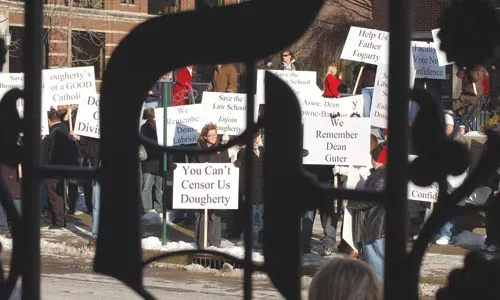
Dougherty removed law-school Dean Don Guter on Dec. 10, sparking outrage on campus. And on Jan. 21, nearly 200 students and faculty members protested in front of the administration building, demanding an explanation for why Guter had been ousted from his post.
Much of the media coverage, and the Duquesne administration itself, have painted the controversy as being confined to the law school. But the controversy is broader, and deeper, than that.
“Save The Business School — Downsize Dougherty,” one protester’s sign read. “Save The Liberal Arts School — Enlighten Dougherty,” read another.
“All of the schools have problems with [Dougherty],” explained Edward Duvall, a third-year law student attending the protest. “It’s bigger than the law school. [Guter’s removal] was the straw that broke the camel’s back.”
More than once, Dougherty has made decisions about deans that either ignored or circumvented input from faculty search committees. No one questions that Dougherty has the power to take such steps, and some on campus support the moves. Guter was not universally popular among his colleagues, and Dougherty’s supporters say the university is stronger today than it was when he took over.
But many on campus worry that the decision to remove Guter is emblematic of a campus where academic freedom is at risk, and collegiality is disappearing. Instructors admit being wary of speaking on the record, meanwhile, partly because Duquesne’s policies can make it risky for anyone — from board members to adjunct professors — to be critical.
Meanwhile, Guter is not the first dean Dougherty has ousted for murky reasons — and he may not be the last.
“We learn a lot about justice and procedure in class,” Duvall says. “To be led by someone who rules in such an authoritarian manner spits in the face of everything we’re learning.”
Dougherty became Duquesne’s 12th president in 2001, following a six-year stint as academic vice president at Nebraska’s Creighton University. And Duquesne seems pleased with his performance: Not long before he decided to remove Guter, Dougherty’s own contract was extended through 2016.
You can see some of the reasons just by walking across campus. Under Dougherty, the school has renovated old facilities on its Uptown campus, and replaced campus eyesores with green space. Perhaps most visibly, Duquesne replaced a block of Forbes Avenue with the Power Center — a 130,000-square-foot state-of-the-art recreation center.
Duquesne’s image has been enhanced outside campus too. In 2008, U.S. News & World Report recognized it as a “top-tier” university for the first time. Out of 1,400 schools surveyed, U.S. News ranked Duquesne at 130.
But in academic offices and hallways, there were mutterings of dissent. Sometimes they were barely audible amidst the sounds of construction, but as an undergraduate member of the university’s student newspaper, The Duquesne Duke, I began to hear them more often.
In September 2005, the administration released a memo to faculty, outlining a new policy for fielding calls from reporters. As The Duke reported, faculty were not to directly respond to queries that “could impact the university’s image.” When reporters asked about topics “relating to the administration or personnel issues,” the memo said, faculty were to direct reporters to the public-affairs office instead.
The memo sparked an uproar, stoking fears Duquesne was curtailing free speech. The university’s spokesperson, Bridget Fare, said that the policy was badly worded. “I can see why [professors] have concerns,” she told The Duke, adding that the memo was simply meant to help direct reporters to the best source. “[T]here is no intent to curb [faculty members’] freedom of expression,” she said.
But Duke staffers often had reason to think of the memo after five Duquesne basketball players were shot following an on-campus dance in 2006. For months afterward, professors redirected almost every interview request we made — including queries completely unrelated to the crime — to public affairs.
“There were times when professors were genuinely nervous,” recalls Bethany Chambers, The Duke‘s former managing editor. “They definitely had a concern that they would be called out for speaking.”
“Duquesne is still wearing its public relations mask,” wrote The Duke‘s news editor in an October 2006 column. “What top-secret information lurks about in the Administration building?”
It may have been something like the story of Jim Stalder.
In 2000, Stalder left his job at PricewaterhouseCoopers LLP, where he worked as a managing partner in the company’s Pittsburgh office, to become Duquesne’s business-school dean. Stalder received yearly evaluations from the provost, Dr. Ralph Pearson, and “My performance ratings … were all outstanding,” Stalder says.
During his fourth year as dean, Stalder underwent a more extensive review to see whether he should be reappointed. The review, a standard university practice, involves evaluation by a seven-member committee, consisting primarily of tenured professors appointed by the faculty and the president.
Pearson’s March 2004 evaluation gave Stalder little reason for worry. The evaluation, which City Paper obtained, ranked Stalder in 11 categories, ranging from “Motivation and Initiative” to “Human Relations/Supervisory Skills.” In six of those categories, he obtained the highest mark, “Substantially Exceeds Expectations.” In no category did he score lower than “Meets Expectations.”
The review committee, meanwhile, unanimously supported Stalder’s reappointment.
Dougherty decided not to renew Stalder’s contract anyway. “He said the faculty didn’t support me,” recalls Stalder.
“I was absolutely shocked,” he adds. “I was told by the provost that I was doing an outstanding job.”
The chair of Stalder’s review committee, Dr. David Pentico, also seemed stunned. In a Sept. 1, 2004 letter to Duquesne’s board of directors, Pentico noted that Duquesne officials told the Chronicle of Higher Education that Stalder’s contract was not renewed “[b]ased on that [committee] review.”
That was news to the review committee, wrote Pentico, a professor of management science: “The members of the committee all believe that the report’s general tenor is positive.” In fact, “70 percent of the faculty and staff who responded to the survey agreed that Dean Stalder should be reappointed.”
According to the letter, Dougherty refused to discuss the issue because it was a confidential personnel matter.
“[T]his is a university, not a corporation,” wrote Pentico, who could not be reached for comment. “President Dougherty’s refusal [to meet] speaks volumes to me about his view of the … appropriate way to deal with members of the university community.”
Even Dougherty’s predecessor, Dr. John Murray, seemed confused. “I don’t know what happened here,” Murray, who is now Duquesne’s chancellor, told the Pittsburgh Post-Gazette in June 2004. “The only person who could possibly tell you about that is the president.”
Dougherty did not speak at the time, though, and he rarely speaks to reporters. Neither Dougherty nor provost Pearson would comment for this story. Contacted by CP, Duquesne spokesperson Bridget Fare reiterated that Stalder’s removal is a confidential matter. She does say, however, that “The clearest evidence that the change [in deans] was the right thing to do is the progress the business school has made” since then.
According to Fare, the number of business-school donors has increased by 81 percent since Stalder’s departure. And she notes the business school has been ranked as one of The Princeton Review‘s “Best 296 Business Schools,” for three years running.
In any case, Stalder left Duquesne quietly, with no intention of going public with his story. But that was before he saw it happening all over again. When Guter was removed, Stalder penned a Jan. 23 letter to the Post-Gazette. Initially, he’d stayed quiet “to protect the university,” Stalder wrote. But Dougherty’s action could “damag[e] Donald Guter’s reputation and that of the law school,” he added, and “doing nothing is no longer an option.”
By then, the controversy was already well underway. Dougherty removed Guter on Dec. 10, just before finals commenced. But the response was immediate. The very next day, Duquesne’s student governing body, the Student Government Association, voted 21-13 in favor of a “no confidence” resolution against Dougherty.
“The dean’s removal was an injustice,” says Vanessa Browne-Barbour, who resigned as the law school’s associate dean in protest. (She is still a professor at the school.) “It’s destructive to the university.”
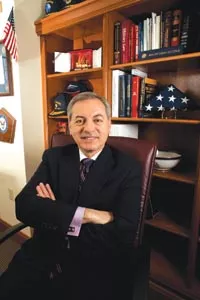
Guter, a retired U.S. Navy rear admiral who remains a tenured professor at Duquesne, could point to accomplishments of his own. According to the Allegheny County Bar Association, Duquesne’s law-school bar-exam pass rates rose during each of Guter’s three years as dean, from a 68 percent pass rate in 2005 to 97 percent in 2008. In addition, the U.S. News and World Report ranked the law school 30th out of 200 law schools in “Research and Writing.”
“Guter had been making large strides at the law school,” says Adam Krynicki, a second-year law student who was among the nearly 200 on hand at the Jan. 21 protest. “When they fired Guter, [the administration] wasn’t thinking about the students.”
“Guter had been doing such a good job,” agrees Kelly Goodrich, another second-year law student.
What prompted the move? In a letter to law faculty, Dougherty wrote that Guter “could not and would not accept” his role “as a part of the University’s administrative team” and that he did not “effectively manage the school.”
Guter suspects the trouble began in 2006, when Dougherty denied law professor John Rago tenure, even though the faculty and Guter had recommended he get it. The president gave no explanation.
A grievance committee composed of faculty from across the university voted unanimously in favor of a resolution urging Dougherty to reverse his decision. Students demonstrated in support of Rago as well. Eventually, in the spring of 2007, Dougherty did grant Rago tenure. But Guter says Dougherty never forgave him for voicing his dissent.
“He got very upset about that,” says Guter.
In fact, in a 2006 evaluation of Guter, provost Pearson wrote “[I]t is not acceptable that … an officer of the university air publicly strong disagreement with the president’s decision.”
Some law school faculty support Dougherty’s decision to remove Guter.
Guter’s removal “was not unjust at all,” says Duquesne law professor Bob Barker. “It was long overdue.”
Barker says the law school has been run by a “fiefdom” of a half-dozen professors, who he claims ruled by fear and intimidation. “Guter was in the pocket of that crowd,” he says.
Barker says Guter’s interim replacement, Ken Gormley, is a welcome change. “His attitude is, ‘We should become the best law school we can be,’ not, ‘I am here to run the school for my own aggrandizement.'”
Gormley says he’s trying to distance himself from the squabbles.
“From the start I’ve tried not to be a part of the debate over whether [Guter’s removal] was right or wrong,” he says. “My sole focus has been to try to stabilize things and focus on moving forward.”
Still, if the law school was divided before, it seems to be even more so now. On Feb. 11, the law-school faculty held a “no confidence” vote on President Dougherty: Of its 34 full-time faculty members, 14 voted in favor of the motion, while 15 supported Dougherty (There were also four abstentions and one non-vote.) Passage of the resolution required 18 favorable votes.
In a statement to the faculty after the vote, Dougherty wrote, “I interpret this vote as an expression of your desire to move past this unfortunate moment to a better future for the school.”
Or not.
“This [law school] is a hornet’s nest of treachery,” argues adjunct law professor David Millstein, a strong supporter of Guter. In a letter to the law-school faculty after the vote, Millstein faulted the “lack of character … integrity … backbone and … resolve” which he said the school’s faculty had “demonstrated in its unwillingness to go toe to toe with tyranny.”
“If anything, the tension has risen” since Guter’s removal, says Colin Morgan, the vice president of the Student Bar Association (SBA). “I don’t think relations [between faculty members] have improved at all.”
When Stalder was removed, Dougherty overruled the judgment of a review committee. In Guter’s case, the committee was not even fully formed. That’s one of the things that bothers law professor Kellen McClendon most.
Dougherty has the power to remove deans if he wishes. But Duquesne’s faculty handbook, which spells out the terms of employment for instructors, makes clear that faculty wishes should be taken into consideration. When deciding whether to reappoint a dean, it says, the school will “solicit the opinions of the full-time faculty of the school or college, and from other administrators and students.” According to the handbook, that feedback “shall be considered by the President.” But no such process took place where Guter was concerned.
During the fall semester, McClendon says the law school started the process of creating a committee to review Guter’s performance. The faculty, he says, chose four members and the dean selected two, McClendon being one of them. In order to initiate the process, however, McClendon says the provost had to appoint someone to the committee. But, he says, Guter was removed before that ever happened.
“My rights as a member of the committee and as a member of the faculty were violated,” McClendon says. “I did not have the opportunity to participate in the governance of the law school.”
Dougherty didn’t reach out much after making the decision, either. He did meet with student government leaders and the SBA, but with little effect. Morgan says Dougherty started the meeting on the wrong foot by reading from a prepared script. “His explanation was that it was in his power [to remove Guter], so he did it.”
Such assertiveness doesn’t surprise some of Dougherty’s former colleagues back at Nebraska’s Creighton University.
“[Dougherty] is a very hands-on administrator,” says Creighton chemistry professor Holly Harris. “He’s not a very good delegator.”
“He’s definitely somebody who has high standards,” says Pat Borchers, a former law-school dean who now holds Dougherty’s old job as Creighton’s VP of academic affairs. Borchers says Dougherty wasn’t necessarily difficult to work with, but, “The fact that he’s been willing to move out people who weren’t on the same page with him doesn’t surprise me at all.”
And because of Duquesne’s unusual power structure, it’s not clear whether anyone can stop him.
Duquesne was founded in 1878 by a Roman Catholic order of priests and brothers — known as the Holy Ghost Fathers, or the Spiritans. The Spiritans still own the school, which has a governing structure unlike most universities.
Most schools are run by a board of directors. Duquesne, by contrast, has a two-tiered system. Its 20-member board votes on major decisions, but a board of six Spiritans — known as the Corporation Members — have final say over any move the university makes. The members are appointed by members of the spiritual order itself.
Dr. Joseph Rishel learned just how much authority they have while researching his history of Duquesne, “The Spirit That Gives Life”: The History of Duquesne University, 1878-1996.
“If the Corporation wanted to,” Rishel remembers asking a former Duquesne administrator, “they could turn this place into a bubble-gum factory?”
“Yes,” was the answer.
The Corporation can reverse board decisions, acknowledges Father John Sawicki, a Corporation Member (and a poli-sci professor at the school). But, “You really shouldn’t meddle in [the board’s] process.” The powers to do so “are not unlike nuclear powers. … If you have to [use them], it’s not a good scene.”
Sawicki says the Corporation “is in full support of the president,” so even if the board opposed Dougherty, it’s not clear it would matter. In any event, the board doesn’t oppose him at all.
“The board fully backs the president,” says Mary Grealy, who has been on the board for two years. “I’ve been upset at the personal attacks on [Dougherty]. … It’s not fair.”
“I’m more than 100 percent behind him,” agrees Ted Senko, another two-year board veteran.
Which is just as well. According to the university’s bylaws, board members “are subject to removal, with or without cause,” by Corporation Members. And in early 2005, after Stalder’s departure from the business school, the bylaws were changed to give the board chair — currently P. David Pappert — similar power to remove members at will.
Since 2005, in fact, the board has undergone significant turnover. Of the 29 people on Duquesne’s board that year, only 11 remain. At least one board member stepped down because he objected to the new rules — and even he would only speak on condition of anonymity. “If you want a board of ratifiers, get some stooges,” he told City Paper.
So much turnover “is definitely troublesome,” says Darryll Jones, an expert in nonprofit management and a former associate dean at the University of Pittsburgh law school. “You want stability on a nonprofit board because it allows for long-range planning. … I would be worried if I were a stakeholder.”
Allowing a board chair to remove board members at will is also potentially “unhealthy,” says Jones, who now teaches at Florida’s Stetson University. “It’s not so odd with regard to religious institutions, since religious institutions usually grant one person a whole lot of power.” But even so, he says, “Each board member has a legal obligation … to exercise independent and informed judgments. If [board members] go along just to get along, knowing certain judgments aren’t in the institution’s best interest, they can be held liable.”
Some former board members say nothing prevented them from doing due diligence. “I was extremely outspoken,” says Cynthia Baldwin, a Pittsburgh lawyer who served on the board for nine years until leaving in 2006.
“[The board members] aren’t wilting lilies,” agrees lawyer Edward O’Connor, a 12-year veteran who left the board about two years ago. “They wouldn’t let anyone dictate them.”
In any case, this isn’t the first time that Duquesne’s board has stood foursquare behind a controversial president. According to Rishel’s history of Duquesne, during the 1980s, the term of President Donald Nesti inspired complaints similar to those echoing on campus today.
According to Spirit, Father Nesti felt that the faculty had too much say in running the school. In 1984, Nesti dismissed a popular dean of the College of Arts and Sciences. Teachers “were outraged,” writes Rishel. “Nesti’s governing strategies, which some described as ‘autocratic,’ threw much of the campus into turmoil.” Popular administrators quit or were dismissed, and increasingly there was an on-campus “atmosphere of discontent and mistrust.”
Despite widespread calls for Nesti’s resignation, though, the board of directors “gave the administration another vote of confidence,” Rishel writes. Members of the Corporation became “increasingly alarmed,” but before they could do anything, they were ousted by Rev. Norman Bevan, one of the Spiritans in charge of appointing Corporation members.
Nesti eventually resigned amid the controversy. Even so, Rishel writes, “Much speculation has been made concerning the relative importance of the president and the board in the governance of Duquesne University.”
Such questions have become more pressing, even as Sawicki says controversy surrounding dean appointments “isn’t unusual.”
According to Dr. John Baker, the University of Pittsburgh’s faculty-senate president, a dean’s role is inherently conflicted. On the one hand, he says, deans are administrators who “serve at the pleasure” of the president. But on the other hand, “They are also the spokesperson for their faculty.
“It is a complicated role,” Baker says.
As it turns out, Duquesne could be seeing more complications in the future — this time at the university’s college of liberal arts.
The previous dean of the liberal arts college, Francesco Cesareo, left Duquesne in 2007 for a post elsewhere. An English professor, Al Labriola, has served as acting dean while the school began a search process. By many accounts, he’s done an excellent job.
“Dr. Labriola has a very strong following amongst the student body,” says Eric Mathews, a senior in the liberal-arts school.
Perhaps most notably, Labriola helped construct a new, state-of-the-art digital media center. And when the search committee submitted the names of three potential dean candidates, Labriola was among them.
Labriola, like Stalder before him, says provost Pearson was encouraging about his prospects. Pearson, he says, told him “I was the best acting dean he had ever worked with.”
But two months later, Labriola found out that Dougherty had rejected him — along with the other two candidates the search committee recommended. The school has since started another search from scratch.
“I was very much surprised,” Labriola says. “I had no inkling [Dougherty] was dissatisfied with my performance.” And “The faculty led me to believe that there was widespread support for my candidacy.”
After telling the acting dean that the first search had been scrapped last April, Labriola says Dougherty told him, “You don’t bring the right chemistry to my administrative leadership team.”
“Don’t ask me what that means,” he says. “It may mean that we have a personality conflict, it may mean that he doesn’t like my style of leadership.”
“[Labriola] has been given unfair treatment by the administration,” says Mathews, who joined the January campus protest in support of his acting dean. “He’s been kicked around.”
Labriola says he reapplied for the second dean search, which is currently underway, but he was told by the administration that he could not be considered since the new search must yield three new candidates.
If the second search fails, the university’s faculty handbook allows Dougherty to choose anyone he wants, regardless of whether the faculty committee approved.
If he does so, there could be more outrage on campus — and more fears about expressing it. Professors contacted by City Paper were wary of even praising their colleague on the record — for fear, they said, of reprisal.
“Labriola is the best thing to ever happen to the liberal-arts school,” said one professor in the school.
“Labriola is an independent-spirited guy,” surmises another. “[Dougherty] wants someone in there who is malleable.”
In theory, professors should be able to talk freely about such concerns. One reason instructors are granted tenure, in fact, is so they can speak their minds without fear of reprisal.
But at Duquesne, professors have reason to be wary. Under a section titled “Termination of Tenure,” the faculty handbook warns that faculty members’ tenure can be forfeited for “insubordination.”
According to Robert Kreiser, a program officer of the American Association of University Professors (AAUP), the clause is “contradictory to the principles of academic freedom.” Punishing insubordination “is common in a military or corporate setting, but not in an academic setting.”
The insubordination clause is easy to overlook — it’s tucked into a footnote along with other reasons for firing, including discrimination and failure to meet standards of teaching and research. And judging from archived editions of the handbook, “insubordination” has been a firing offense since 1994, during the presidency of Dr. John Murray, the current chancellor. (Murray declined to be interviewed for this story.)
But as controversy over Dougherty has mounted, faculty members have become increasingly concerned about the provision. According to a Jan. 29 e-mail obtained by CP, the faculty senate’s executive committee recently unanimously passed a resolution urging the “insubordination” clause be removed.
“This passage threatens academic freedom and the tenure process,” states the resolution, which the e-mail says will soon be voted on by the full faculty Senate.
Will the clause be taken out?
“It would be premature to speculate on any possible changes,” Fare said in an e-mail.
But in Charles Dougherty’s Duquesne, speculating about changes is all some critics say they can do. Even as he builds a sparkling campus, they fear, there’s nothing to stop him from undermining its academic principles.
“What does it say about the university when you have tenured professors who are afraid to talk?” asks Vanessa Browne-Barbour, the former associate dean who resigned in protest.
“Why does fear have a place in a Catholic institution?”
This article appears in Feb 26 – Mar 4, 2009.





What about the previous Dean to the Law School (before Guter) who was also asked to manufacture a reason for resigning, which he did? Then, there is what is being played out right now regarding the Schools of Pharmacy and Science, which has been largely kept quiet? It seems that these issues are relevant also.
A programming note: I have deleted a couple of posts that show signs of “sock-puppetry,” and that contained potentially scurrilous allegations.
I spent 4 years as an undergraduate at Duquesne and received my JD from their law school, and I can say that I will probably never give them a dime. As an undergraduate at there Liberal Arts School, you could just feel how idependant thinking and free speech was discouraged. There are basically no students groups that are art centric, and if you wanted to start one the process was similar to Nazi Germany. Campus life was particualrly bad for people in the LIberal Arts. Only one year of my 8 years at Duquesne was without Dougherty and let me tell you, he is a dictator, but the administration is just as bad. They could have not renewed his contract. Now the law school was a different story.
I really enjoyed my time there and thought all three years under Guter (when I attended) where some of the best education I got (especially with my bar results). I liked all the professors mostly except one. And wouldn’t you know it, it is the only out spoken supporter of Dougherty Bob Barker. He is by far the worst, most useless, evil person I have ever had the tragedy of meeting. It is ironic he accuses the law school professors or ruling with fear and intimidation because that is exactly how he ran he class. You have to understand that Barker teaches a class to first year law school that basically is his opportunity to get out is aggressions. He basically humiliates students by insulting and screaming at them all in an attempt to prepare them for law. Most schools do make students go through a first year “haze” if you will, but Barker takes this to an extreme as a vestige of an old ancient way of thinking that is outdated. Barker wished for this continue while, my feeling, is that Guter wanted change.
Duquesne is a strange place and I am glad to see articles like this done. It is a place full of dark secrets (believe me, they have some major secrets up there regarding drugg addiction and public relation nightmares that they keep under tight raps). I think it is great for the city of Pittsburgh, but when you have a Catholic Image obsessed school, education and free thinking will always come second
I am a student at Duquesne and while I love going to school here, I feel there is a serious problem with Duquesne brushing extremely serious situations under the rug rather than actually addressing the situation. Awful situations that occur on campus are ignored or lied about and so are the victims involoved in the situations to save Duquesne’s image. Duquesne’s mission statement is supposed to be “serving God by serving students,” however Duquesne would rather protect it’s image then handle a situation appropriately and “serve its students,” a few of whom have faced injustice or hardship while attending the school. People don’t feel safer or better because outsiders don’t know about situations, people feel scared and uncared for because this instituation is supposed to protect and care for it’s students. I truly think Duquesne is a wonderful place and I am very happy here, but I have heard and been witness to many things that makes me feel the administration either needs to change or needs to change their approach. When choosing between helping the students and not “going public” Duquesne should reconsider their mission statement and what God would truly call them to do- and what any decent human being would do regardless of religion or race or status or whatever! Bad things happen at every college and in every city in the world- don’t lie about situations, address them!
Like kbomb above, I too received a BA and JD at Duquesne and I second kbomb’s message above. They won’t get any of my money until Daugherty is gone. Labriola was my favorite professor and gave me the gift of appreciating Shakespeare. Daugherty would make a great CEO of a public corporation but he is an awful choice for president of a university. College should be a place to provide fertile ground for new ideas (which DU was when I was there). Who would want to send their kid to school where they let one old cranky guy dictate everyone’s thoughts and opinions? This isn’t the kind of press my old school needs. I have 2 kids but unless the Board can turn the tide in the next few years, they won’t be going to the bluff. Hope he doesn’t try to revoke my degrees for posting this …
Dougherty may be one nasty symptom, but he is not the disease Duquesne suffers from. I’d like to thank the author for explaining (or at least alluding to) the entirely misunderstood, and troubling nature of who “owns” the institution we call Duquesne University. Best CP cover story in a long time.
Dougherty’s pulled all the superficial strings of a contemporary corporate leader- lots of shiny new buildings, emphasizing hitting the predictable markers that “rankings” and “ratings” lists look for, relentlessly hammering the notion that the “brand” is the universal and unquestioned virtue of the university, and using some success in those area to consolidate power. In other words, the stock price is up (for now) and so you are either with Dougherty or against him.
In the short term, this works. But I invite you to sit in on a few undergraduate classes. Look closely at the numbers. Consider the ways in which the quality of a higher education cannot be measured accurately by those above mentioned measurements and ask yourself what the average undergraduate gets for four years of education that costs more than the median home price in a place like Pittsburgh. That is why the school contains only small pockets of (largely left-over and accidental) excellence and remains a bastion of (mostly well-heeled) mediocrity that make the couch burners further up Forbes Avenue seem like a bunch of financially astute and relatively worldly Rhodes Scholars in comparison.
I am a current law student and I spoke out against the actions of Dougherty. I proudly carried a sign of protest and pleaded with the faculty to vote no confidence in the president. I am very thankful to the faculty members who were willing to stand up to tyranny. Since that time the Interim Dean of the Law School has repeatedly told many students that we were going to be blackballed from the downtown firms and we were putting our future employment in jeopardy. He has also indicated he would have to think twice before signing our certificates of good standing in order to sit for the BAR. We have had to double check with our registrar to ensure our graduation is not in jeopardy because no one knows what Dougherty and Gormley are capable of. Gormley has repeatedly insinuated that he has control over our futures as lawyers in the city of Pittsburgh and that speaking out in protest is not good for our reputation.
Although I have really enjoyed my law school experience and I am proud for standing up I have to think about graduating and moving on. I will not attend graduation and I will protest the scab dean signing my Law Degree because I do not want a life time reminder of that snake.
To Chris Potter: I will not respond to questions and I will keep my identity a secret, this is not “sock puppetry” this is for protection.
The Pharaohs of Egypt are remembered (for centuries possibly eternity) for their power by the structures that they built. For what he has done, he will always be remembered prominently and his vision of what Duquesne should be has not waivered. He has successfully implemented his vision but I don’t think that it is shared by many in the Duquesne community because it doesn’t follow our underlying beliefs and principles. The soul of the University is not in it’s structures but the people that work and teach and learn there. That such a well-respected Professor such as Labriola is viewed in any negative way by the University Management is testament to a lack of understanding of the principles that Duquesne was founded on. If the philosophy that Dougherty has instituted is that the professors and students quietly accept what is “best” for the Institution then I would hope he quietly resigns and moves on to a position that would be more conducive to his philosophies.
The Pirates could really use a guy like Dougherty, not Duquesne University. (I mean the Pirates could realllly use a number-centric success at any price guy like Dougherty.)
Law Students- how can you be an advocate for someone else when you can’t be an advocate for yourself?
Law Professors- how can you teach the students to advocate for justice when you yourself don’t value justice?
Duquesne is a sad and scary example of what much of our society has become.
FanofDr.Murray-where is Dr Murray now? Is he helping the students fight for justice?
For those of you that think Dougherty may not be good for a University but may be good for a Corporation, you do not know his background.
He received his master’s and doctorate degrees in philosophy from the University of Notre Dame in 1973 and 1975, and he received his bachelor’s degree in philosophy from St. Bonaventure University in 1971. He has NO business experience at all, he is a philosophy major with two self published books!
James Stalder: Stalder served as Managing Partner of the Pittsburgh office of PricewaterhouseCoopers LLP (PWC) since July 1998, after previously serving as Managing Partner of the Price Waterhouse LLP (PW) office in Pittsburgh since 1988. He also served PW as Director of Tax Research and Technical Services, among other positions. Mr. Stalder has over 37 years of experience in providing tax consulting, valuation and financial planning for corporate and individual clients in variety of industries, with an emphasis on manufacturing and real estate.
Don Guter: A retired rear admiral who served as judge advocate general. he advised the Navy on ethics, federal court litigation strategy, personnel matters, and environmental, criminal and international law. He led a team of 1,800 active duty, reserve and civilian lawyers, and 1,000 paralegals of the Judge Advocate General’s corps. Guter’s personal decorations include the Defense Distinguished Service Medal, the Legion of Merit with two gold stars, the Meritorious Service Medal with two gold stars and the Navy Commendation Medal. Guter is also an advisor to President Obama on Guantánamo Bay.
Al Labriola: A world renowned English scholar. He has had numerous awards and has been recognized and quoted too many times to count. He brings recognition to Duquesne’s School of Liberal Arts on an international level.
All of these men have had distinguished careers in their respective fields, they have had NATIONAL and INTERNATIONAL recognition for their work. They are all respected and well liked by their faculty and by their students.
They also have one more thing in common, they have all been fired by Charlie Dougherty. The Holy Ghost Father’s of the Corporation should ask themselves a question: Is Charlie Dougherty really doing what’s best for the University or is he so small minded that he allows his fear of others success rule his decision making?
Dougherty made a public statement that he chose Ken Gormley to replace Don Guter because Ken was President of the Allegheny County Bar Association. Is that a joke?
One of the most underplayed parts of this story are the personal politics involved. Guter wanted to have U.S. Senators and presidential candidates speak at law school graduation. This is fairly common for law schools. He wanted an open political dialogue at the school. Dougherty said “no.” Guter was also a leading advocate against the Bush Administration’s interrogation and torture techniques. When it looked like McCain was going to lose in the fall, the conservative Duq board and Dougherty wanted to make sure they were positioned to ride out the upswell in liberal-ness. They did not want someone as righteous as Guter around.
Don’t believe me? There are a few people involved with this story, including board members, who have given money to political causes.
And this is very telling:
Prof. Robert Barker $1000 to Sam Brownback (Republican) $200 to Bush-Cheney ’04, Gregory Babe $1000 to Mitt Romney (Republican), Thaddeus Senko $1750 to KPMG PAC (71% outlayed to Republicans), and Winston Pittman $10,000 to Republican Party of KY.
To fanofDrMurray …. The real genius was Dr. Michael Weber. Murray was a fund raiser and the image of Duquesne but Dr. Weber (the Provost under Murray) ran the place and made it what it became. He is the one we should be praising.
I also am a law student among many who will not attend graduation and I will not take a diploma with Gormley’s name on it. He has made shambles of the law school and if he cares about us as Guter does, he would never do this to us. I don’t want to be reminded of him and his unconscionable ways my entire life. I loved the law school under Guter and I resent Gormley and Dougherty for what they have done.
I wish I could express to the Holy Ghost Father’s and to the Board of Director’s how incredibly bad it is on the Bluff. I believe the information is out there and no one is listening. I know you have a 27 or 28 point check list to determine if Dougherty is doing his job but maybe you should change the check list. As an employee of more than fifteen years I can tell you the employee morale is at an all time low, the student’s anger is at an all time high. I truly believed we hit rock bottom a few years ago but I can tell you we are way below rock level. NO ONE wants to be there, every one I speak to dreads the daily chore of coming in to work and the students can see it on our faces. I can tell you Duquesne use to be a great place to work. We felt good about what we were doing and where we were going, but the decline since Dougherty took over the reigns has been fast and steady, getting worse on a daily basis.
We are truly seeking the help of the Fathers and of the Board to listen and investigate how things are truly going up on the Bluff, you may see for yourselves how bad things really are. We are praying for your help, please find it in your hearts to do what is best for our school, begin the search for a new President. A leader that is not afraid of the success of others, one that does not seek out mediocrity in its deans, one that is not afraid to meet others in public, one that will not be afraid of fund raising. HELP US BRING DUQUESNE BACK!!!!
I understand a new paper will be coming out tomorrow, but I hope the story and the comments will still be available for reading. The Holy Ghost Father’s will be having a meeting very soon and I want to have this available to them. They need to see what the people of Duquesne are saying. We are fed up with the way Dougherty is running things. We see on a daily basis the decline of the University and of employee morale.
The buildings look real nice but what’s inside is ugly and distraught. We are over 50 million dollars in debt with little fundraising coming in, we are completely tuition driven, if student enrollment goes down so does our operating budget and that is no way to run a University. You speak about applications going way up since Dougherty took over, but that’s what happens when you make the application free. The numbers Bridget Fare is feeding the press is inaccurate, a comprehensive and independent audit is needed. The Holy Ghost Father’s need to get their heads out of the sand and stop listening to the halve truths of Dougherty.
I spoke to just 3 people about this idea and immediately had pledges totalling $10,000! What if we were to keep a tally of alumni and friends of Duquesne University that would donate X amount of dollars as soon as Dougherty gets fired? I think that this idea could help to get rid of the dictator that is ruining our institution because, as they say, “Money Talks”! We’d have to make the donation pledges anonymous yet verifiable by a third party (like an Accounting Firm). What do you say? I’m in for $5,000!
I am a third year law student at Duquesne and I can tell you that a large number of students plan to protest graduation and we are planning a protest across campus for April. We want the Holy Ghost Father’s and the BOD to understand how angry we are and the Interim Dean of the Law School is not going to clam things down. We are angry and we will not sit still! We are asking that all students at Duquesne join us, help us to stand up to Dougherty and take back our schools.
Excellent discussion here. Most of it is accurate.
For any Holy Ghost Father or BOD member that may be reading this I would like to add my two cents. Maybe, just maybe, the response would not be so drastic but for the fact Dougherty appointed as Interim Dean the same person that the faculty rejected during the Dean search just a few years ago. We found him insufferable then and even more so now. He makes promises, and if that doesn’t work he makes threats, to get his way. Everyone knows Dougherty did this to Dean Guter for the sole purpose of circumventing the faculty and appointing his friend as Interim dean in hopes of making it permanent. Does it surprise anyone that Dougherty has not permitted the beginning of a dean search? I can tell you, it will not work. As long as that poor excuse for a lawyer, and a man, is in that office we will not be quiet! Ken Gormley is the reason the Law School is divided, if you do the research you will find that EVERY negative incident, every false innuendo, every accusation, every denial of tenure and tenure track position, every fraction between the faculty members and the President, Dean Guter and the President started with Interim Dean Gormley.
As the great Roman Statesman, Marcus Tullius Cicero, warned us “A fish begins to rot from the head down” Duquesne has been rotting since Dougherty became President and now that Gormely is Interim Dean of the Law School it too will begin to rot! “And there is only one thing to do with a stinking, rotten fish head, is to cut it off, cut it off and throw it away.”
The acrid rotting stench blowing from the bluff is a disgrace to the city of Pittsburgh.
Hey Gormely’s Advisory Board,
Do you ever wonder if your reputation is at stake for supporting the person who orchestrated Guter’s overthrow?
Those of you from PITT BOD…PITT’s Dean position was open when Gormely was rejected from Duquesne when Guter was chosen. I understand from many people and see from your actions that you support the fact that PITT doesn’t want Gormley even on the faculty, let alone PITT’s Law Dean. So those of you from PITT BOD, will you make DU Law better than PITT Law?
Back when some older – ahem, more experienced – attorneys that I know were in law school at Duquesne (in the early 1990s), the school was far different.
The biggest issue at the school was whether to spend $$$ repainting the student lounge area or improving the library. They chose to improve the student lounge, since it would be the cheapest way to make the school look better to the accreditation committee.
Robert Barker is a relic of that style of law school leadership. While he is a brilliant constitutional mind, that doesn’t validate his opinion on how to run a law school. Especially now.
I wonder if the Holy Ghost Father’s or the Board of Director’s, or even Dougherty for that matter, ever wonder why they don’t see the protests, the firings, the outrage from students and faculty from other local Universities. Are they doing something wrong or are we? I cannot believe they think this is normal. It isn’t normal operating procedures for an institution of higher learning to be in such disarray year after year. It appears that soon after Charlie thinks he has gotten away with something, denial of Dean Rago’s tenure, he tries something else, Jim Stalder’s firing, then denial to our recently dearly departed Al Labriola, then firing Dean Donald Guter. It never stops and the BOD and HGF don’t get it. How much more can the University take? Our reputation is mud, our students are angry, donations are way down and faculty is fed up. DO SOMETHING!!!!