

Deprecated: mb_convert_encoding(): Handling HTML entities via mbstring is deprecated; use htmlspecialchars, htmlentities, or mb_encode_numericentity/mb_decode_numericentity instead in /var/www/html/wp-content/plugins/super-cool-ad-inserter/inc/scaip-shortcode-inserter.php on line 37
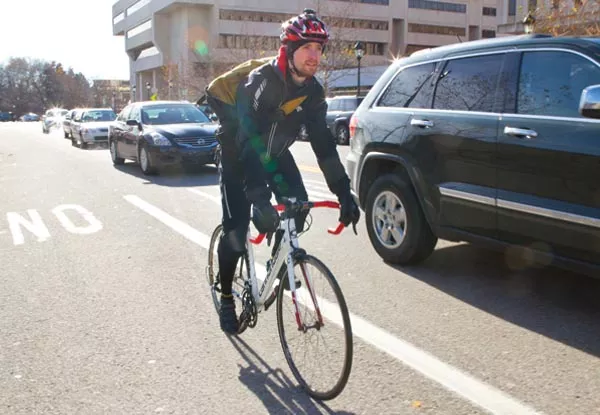
As the knife came toward him, Colin Albright hoisted his bicycle toward his attacker. On the desolate South Side steps at 11 p.m. on Sept. 5, Albright thought that’s what the man was after.
“I said, ‘Dude, take the fucking bike,'” Albright says. “I thought it was some cheap street robber.”
But it wasn’t. The attacker grabbed Albright from behind his shoulder and stabbed him “for a couple of seconds” without saying a word. He grabbed the cyclist’s black-and-white road bike and chucked it over the railing.
The man ran down to a gray car parked at the base of the steps at Harcum Way in the South Side. Albright followed, dialing 911.
Seeing the vehicle, his memory clicked. He had seen the car a short time before, at the Hot Metal Bridge, then at the base of the stairs making a three-point turn.
Albright says the car followed him on his path from the South Side bridge to the steps where he was attacked in an apparent road-rage incident. But rage over what? Albright says he never engaged with the driver — alleged by authorities to be Anthony Scholl — until they met on the stairs.
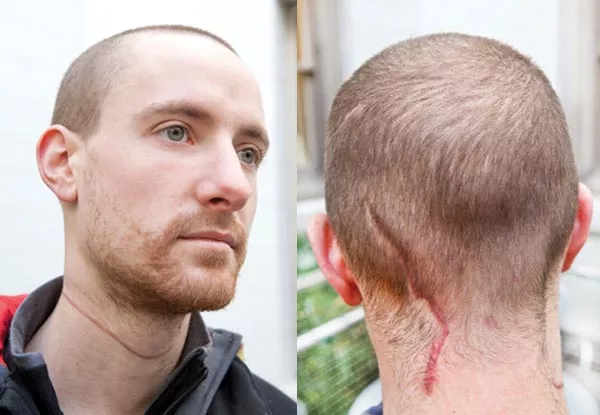
As Albright dialed 911, “I could feel my neck flapping. My legs felt wet.” Blood covered his torso. His throat had been slit millimeters from his carotid artery and trachea; he had multiple stab wounds to his head, shoulders and arms.
The case made headlines in what was already being described by advocates as the most dangerous year in history for Pittsburgh cyclists. During the summer, for example, motorists struck down two cyclists on Penn Avenue in Point Breeze within a week of each other, killing both James Price and Anthony Green.
“In over 10 years there have only been a handful of fatalities, then two happened on the same street in six days,” says Scott Bricker, executive director of advocacy group BikePGH. “There’s no word for it. It’s an anomaly.”
Add to that several hit-and-run cases, and Albright’s attack, and cyclists and advocates were left scratching their heads as to what it all meant in city that’s trying to grow its bike infrastructure and community.
“It’s data from one summer. Right now, we believe this year is an outlier,” Bricker says. “There’s no reason to think it’s going to be like this from now on.”
But there is evidence to suggest that there is growing animosity between cyclists and motorists. BikePGH’s own interactive online crash map includes a category for confrontations. And tensions from the streets spilled out in debates in the online comments section of news stories about the incidents.
“On any given day I see drivers texting, or trying to make a left turn with the phone in one hand and going way into the other side of the road,” one City Paper commenter wrote.
“Most people have had enough of these morons on their little bicycles in the streets. I’m sure there are plenty of paths for them to pedal along to their little heart’s content where they don’t hold up vehicular traffic,” said another commenter on an article about Albright’s stabbing.
Some blamed motorists for motoring too fast and not being respectful of others on the road. Others blamed cyclists for zipping through traffic and running red lights. Everyone pointed the finger outward. But cyclists, advocates and transportation planners will all tell you the answer lies with how we all interact with one another on the road.
“It doesn’t matter if it’s between motorist and motorist, or pedestrian and pedestrian,” says Stephen Patchan, the city’s bike-ped coordinator. “Road rage is road rage.”
Bricker and others believe the problem could be as simple as growing pains: There are more cyclists on the road than ever before. According to the 2010 U.S. Census, the number of bike commuters has increased in the city 269 percent since 2000, with 1.6 percent of the city’s population commuting by bike.
Meanwhile, drivers are adjusting to sharing the road. A bicyclist is “not part of the dominant traffic argument,” says Albright. “You’re almost an anomaly.”
Albright, 25, started riding when he was 19. “I thought it’d save the planet,” he jokes. He worked as a bike messenger and now is a technician at Pro Bikes, in Squirrel Hill.
Recounting the moments leading up to the attack, Albright says he never engaged with his alleged attacker. He says he rode off of the Hot Metal Bridge’s bike path, off the sidewalk and onto Hot Metal Street toward East Carson as the cross-traffic light was yellow. A car was sitting at the red light coming off the bridge in the right-hand lane, and Albright says he pedaled several feet in front of him, while he was still at the red light, without incident.
“There was no honk. Nothing happened,” Albright says. The two didn’t meet again until the steps, when Scholl, 21, of West Mifflin, allegedly stabbed him. Scholl fled, and police arrested him on Oct. 25 while he was jailed on arson charges, accused of burning his family’s house down. He’s awaiting a preliminary hearing in the Albright case, scheduled for the day before this issue hits the streets.
Until his Sept. 5 stabbing, Albright says his interactions with motorists had been mostly positive. In his handful of previous wrecks, “It’s always been [the driver saying,] ‘I’m so sorry,'” he says. One motorist even called to check on him a week later, and the pair hung out.
But other cyclists he knows haven’t been as lucky. “A lot of people have experienced when they get into a wreck — as long as no one is really injured — immediate confrontation,” he says. Other cyclists say they have been cursed at, honked at, even intentionally hit. And if a wreck does occur, many say drivers don’t even stop.
As Dan Yablonsky recounts the May 13 accident that left him unconscious for more than three weeks, he shifts in his chair.
“I’m still pretty uncomfortable,” he says softly.
Yablonsky’s injuries were severe, including a torn aorta, shattered pelvis, a broken lower spine, a broken arm, fractures in both legs and brain damage. Yablonsky believes his crash was the result of a “weird” traffic grid and the driver not paying attention. He’s had several surgeries so far, and is preparing for another in the spring.
Yablonsky was riding with a group on May 13 around 2:30 a.m., passing through the intersection of Liberty Avenue, Herron Avenue and Ligonier Street in Lower Lawrenceville when he was struck head-on by a vehicle driven by Beau Fishinger. Yablonsky says he was riding with a helmet and full reflectors.
Fishinger allegedly fled the scene, but turned himself in the next day. He’s been ordered to stand trial on charges of felony aggravated assualt with a vehicle and other traffic infractions. According to detective testimony at his preliminary hearing, Fishinger admitted to fleeing because he was drunk and driving on a suspended license, KDKA reported at the time.
Yablonsky, of Larimer, came to the city for an internship with BikePGH last February. Instead of buying a car, he bought a trailer for a bicycle so he could explore the town on two wheels. But today, though he plans to ride again, his confidence in cycling is also fractured.
“The perceived risk from my perspective is so much higher,” he says. “I don’t have the same confidence or feel the same freedom.”
But Albright says that it’s not always safe to follow laws that were made for four-wheeled vehicles or that don’t even address cyclists at all.
“If I get to a red light and there are six cars piled behind me and there’s no cross traffic, I’m supposed to wait for the light to change. If I do that, I have to accelerate back up to speed and the cars wait behind me,” he says. “If I look and there’s no traffic, I can get a half block ahead. It’s better for everyone.”
The truth is, he says, “the legal requirement of acting like a car is completely inapplicable to most situations a bike is in.”
Albright doesn’t advocate biking dangerously, “If you do, you are submitting drivers whose path you cross to killing someone,” he says. And darting in and out of traffic, or visibly breaking laws without regard to safety, sours drivers’ perceptions.
“When you have a biker behaving badly,” says cyclist Nick Drombosky, “you affect how other bikers get treated on the road.” Drombosky’s company, Fiks: Reflective, makes safety gear for cyclists; he was also the victim of a hit-and-run.
Other cyclists dart in and out of traffic or don’t know how to ride in traffic, observe some drivers. Around mass transit, operators often face cyclists darting up the right side of the bus in order to pass, says operator Jim Bonner. That presents a danger when drivers try to curb the bus to pick up passengers.
“That’s the most dangerous thing they can do,” he says. Bonner says many cyclists he observes just aren’t paying attention. But he acknowledges that many are courteous and try to stay in front of the bus — which is where he prefers. “I like cyclists in the front of me or the left.”
While riders say the streets don’t feel more dangerous, they have noticed more tensions with and guff from motorists. And while overall the number of cases of drivers hitting cyclists on purpose is small, observes cycling law attorney Marc Reisman, “we’re seeing more of those in the last year where it looks like the driver wants to hit the cyclist or scare the hell out of him.”
Laws designed for four-wheel drivers are slower to catch up with the increases in those getting around on two.
In April, the state implemented a law mandating that motorists give cyclists a 4-foot buffer when passing. Also this spring, another law passed closing a loophole that made it an incentive for drivers to leave the scene of an accident. Under previous state law, if a driver failed to stop at the scene of an accident and the person they struck died, they would be subject to a one-year minimum prison sentence. But if they stopped — as the law requires — they could have faced a three-year minimum sentence if they were found to be impaired.
The new law, authored by Indiana County Republican Dave Reed, increases the penalty for drivers who flee to a second-degree felony, while allowing judges to order a longer prison sentence of up to 10 years.. The legislation was born of a hit-and-run that left Indiana County cyclist Sean Pearce dead in 2005. In that case, Reed says, authorities believe Pearce was run over twice by two different vehicles and left for dead.
“It makes you wonder what would have happened if the first person would have stopped,” says Reed. “My only goal is really to get a [driver] to stop and help the person … so maybe they’ll have a chance to survive.”
Closer to home, there have been 496 reportable bicycle/motor-vehicle crashes in the city of Pittsburgh since 2002, according to figures from the Pennsylvania Department of Transportation. Nearly 70 percent of those accidents were the fault of the motorist, according to the data.
But Bricker says the number is likely much higher. State data is based on only “reportable” crashes, meaning that the incident involved at least one motorized vehicle and that an injury or fatality occured, or that a motor vehicle was towed from the scene.
BikePGH’s online bike-crash map, for example, displays 156 crash reports, from fatalities to cyclists hit by drivers opening the doors of parked vehicles, from cyclists wrecking on slippery surfaces to vehicles making left turns into their paths. Some of those accidents aren’t included in state data.
Without truly accurate data, says Sara Walfoort, a transportation-planning manager at regional planning body Southwestern Pennsylvania Commission, it’s harder to shape public policy and get the attention of lawmakers. That’s one reason the SPC started doing its own twice-annual bike counts, she says.
“Lawmakers would ask, ‘Well, how many cyclists are there?'” she says. “But we didn’t have the data. For better consideration of bicycling as transportation need, we need to use the same language,” she says. “And right now we don’t get to do that.”
The city and advocacy community have been doing what they can to mitigate the issue and improve safety. Pittsburgh was the first municipality in the state to have a paid bike-ped coordinator and department, of which Stephen Patchan is the sole employee. In that role, Patchan manages MovePGH, a multi-modal transportation dream plan for the city. He also works with the Department of Public Works on implementing infrastructure and safety measures.
“The original message when I was hired was, ‘Get people on bikes,'” says Patchan. Bike-friendliness, he says, has become a measure of desirability for cities. “You don’t hear anyone saying, ‘Come to Columbus, we want you to drive more.'”
Cities like Pittsburgh are chasing ratings by the League of American Cyclists, who determines levels of bike-friendliness on a scale from bronze to platinum. Only one city — Portland, Ore. — has received a platinum level. Pittsburgh has achieved bronze.
About 6 percent of Portland’s population — which is almost double Pittsburgh’s — commutes by bike, according to Census data. As of 2008, Portland’s cycling infrastructure was valued at $60 million. And that’s by design, city officials say. The city has, since the 1920s, always focused on building a bike culture.
“If you look at where major economic drivers are moving, everyone is trying to figure out how to get as much bikeway down as possible,” says Dan Anderson, spokesman for the Portland Bureau of Transportation. “It’s the future of the United States.”
Portland has 181 miles of bike lanes, 79 miles of paths, dedicated car-free days on certain streets to expose residents to cycling and the pedestrian lifestyle, and driver-training and -awareness programs.
Pittsburgh, by contrast, has approximately 35 miles of on-street bike infrastructure, from bike lanes to shared markings and signage. There are 20 miles of separated mixed-use trails. Patchan hopes to only grow that number. The city is exploring future projects like “cycle tracks,” which are bike lanes with a buffer between traffic and a dedicated cycling lane.
Bricker says BikePGH is trying to develop a vision of implementing more bike lanes and infrastructure into the city’s existing street grid, while looking for safer way to connect cyclists to safer routes.
The organization received a grant from the Richard King Mellon Foundation to start producing a design plan to dovetail with the MovePGH vision. That plan is due in the spring, Bricker says.
“It’s putting … bike routes and more language out there to start developing an idea that links bicycling to an overall transportation plan,” he says.
For now, he and other cyclists believe the only way for drivers to get used to having them on the road is to encourage more people to ride.
“People see it as a problem and want to place a victim in the whole thing,” says Chris Matrozza, a bike mechanic at Iron City Bikes, in Oakland, and friend of Albright’s. “It will get better with more bikers on the road.
“We’re not going anywhere, we’re here to stay.”
This article appears in Dec 12-18, 2012.



Put a cycle track w/ buffer on the East Bus Way – that’d be awesome.
Seems fairly impossible to implement “don’t be a jerk” regulation on the majority fuel-burning populace, and so it falls to the minority bike crowd to change the perception and ease tensions. Aside from getting our numbers up to balance the disproportion, behaving with respect to motorists, and being seen consistently suffering the weather this winter (which could hopefully instill some empathy and remove some of the bike=joyride mentality), its a matter of rider education. How about free classes for bike/traffic integration and more in-depth literature like the bike pgh’s bike commuting 101?
I work in Oakland but drive in from New Kensington so I encounter a lot of bikers. I am courteous to them and abide by the 4-foot law. I respect them for using bicycles for transportation for whatever reason they have. While the majority of bikers I encounter seem to be “mature” riders there are an awful lot who are not. I cannot say how many times someone has come whizing through traffic on a bicylce, trying to avoid the snarls like everyone else, without heeding any of the traffic laws. I may be wrong, but I thought if someone rides a bicycle on the road they are to obey traffic laws like those driving other vehicles. If that is not true, it should be. Flying through red lights, cutting off cars, not stopping at stop signs, and not signaling your intent to turn, among other things are actions I have seen bicycle riders doing. It is simply not safe for themselves or others. I often wonder if they drive cars the same way the ride their bicycles. Riding a bicycle does not give anyone freedom to do what they want on the road. Vehicle drivers are not exempt – I have encountered and been the victim of aggressive drivers as well. I just think some of the bicycle riders need more education on safety and also with the rules of riding a bike on the road. Ideally, there would be bicycle lanes on every road but I don’t know if that is even feasible. Everyone on the road should respect each other so that we can all be safe. Those who cannot do so, bicycle or other vehicle, should be ticketed or whatever just the same.
Good story, except on one point: Colin Albright’s story doesn’t really belong with this group. It is not an example of how angry road users can get at cyclists, and thus a measure of how incendiary conflicts between road users have become (and also a possible warning to people who would choose to ride a bike); it’s an example of the problems that come with a lack of resources for people with mental illness. The perpetrator could just as easily have stabbed someone in line at the grocery store.
Thank you for reporting on this and the story on the bicycle officers, as well. With the growth in the cycling community, there likely is just more opportunity for interaction between your average Pittsburgh cyclists and drivers (minus the individual who attacked Colin Albright). It is a mark of our region’s improving progressive livability and indicative of forward thinking public policy that we’re seeing more cyclists on our streets.
Cyclists are your neighbors, your co-workers, your fellow volunteers at your children’s school, the folks who sit next to you in church, and the guys who play on our team (shoutout to Antonio Brown http://www.steelersdepot.com/2012/05/video…).
No one thinks twice about taking a second extra when it comes to waving another driver to go ahead at a four way stop, the same should be said for giving cyclists 4 feet when passing and generally just being careful not to hook or door them.
Our city is growing and adapting, an increase in cycling and cyclists is an indicator of that. There is enough room on our streets for all of us.
ok Blake Anthony Green…whatever you say…ahahaha next time http://www.schoolanduniversity.com/ I see you, you better be runnin up then! Aha
Great articles (this and the one by Lauren Daley interviewing the female bike officer, Christine Scalise). I was SO glad to finally hear a (long-overdue in my view) pronouncement, from the highly-unfortunate-but-thankfully-still-alive Colin Albright, about how it often makes no sense for bikers to follow the rules set for cars, such as waiting at a red light in front of a stream of cars even when there’s no opposing traffic. I hope officer Scalise and other bike officers take note, because common sense and biker safety occasionally require bicyclists to break laws made for autos.
Wow, Colin Albright is tough as nails. Way to track down that jerk – those scars are almost unbelievable.