

Deprecated: mb_convert_encoding(): Handling HTML entities via mbstring is deprecated; use htmlspecialchars, htmlentities, or mb_encode_numericentity/mb_decode_numericentity instead in /var/www/html/wp-content/plugins/super-cool-ad-inserter/inc/scaip-shortcode-inserter.php on line 37
Last month, Dutch artist Florentijn Hofman’s 54-foot inflatable rubber ducky could be seen floating in Hong Kong’s Victoria Harbor. Its presence delighted viewers and demonstrated how urban waterways offer dramatic views and public space.
This year’s Three Rivers Arts Festival highlights Pittsburgh’s waterfront with the re-opening of the Point State Park fountain. Sitting dramatically at the confluence of three rivers, it offers the perfect opportunity for eye-catching public art along the waterfront or in the rivers.
Alas, while the Pittsburgh Cultural Trust-run festival is showing more public art this year, the overall effect is a little too understated.
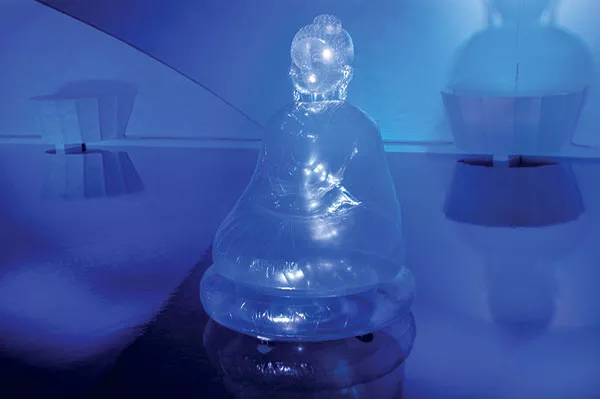
Based on advanced description, it sounded like Chang-Jin Lee’s “Floating Echo” would be situated on the river, as it had been in New York City. There, this large transparent inflatable Buddha was animated by the weather, the natural landscape, the architecture of Manhattan in the distance and the rippling water. It functioned as both a meditation on spirituality and a commentary on kitsch.
In Pittsburgh, “Floating Echo” instead occupies a cramped space beneath the Point State Park Portal Bridge. Barely floating in shallow, still water, the piece loses much of its ethereal quality. Accentuated at night by a backdrop of changing colors, the Buddha tips decidedly away from the meditative and towards an oversized trinket.
The colored laser beams that descended dramatically from the top of PPG place to fall on the fountain, however, were more appropriate. Scheduled for the first three nights of the festival, “Pittsburgh: Spectral Ascending,” was designed by Lightwave International with Yvette Mattern.
Currently, only two other public artworks occupy festival grounds. Hugh Hayden’s “American Hero #4” sits on a lawn painted white at Gateway Center. It is a classic Ford Mustang, also painted white and decorated with two black racing stripes made of hair braided into cornrows. Hayden’s use of hair as commentary on cultural identity builds on work by more established artists such as David Hammons. And Vanessa German’s “Art House” is a hands-on space of creativity and imagination, located in the Creativity Zone.
Two more public works are scheduled for the festival’s closing weekend (June 14-16). “Instabiles,” by Andrew Hieronymi and Ian Brill, will be an interactive installation, and “The Drift” will be a collaborative performance space that actually floats on the river.
Looking ahead, in September, the Cultural Trust is bringing Hofman’s ducky here, which portends positive developments in river-based public art.
This article appears in Jun 12-18, 2013.


Burying “Floating Echo” under the bridge—contrary to the advertisements for it before the festival—weakens the image and defeats the installation’s purpose. Furthermore it runs against the artist’s own statement: “Through the statue one can see the nature, landscape and architecture around the water. Its subtle presence embraces and reflects the surroundings, both natural and man-made.”
Hi Nadine,
I’m curious about scale. It seems to me that the size for this installation was a good match for the space under the bridge. Was there a larger version on the Hudson? If the piece does exist in a size on the scale of Macy’s Parade inflatable, then it would be a perfect match for our three rivers, in both scale and concept. On another track, it seems to me that this installation relegates the Buddha to an object, reminding me of Nam June Paik’s Buddha series. If the artist’s intention is to get us all thinking and reflecting on Nature– we’re stuck with a reflection of just man-made surroundings. Still another question I have is was the placement the artist’s decision or was it a curatorial one? or based on getting/not getting permission to have it float on the river? was the decision a bureaucratic one or an artistic one? Perhaps the Buddha is doing his eternal job of reflecting back our all too human mechanisms!