

Deprecated: mb_convert_encoding(): Handling HTML entities via mbstring is deprecated; use htmlspecialchars, htmlentities, or mb_encode_numericentity/mb_decode_numericentity instead in /var/www/html/wp-content/plugins/super-cool-ad-inserter/inc/scaip-shortcode-inserter.php on line 37
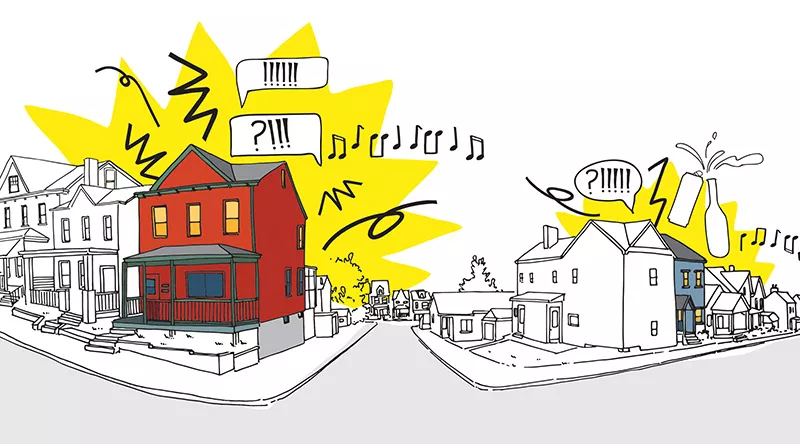
The global coronavirus pandemic has meant a lot of additional stress in everyone’s lives. It’s stressful to shop for groceries, to educate children at home, and to figure out how to pay bills during record levels of unemployment. But, for the most part, isolating at home can offer a reprieve. It’s one of the few places where people are in complete control. Residential neighborhoods are quiet, and with stay-at-home orders still active for much of Pennsylvania, they aren’t seeing many, if any, visitors.
Unless, that is, you live next to a home being used as an Airbnb. Throughout the pandemic, the online short-term rental company has been listing thousands of rooms, homes, and cabins available for rental in Pennsylvania, and visitors are taking advantage. There are some loopholes that allow certain short-term rentals to operate, like for essential travel of frontline workers, which some Airbnb homes are hosting. But it also appears that many Airbnb hosts and visitors aren’t limiting themselves to those parameters — that means people traveling who shouldn’t be, and people breaking social-distancing rules for the sake of a weekend getaway or to throw a party.
Airbnb officials insist they are following the state’s guidelines and rules involving non-essential business closures, and are providing all the proper information to their hosts.
But a South Pittsburgh resident says they have witnessed several stays at a home used as an Airbnb on their street, including what appeared to be a party in early May. Posts on social media indicate other Airbnbs in Pittsburgh are being used in similar ways, and reviews on Airbnb’s website for stays in April and May rarely mention they were for essential travel. Even though these short-term rentals are likely violating several rules and orders, there doesn’t appear to be much motivation to force them to stop.
The weekend of May 2, a quiet side street in a residential South Pittsburgh neighborhood was flooded with visitors. Twelve cars were parked on the narrow street, some up on the sidewalk so all the cars could fit close to a home at the end of the road. A neighbor who spoke to CP on the condition of anonymity expressed their displeasure, especially baffled at the thought of something like this happening during the coronavirus outbreak.
“We were up until 3:30 in the morning,” the neighbor said. “This house next door is being specifically used for the parties. … It was really loud. Our house doesn’t have the best insolation. We could hear them screaming and playing loud music.”
The neighbor said this gathering took place at a home used as a short-term rental through Airbnb. The party involved people defying stay-at-home orders to visit a different neighborhood to party and was booked on a short-term rental site, which also violated Gov. Tom Wolf’s orders on business closures.
The South Pittsburgh resident says the property next door was bought and flipped a few years ago, and has been solely used as an Airbnb location (no one lives there full- or part-time). The resident is worried for other people in the neighborhood, including a senior who lives next door, and for themselves in terms of a potential increased chance of contracting COVID-19.
“For myself, I would be considered a high risk for the disease. I have asthma and a blood disorder,” said the neighbor. “Who are these people coming into our neighborhood? They have no respect for social distancing.”
The neighbor has reached out to corporate communications at Airbnb and gotten a response, but nothing saying they would take action against the host. Directly after the party, the neighbor said the home played host to another group of about five or six guests. “It is so frustrating and there is nothing we can do,” said the South Pittsburgh resident.
In mid-March, Wolf issued his order closing “non-life-sustaining” businesses throughout the commonwealth. While hotels, motels, and hostels could remain open, it meant that short-term rentals, like those booked through Airbnb, VRBO, Expedia, HomeStay, and other websites, were no longer allowed when a county was under the red phase of the governor’s coronavirus plan.
Then on April 7, Pennsylvania Community and Economic Development Secretary Dennis Davin wrote letters to Airbnb and Expedia, urging them to take stricter measures informing property owners that they shouldn’t be advertising short-term rentals online.
“There is nothing that’s essential about a short-term rental in the Poconos, and so we have shut them down,” said Wolf during an April 1 press conference.
But in browsing the Airbnb website, hundreds of listings are still shown throughout Pittsburgh. Some hosts have indicated in their profiles that they are adhering to Wolf’s orders prohibiting short-term rentals and not renting during the pandemic, but most are not. Even a cursory glance reveals that several Pittsburgh Airbnbs have hosted guests in April and May, including visitors from out of state like Arizona and New York.
Searches of Philadelphia also show guests staying in Airbnbs in April and May. Harrisburg turned up similar results, including people staying in rooms in people’s homes. Even in the Poconos in Northeastern Pennsylvania, where Wolf specifically pointed out that short-term rentals were non-essential, visitors stayed at Airbnbs in April and May. Some visitors even traveled from New York City to stay at cabins in the Poconos. One guest from New York traveled twice to the same East Stroudsburg Airbnb between April and May. A request for comment to the state Department of Community and Economic Development went unanswered.
As of May 11, more than 57,000 people have tested positive for coronavirus in Pennsylvania and more than 3,700 in the state have died. That includes more than 1,500 COVID-19 cases in Allegheny County. The highest rates of coronavirus cases are mostly in the eastern part of the state with Berks, Delaware, Lehigh, Monroe, Northampton, Philadelphia, and Pike counties all seeing more than 700 positive cases per 100,000 residents.
Josh Meltzer, head of Northeast Policy for Airbnb, says the company is communicating with hosts about the state’s orders during the pandemic, including ensuring rentals are only for essential situations.
“Airbnb is working with local governments in realtime to both address these orders and ensure short-term rentals are an available resource for frontline responders and those sheltering in place during this crisis,” said Meltzer in a statement to CP. Airbnb also started to block bookings starting sometime in mid-to-late April in four Northeastern Pennsylvania counties: Carbon, Pike, Monroe, and Wayne. While the company says it has provided several guidelines and rules to Airbnb hosts, the only warning Airbnb provides guests on its website is a written disclaimer in small bold type that reads, “Check travel restrictions before booking. The health and safety of our communities come first. Please follow government guidelines and travel only if it’s essential.”
Only after navigating through four online links is an explanation provided about Pennsylvania’s short-term rental rules on page 13 of a 16-page document. And the short answer as to whether Airbnb hosts should be renting out their residential properties during the pandemic is no. Unless guests are explicitly traveling to perform military, emergency, governmental, health, or infrastructure related responses, no stays should have been permitted after April 1. Vacation activities in lodgings are prohibited.
Airbnb recently launched a program it says has resulted in 100,000 homes being offered up by hosts to help house medical workers who need lodging to self-isolate near hospitals.
The South Pittsburgh resident might be more sympathetic to people using Airbnbs if guests were relegated to essential workers, business travelers on necessary trips, or people moving to Pennsylvania permanently and looking for temporary lodging before finding a home. But the resident doesn’t understand how parties are being allowed during the pandemic. Airbnb has a strict no parties rule for hosts and guests, but evidently some people in Pennsylvania are ignoring those rules.
However, Airbnb says that when it is informed about parties happening at properties, it takes action against the hosts. Breaking this policy can result in Airbnb hosts losing their account with the short-term rental giant.
According to its website, another Airbnb location, this one located in Beechview, hosted a Pittsburgh family for a 13-year-old’s birthday party in April. “Her group were fantastic guests,” reads an April host review response from the Beechview Airbnb host. “We were so glad to be able to help her make her daughter’s 13th birthday special.”
Multiple reviews of Airbnb listings across Pittsburgh during the pandemic mentioned quick stays without context of essential work. A review from a Lawrenceville rental in April said, “The perfect place for a quick weekend trip.” In May, a renter in the South Side Slopes posted, “great lil place to stay and getaway for sure with a nice view of the city.”
On May 10, local blogger Sue Kerr posted on Facebook about a party held at an Airbnb in her North Side neighborhood that included guests without masks and trash left in the street. “Alt-hotels do not belong in neighborhoods,” wrote Kerr. “I’m tired of texting the owner. Just stop trading our health for money. It’s not okay.”
Coronavirus closures have been hard on Airbnb’s bottom line. Last week, Airbnb laid off about 1,900 employees (25% of its workforce) in response to a big dip in bookings. A recent Wall Street Journal article also detailed how some hosts were experiencing large amounts of lost revenue, but this was largely concentrated among hosts who had overextended themselves and bought properties for the sole purpose of converting them into Airbnbs.
On May 15, Allegheny County will join 37 other Western and Central Pennsylvania counties in the yellow phase of Pennsylvania’s reopen plan. Short-term rentals are permissible in yellow-phase counties, as long as disinfecting and cleaning rules are followed, and gatherings have fewer than 25 people.
“More businesses can reopen, but proper safety measures must be in place,” tweeted Wolf on May 8 in reference to the yellow phase of his reopen plan. “There are fewer social restrictions, but residents should continue social distancing, wearing masks in public, and doing everything they can to prevent the spread of #COVID19.”
However, even under the yellow phase, some Airbnbs are violating a recent state Supreme Court ruling which states that properties solely and continually operating as short-term rentals are violating residential zoning codes. Pennsylvania municipalities, like Pittsburgh, can now enforce zoning violations onto properties in residential zoning districts that operate solely as short-term rentals.
Pittsburgh city officials could not say how many Airbnb complaints they have received under the coronavirus pandemic, nor did they indicate any enforcement actions against short-term rentals under zoning laws.
The South Pittsburgh resident thinks Airbnb should just take down all listings in Pennsylvania during the pandemic. They believe there are just too many hosts and guests violating social distancing rules, and they shouldn’t be encouraged to enter people’s neighborhoods.
“Airbnb as a whole needs to just shut their website down in Pennsylvania,” says the resident.
This article appears in May 13-19, 2020.


My name is Julie Ransom, I operate as a full time business 4 furnished rental units that can be rented on Airbnb as well as other booking platforms (and booked directly through me). I’ve been doing this continuously since 2009. I am also the moderator of the Airbnb Hosting Group here in Pittsburgh, which I have been doing for about 4 years. Collectively, we have over 250 members who represent roughly 1,000 property listings.
What this story did was cherry pick from the thousands of local listings a few property owners who appear to have violated the governor’s orders prohibiting short term stays where guests would be sharing a property with the hosts. Hosts who rented out entire properties could still rent out the property, with the exception of renting to tourists.
What this story did not discuss was the overwhelming majority of hosts that are adhering to the governor’s policy, which our group agrees makes sense. Who wants to host guests in their own home who may or may not be carriers for the virus?
Unfortunately, there are bad actors on both sides of Airbnb: bad guests who come into properties and destroy them, and bad hosts who do not maintain their properties, disregard occupancy laws, and allow loud groups of people to party in their properties. However, I cannot stress enough that regardless of how much articles like this try to do, this is an infinitesimally small number of people.
Hosts who care about their properties will want to know about bad guests in their properties. And if hosts are repeatedly non-responsive to guests’ bad actions and continue to host loud, large groups, neighbors can report the property to 311.
While these kinds of stories tell salacious stories about Airbnb, they do not depict the reality of the vast majority of rentals. A survey completed by hundreds of local hosts report that most of the money they make from Airbnb goes toward bridging the gap between salary and bills, and the rest is put towards improvements to their property: from a lick of paint on the outside, to new doors, windows, heating systems and carpeting.
These improvements not only raise the value of the Airbnb property, but often help raise the value of the surrounding homes. This story did not make a point of mentioning it, likely because no Airbnb hosts were interviewed, but they also vet guests to make sure they are a fit for their property. I do primarily extended stays for my properties and use social media and other web sites to confirm the information the guest has provided as a way to confirm identity and purpose of the visit.
Hosts become mini-ambassadors for this city. They encourage guests to use public transit and bikes, to eat at locally owned, neighborhood restaurants, to shop at some of our neighborhood’s wonderful shops and retailers, and guide them to that “not in Fodor’s” attraction to provide guests with an insider’s experience of Pittsburgh they will not only cherish, but will tell their friends about, and may even return.
Because of the nature of the business, realistically you are never going to have 100% compliance w legal guidelines, or have hosts who care only about how much money they make, not unlike slum landlords in the unfurnished property business. But does that mean all unfurnished rentals should be shut down? No. You investigate the law breakers and you fine and punish accordingly. To do otherwise is throwing the baby out with the bathwater.
As far as social distancing and wearing masks, people should be doing both. We’re also supposed to be self-quarantining, so you’re not to leave the house unless necessary, especially if in a risk group. What makes absolutely no sense to me is the individual quoted in this story, who by her own admission falls in a risk group and shouldn’t be leaving her house. Yet she feels at risk because the Airbnb next door had guests who didn’t wear masks outside? If you’re in a risk group and see a group of people without masks, stay away from them, tell them to put on masks, but don’t blame the property owner. This is a matter of personal responsibility.
The next time you write about Airbnb, I would hope you could reach out to hosts and guests to create a fair and balanced story, and not focus a few, very vocal people who, while they have every reason to be unhappy, are by no means having a typical experience of having an Airbnb in their neighborhood. This is, frankly, irresponsible, one-sided, misleading journalism.