

Deprecated: mb_convert_encoding(): Handling HTML entities via mbstring is deprecated; use htmlspecialchars, htmlentities, or mb_encode_numericentity/mb_decode_numericentity instead in /var/www/html/wp-content/plugins/super-cool-ad-inserter/inc/scaip-shortcode-inserter.php on line 37
The Dollar Bank Three Rivers Arts Festival opens today without what’s already become its most-discussed artwork.
Last week, artist Tom Megalis pulled from the festival his painting “Within Two Seconds, The Shooting of Tamir Rice,” after online criticism alleging that the work exploited the death of Rice, the 12-year-old African-American boy shot to death by police in Cleveland in 2014. Megalis, who is white, was accused of cultural appropriation, and of insensitivity in his handling of the tragedy.
But the racially charged controversy over the removal of the painting is about more than the skin color of the artist. Critics say it illustrates, painfully, the chasm between the way white people experience the world and the way black people do.
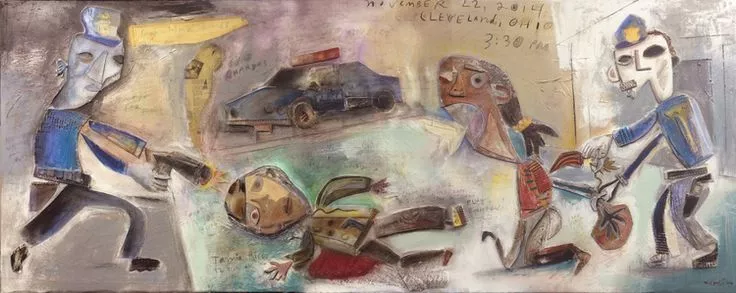
Megalis’ large-scale painting, completed in 2016, depicts an officer shooting Rice, who lies in a pool of blood, his toy gun still resting on his stomach. To the right, a black girl (representing Rice’s sister) who cries out at the sight of the killing is restrained by a second policeman. Text in the background reads, “No charges” — a reference to a Cuyahoga County grand jury’s 2015 decision not to indict the cops, the news that Megalis says led him to create the painting as a memorial and “a tribute to Tamir Rice.”
Megalis, a former Pittsburgh resident who now lives in Cleveland, submitted the painting for the arts festival’s annual Juried Visual Art Exhibition. His work was one of about 50 selected by three local artists serving as jurors; submissions were “blind” in that jurors weren’t given the names or other identifying information about the artists.
On May 21, Megalis announced on his Facebook page that the festival had accepted the painting. The painting and Megalis himself were quickly denounced by numerous commenters. Some said that as a white artist he had no right to depict black suffering. Others said that for black viewers, his painting simply reprised the trauma of Rice’s shooting — video footage of which had been widely circulated — without providing any additional insight. One critic labeled the painting “Black trauma porn.” Megalis was told to pull the painting from the exhibition, and even to destroy it. (Megalis has since removed the post.) Critics also contacted the Pittsburgh Cultural Trust, which runs the arts festival. “This isn’t his story to tell,” said a commenter on the festival’s Facebook page.
That same day, Megalis informed the festival that he was withdrawing the painting. Organizers told him the work could stay if he wished, but accepted his decision to withdraw it, says festival director Sarah Aziz. Megalis says he realized the image was causing pain, and adds, “The last thing I wanted to do was cause pain for the black community or Tamir Rice’s family.” The controversy continued with a May 22 Huffington Post blog post by Pittsburgh-based writer and activist Caitlyn Luce Christensen.
The criticism recalled the controversy from this year’s Whitney Biennial over “Open Casket,” white artist Dana Schutz’s painting of the murdered Emmett Till. While Schutz’s painting remained in the exhibition, activists held protests in the gallery, and the museum organized discussion events. At 6 p.m. Wed., June 7, the Cultural Trust will hold a public forum Downtown to address “race, representation and art.” (Details at the end of this post.)
Some critics have called Megalis’ painting an example of “cultural appropriation,” or the presentation of another group’s cultural experience as if it were one’s own. Megalis, interviewed by phone last week, said he was responding to Rice’s shooting, and the lack of criminal charges, as a white person and a father. “I was making a white statement that this was shameful,” he said. He said he had taken to heart the words of activists and commentators who urged white people to join in denouncing racism and racist acts.
Megalis says he never meant to sell the painting, and that he intended it to increase awareness.
Critics say that Megalis’ intentions are beside the point.
Kilolo Luckett, the Pittsburgh-based art historian and cultural producer who will moderate the June 7 forum, says that both Megalis’ creation of the painting and the jurors’ selection of it speak to a larger problem: the way that white people in America view the lives of nonwhite people here.
“It really tells you a lot about what’s missing in our history and our culture,” says Luckett.
It’s not simply that artists like Megalis and Schutz are white, says Luckett, who is African American; it’s that their work conveys neither much understanding of black lives nor any real critique of the system that took those lives. “’Two Seconds,’” says Luckett, “is such a one-liner and it does speak to a lack of understanding that the artist and the jurors have.” (None of the arts festival’s three jurors was black; exhibit organizer Ivette Spradlin and one juror whom CP contacted referred questions to the Cultural Trust. Festival organizer Aziz said works were selected based on artistic merit.)
Neither Megalis or Schutz regularly makes art about social-justice issues or black life. They “just aren’t centered coming from that space,” says Luckett.
Central to criticisms of “Two Seconds” is the depiction of Rice’s body, and the manner of depiction. It’s the representation of a black body victimized, suffering, deceased. Megalis believed that depiction necessary to express the injustice that outraged him. Critics, however, saw it not merely as exploitation, but as the perpetration of a fresh trauma. Similar arguments arose in 2015, after conceptual poet Kenneth Goldsmith’s public reading (at an academic conference) of “The Body of Michael Brown,” Goldsmith’s appropriated version of the autopsy report of the African-American man shot to death by police in Ferguson, Mo., in 2014. Critics said that Goldsmith seemed to be claiming ownership of Brown’s body — not only re-creating the tragedy but, in a way, replaying America’s legacy of chattel slavery.
Well-intentioned white artists, Luckett says, “tend to render black experience … as a summation of this violence against us.” Megalis says his painting was an expression of outrage, but “He’s expressing it through re-enacting that event,” Luckett says. “How about, how does he see himself as a white man implicated in this?”
“Why not break apart and look at how the criminal-justice system has systematically oppressed and marginalized” black people, she asks. “Why do you need to re-enact that actual injustice? … In a way, it’s being kind of lazy.”
“You could, as a white artist talking about social justice, first hold a mirror up,” she adds.
For his part, Megalis said that the scene, while based on a real event, was his interpretation: “I built it like a filmmaker would build it.” The police officers, he notes, are eyeless and skeletal. “I was trying to make a statement on that, that they had no souls when they entered into this,” he said. “I was making a white statement that this was shameful.”
Yet many viewers have taken away something very different. Christel N. Temple, who chairs the Africana Studies department at the University of Pittsburgh, calls Megalis’ painting “grotesque.”
“It’s the exact duplication of a dying child,” says Temple, reached by phone. “You cannot discern [the artist’s] message from that. The image does not compel a deep reading of what happened to Tamir Rice.”
Nonetheless, Temple adds via email that to her, “the most problematic aspect” of the controversy is the fact that the painting was to be displayed at a public venue, a free arts festival. “The representation of a Black moment of fresh and lingering trauma — Rice’s death in Megalis’ painting — politicizes the Festival experience, especially for Black patrons whose over-policed and over-brutalized experience it will speak to in sad, non-festive ways.”
Some observers see the controversy more in terms of artistic freedom. Mark Clayton Southers, artistic director of Pittsburgh Playwrights Theatre Co. and an art collector, defends Megalis’ right to paint what he wants and show the work. “It shouldn’t have to be artists of color to depict people of color,” Southers says. Southers, who is African American, agrees that black people have different experiences of violence against blacks than do whites, but says, “You can’t shut artists’ voice down because of what you think.” (Southers adds, however, that he doesn’t agree with Megalis’ decision to withdraw the painting: “I think he punked out.”)
David Bernabo, a white artist whose work will be exhibited in the Juried Visual Art Exhibition, says, “I’m against censoring artists when it comes to the work of art they want to make,” though he adds, “the artist needs to be open to criticism when it comes to making art about communities.”
In March, during the initial controversy over Schutz’s “Open Casket,” at the Whitney, the internationally known African-American artist Kara Walker, who’s known for her explorations of race, wrote on Instagram: “The history of painting is full of graphic violence and narratives that don’t necessarily belong to the artists own life, … I am more than a woman, more than the descendant of Africa, more than my father’s daughter. More than black more than the sum of my experiences thus far. … I say this as a shout to every artist and artwork that gives rise to vocal outrage. Perhaps it too gives rise to deeper inquiries and better art. It can only do this when it is seen.”
Luckett says that black artists tend to confront issues of state-sanctioned violence differently than do white artists. She cites nationally exhibited, Pittsburgh-based African-American artist Vanessa German, whose practice include “power figures”: large sculpted dolls painted black and adorned with found objects. The Homewood resident’s artworks (like her spoken-word performances) often memorialize victims of gun violence, but she also addresses other aspects of black life. “Her work embodies the wide range of perspectives and expressions within the black community,” says Luckett.
Luckett also cites the work of African-American artist Henry Taylor, whose paintings, like Schutz’s “Open Casket,” hang in the 2017 Whitney Biennial. She cited Taylor’s “The Times Thay Ain’t a Changing Fast Enough!,” which depicts the 2016 death of Philando Castile in a police shooting in Minnesota.
Like “Two Seconds,” Taylor’s painting shows a cop pointing a gun at the dead body of a black person. However, Luckett writes in an email to CP, where “Two Seconds” is a “wide-screen” image of the shooting — an observer’s perspective — with the victim’s blood pooling red, “Taylor’s work engages the viewer as if you are sitting right next to Castile; his wounds rendered brown like his skin; [and] the obscured face of the policeman and behavior represent America’s history of systemic racism [and] institutional injustices toward [people of color] …” (An image of Taylor’s work is available here.)
“Every artist has a right to make work, but … you’d better be responsible and accountable and be prepared to defend your work as well,” Luckett says.
Debates over who has a right to represent the experience of a community that’s not their own, especially that community’s suffering, continue. The June 7 Cultural Trust discussion on race, representation and art, moderated by Kilolo Luckett, takes place at the Trust Arts Education Center, 805-807 Liberty Ave. (Space is limited: RSVP here).
The Juried Visual Art Exhibition artists and jurors, including Megalis, have been invited to attend. Yesterday, Megalis told CP that he will not attend. He wrote via Facebook that some days after withdrawing the painting he changed his mind and asked that “Two Seconds” again be included in the exhibit, but that he was told by organizers it was now too late. Megalis wrote that if the painting was not there, he didn’t wish to participate in the forum.
This article appears in May 24-30, 2017.




Megalis played himself. Good riddens. May the painting spontaneously combust. #BYE
The word you’re trying so hard to use is “riddance.” Stay in school.
I feel that Black Femmes must stand together and reveal the true nature of Megalis’
He is so used to being dominant he could not withstand criticism from the very demographic he depicted in this “art”. How many grieving black mamas has he engaged without asking for notoriety? He literally said that he spent 4 weeks on this and wanted people to see it. Vanity failed him. And this will never be seen to scale. As it should be, throw it in the ocean….
He somehow thought he was doing a favor to a community he admittedly never engaged or wanted to engage. He never sent the family even a note of condolence. This was a ploy to exploit black trauma. If it was not, he would come defend his work…..
I’ve known Mr. Megalis for many years and I’m more familiar with his video work than his painting work. His hyper concentration of the entire life of Tamir Rice into the visual depiction of his last moments is extremely brutal. I think if he as an artist was engaged in the Black community, had a history of working to dismantle white supremacy and social justice work, I think he might have painted this subject matter very differently. He has a right to paint anything he likes, of course, but he should recognize the fresh and painful wounds he’s opening when he does work like this and be prepared to discuss it.
I think it’s more telling that there were no jurors of color curating the event. I know the Arts Festival is working towards inclusion, I believe this is the first year they had a local hip hop showcase (I could be wrong on this, but I know they have a local showcase on June 8 and I don’t recall seeing one in the past and I think that’s definitely progress.) They just have further to go, and I think this piece and it’s resultant controversy illuminates this truth.
I don’t know enough about the artist but news flash, artists aren’t always perfect. How can white people help? There’s racism, and the police have shot innocent black people. A the thin blue line has lost people too. Police have been trained under a warrior mentality for years, and de-escalation in police departments is not popular, the FOP endorsed Trump. It scares me, and I don’t know what to do. Anyone can be next on the list, as we saw in the Holocaust. Who is to judge the levels of prejudice from one person to another? It’s important to talk about it, to try, even if we make mistakes towards one another – not violent ones, just living and learning with each other. It has to be done, it absolutely has to be done. It is naive to think that all white people are blind to their privilege, or that we all want the same kind of status quo world. This is a ripple, not a huge thing. If we don’t resist more smartly we will have wasted years that could be vital!
I think the critiques of this art piece on the basis of race are wrong. The artist has a right to his/her vision and how they represent that vision. In this case the critics are picking an easy target; someone who actually gives a fuck about the needless and grotesque death of young Tamir Rice, at the hands of the state, and, who has painted a telling image of this grotesque fact in a telling and grotesque artistic imagery. It is grotesque in the eyes of all, black, white or otherwise. These critiques are highly subjective, and do not form a standard for a critique on how to deal with the subject of inhumanity visited upon blacks by artists who are non-black. There can be no such standard, short of such standards of excellence elsewhere found. Just as there can be no standard for the human eye viewing and representing inhumanity short of that very artistic humanity itself. Such humanity does not yield to race though it is often informed by race. These critiques are barren. They search for easy targets and soft audiences. The artist, one black, one white, each views inhumanity and each makes an artistic representation. Ours is to like or dislike, not to ban. Cultural appropriation is when one dons the culture of the other and pretends authenticity. Authentic representatoon, in multidimensional formats, from multitudinous sources is precisely, art.
Stop censoring in bigger, more arcane, made-up terms.
Curtiss E. Porter, Ph.D.