

Deprecated: mb_convert_encoding(): Handling HTML entities via mbstring is deprecated; use htmlspecialchars, htmlentities, or mb_encode_numericentity/mb_decode_numericentity instead in /var/www/html/wp-content/plugins/super-cool-ad-inserter/inc/scaip-shortcode-inserter.php on line 37
Update: This afternoon, Leo from Misra got in touch to let me know that the label had supplied both a correctly ordered download and a hard copy of the album to Paste. That doesn’t negate the incorrectly ordered download that was sent by ForceField, but it does explain some of the confusion on the part of the label as to how the reviewer might have ended up listening in the wrong order. Grimm, the reviewer, confirmed to me via email that she had been working with the download provided by ForceField, identical to the one I’d been sent. Either way, the news item that had been posted on Misra’s site, which I linked to in the post below, has been taken down now. Like I said, sounds like a big misunderstanding to me. To give you some context I’ll provide the full text of Misra’s email and news post — along with a screen cap of the original review — after the break, below. In any event, I now have two copies of the new Holopaw record in my iTunes. One in the right order, one in the wrong order.
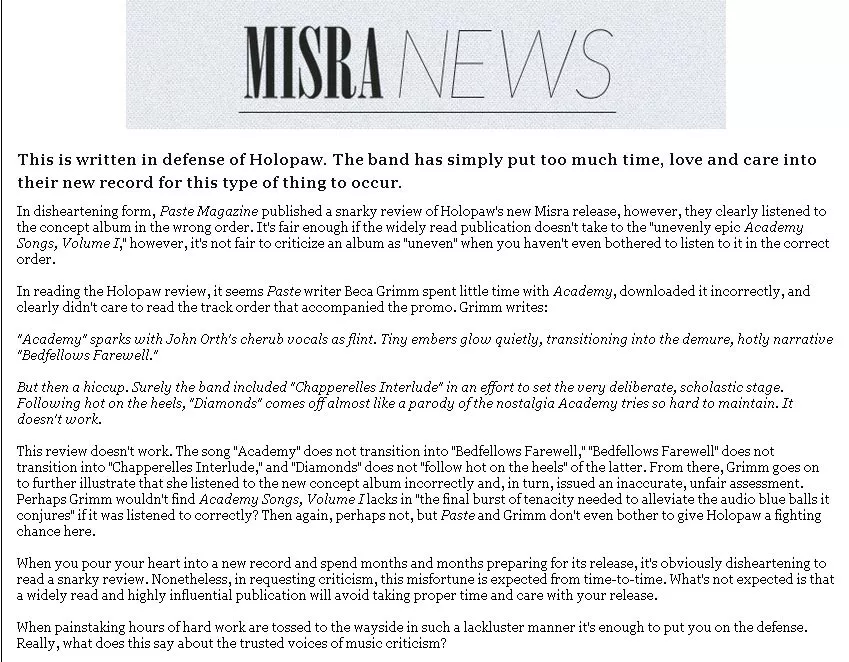
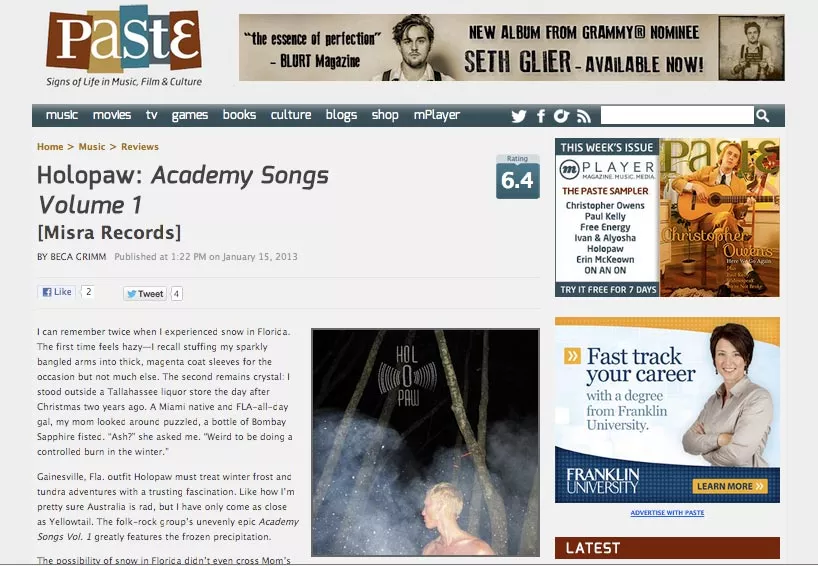
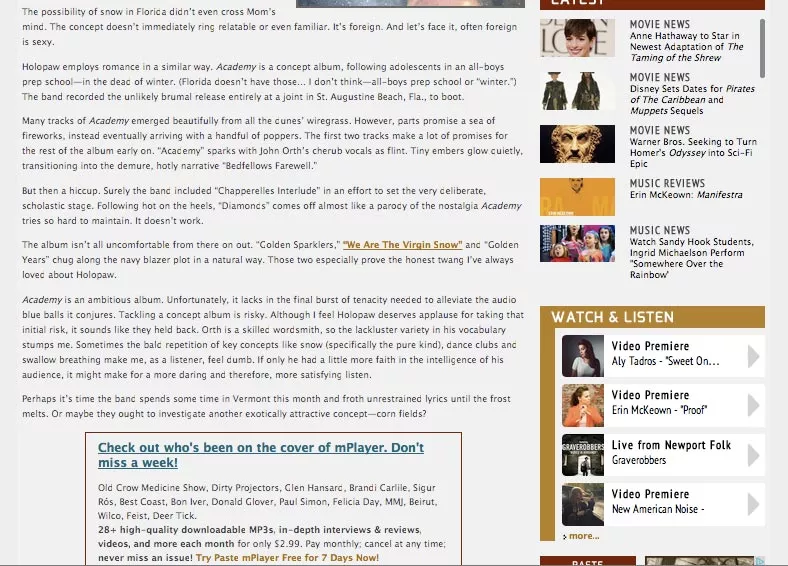
The most interesting email to come across my desk this morning was from Misra Records, who took issue with a review that Paste Magazine ran on the new album from Misra’s Holopaw. The text of the email is here on Misra’s website.* You can also read the original version of the review — which Paste has since appended — below that press release.
The fact, which Paste has owned up to, is that reviewer Beca Grimm listened to the album, which is a concept album, in the incorrect order, and that colored her perspective on the tracks and how they interact with one another. The charges from Misra are that Grimm “[hadn’t] even bothered to listen to it in the correct order,” and that Grimm “spent little time with Academy, downloaded it incorrectly, and clearly didn’t care to read the track order that accompanied the promo.” “What,” Misra asks, “does this say about the trusted voices of music criticism?”
But what does it mean to “download an album incorrectly,” and where’s the burden in a situation like this?
The Holopaw album was sent via digital delivery from ForceField PR, who reps Holopaw. I got it too. And when I downloaded it — by clicking “click here to download the album,” which I presume is the correct way to download an album?
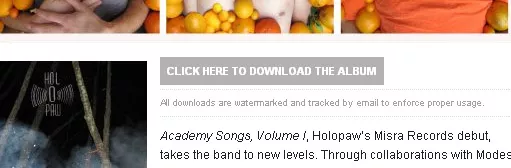
— it appeared track-by-track in … alphabetical order.
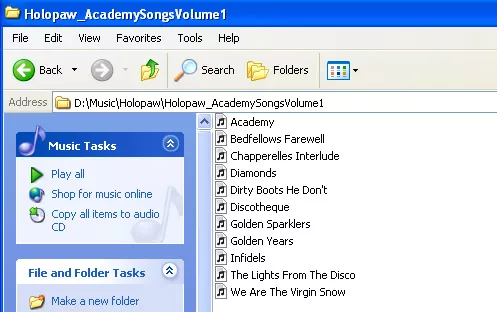
That’s because whoever prepared the MP3s for delivery didn’t add meta information to tell our computers what order the songs should be in. When I imported the songs into iTunes, they remained in alphabetical order:
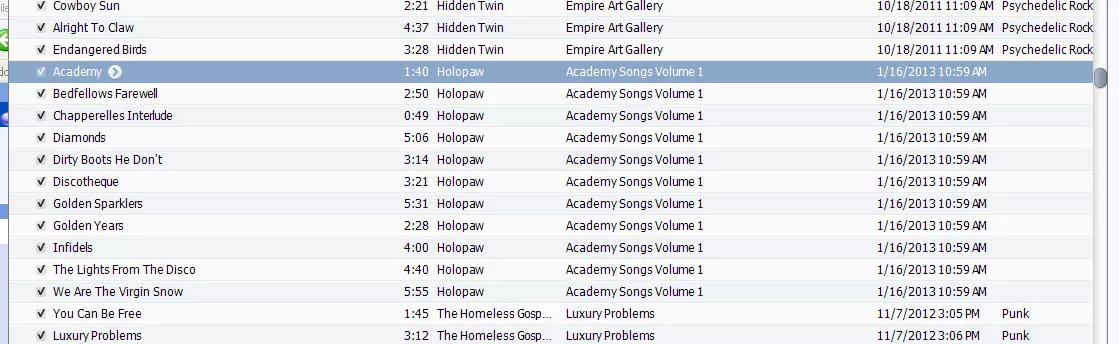
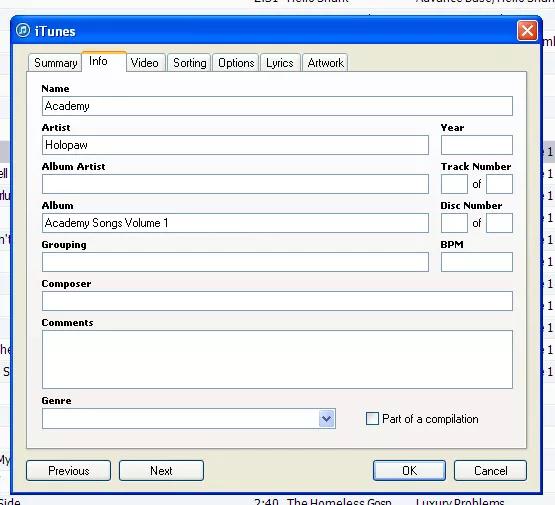
In order to get an album to play in the correct order, one has to either name the files so that it will (“01 Academy,” “02 Golden Sparkler,” etc.) or tag the track numbers, which … wasn’t done here:
Now, to ForceField’s credit, they did include a track listing, at the bottom of the email containing the download. And yes, I’d like to think if I were the reviewer, I’d notice the discrepancy — or notice that I’m listening to the tracks in alphabetical order. There are red flags here. But is it my job as a reviewer to check and re-tag the tracks so that they’re in the correct order? Is that burden on me? If the folks at the label and PR firm didn’t bother taking the time to ensure that the album would come across in the right order, erm, “what does that say about the trusted voices of music publicity?!”
I’m being facetious, obviously — I’ve had generally great relations with both Misra and ForceField in the past, and this whole thing sounds like a major misunderstanding. But to accuse the reviewer of “downloading the album incorrectly” without admitting that perhaps it could’ve been sent in a more careful manner — well, that’s unfair. It’s like sending me a book to review, chapter by chapter, in 18 different envelopes, with a table of contents somewhere in there, then getting upset when you find out that I read it incorrectly.
Ultimately, I don’t know a reviewer or publication that wants to review an album in the wrong order; if something like this happens, it’s not hard to bring it to the reviewer’s attention, and surely they’ll correct the issue, as Grimm and Paste did in this case. Then the next step, rather than start calling names, is to make sure you send your next release out in the right order.
Also, this wouldn’t be a problem at all if you just sent a CD.
*Click through to see the full news post/email and the original review, after the break:
The Misra news blast:
The Paste review as it ran originally:
This article appears in Jan 16-22, 2013.



This post is excellent. I think about this stuff all the time intensely whilst trying to figure out the best way to curate stuff in my music collection. I only recently discovered the power of the “Album Artist” field in iTunes, which cleans up a lot of the sequencing issues with hip-hop album “Artist” data fields. Technology is weird.
Nice. I got the e-mail too, and my immediate reaction was “lazy journalists!” While that may still be somewhat true, this makes me feel less disdain for Paste, which I’ve always thought was a stand-up magazine. Thanks for covering this, otherwise I wouldn’t have known.
Gladly — thanks for reading!
You’ll note that I’ve added an update at the top as of 4 p.m. on Jan. 16 — Misra explained that Paste got multiple copies of the album, but it sounds like the one that ended up in Ms. Grimm’s hands was the out-of-order one. Either way, it appears Misra removed the emailed rant from its website.
To note: the publicist asked me to remove the post on Misra’s website and I complied. Nonetheless, as a musician, label manager, and writer, I do feel strongly about this. I’d say that being provided a track list and bio, along with a physical promo, leaves the responsibility squarely on Paste’s shoulders, regardless of how the one Forcefield promo was “tagged.”
iTunes is not fail-safe (some folks’ iTunes download backwards) and, in the digital age, this is something that needs to be realized if you’re writing a review. Failing to read the track list that accompanies a digital promo (which the writer clearly did) is lazy journalism and unacceptable from an entity as powerful as Paste. I stand by that. Paste themselves immediately realized this and were extremely apologetic.
The main premise of all this: if a band and label spend painstaking hours on a release, please just spend a little time and care with your review. It can make a huge difference.
I do not subscribe to the notion that writers should wholly trust digital technology and fail to take the time to read the carefully constructed material that accompanies promos. I love you guys and I love Pittsburgh (a lot), but I don’t believe that’s a good stance to take.