

Deprecated: mb_convert_encoding(): Handling HTML entities via mbstring is deprecated; use htmlspecialchars, htmlentities, or mb_encode_numericentity/mb_decode_numericentity instead in /var/www/html/wp-content/plugins/super-cool-ad-inserter/inc/scaip-shortcode-inserter.php on line 37
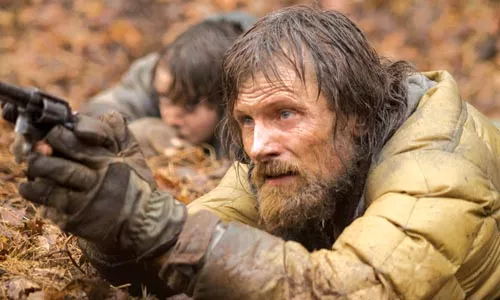
At first blush, the premise of The Road — a father and son trying to survive in a world devastated by nuclear war — seems oddly out of date. In an era of flu epidemics, climate change and terrorism, nuclear Armageddon is one nightmare scenario that doesn’t keep us up at night. But at the heart of this film, based on Cormac McCarthy’s searing novel, is a feeling many of us share: Somewhere over the horizon, somebody is readying bombs that, one way or another, can destroy our way of life.
So director John Hillcoat begins his movie, and periodically interrupts it, with lush images of a rural/suburban American idyll. This is the life his characters have lost, the one we fear losing. In contrast to that vanished world, he uses a washed-out palette to depict a washed-up planet, a post-apocalyptic landscape of lifelessness and despair. The End Times, in other words, look like February in Western Pennsylvania. It’s that grim. (Not coincidentally, much of the movie was shot here.)
That’s the backdrop for The Road‘s ill-clothed characters and deliberately threadbare plot: A father and son wander southward through the ruins, seeking warmer climes, food and shelter from marauding cannibals.
That’s pretty much the whole movie right there. There’s no character development — as in McCarthy’s book, neither father nor son even have names. There’s no real narrative arc either.
So why watch? Mainly for Viggo Mortensen, who plays the father (and who is most recognizable as Aragorn from The Lord of the Rings trilogy), and newcomer Kodi Smit-McPhee, the son.
Their moments of father-and-son tenderness — reading stories by firelight, or sharing a Coke plucked from the ashes — defy the devastation around them, and are made more poignant by it. Considering how little dialogue they have to work with, they create a remarkably believable chemistry. (My brother, whom I brought to the screening to get a family man’s reaction, said it made him want to go home and hug his kids.)
Joe Penhall’s script naturally takes some liberties with the book, often for the better. While there’s no shortage of horror here, some of McCarthy’s most disturbing passages have, wisely, been excised: Scenes that are shocking on paper would be merely gruesome on screen.
And while I’ve yet to read a McCarthy novel with a well-developed female character, the movie gives us Charlize Theron as Mortensen’s wife. Her anguish convincingly voices the film’s existential dilemma: What’s the point of surviving such a disaster? In contemplating suicide, she tells her husband, “Other families are doing it” — a going-down-with-the-Joneses assertion that captures the bitterness of a dream betrayed.
Theron exits early, though the boy wears her knit cap after she departs. It is, conspicuously, the only thing in the movie that remains unsoiled, like a woolen nimbus.
That’s no accident. McCarthy’s book intimates that the boy is a Messiah, here to save a world already lost … even as his father rails against the God that let it happen. McCarthy spells out this double-edged meditation in the words of a roadside wanderer named Ely (short for Elijah, one of two evangelists said to appear in the Book of Revelation, get it?). “There is no God,” Ely explains, “and we are his prophets.”
That line is dropped from the film (though Ely remains, played by Robert Duvall). So is most of McCarthy’s existential ambivalence. In his book, when father and son find a cache of food, the father confesses “some part of him wished they’d never found this refuge. Some part of him always wished it to be over.” In the movie, by contrast, the discovery of food is accompanied by swelling violins.
The film’s ending, too, is a shade more optimistic. This is a commercial release, after all, with every incentive to emphasize the heart-warming passages that made the book an Oprah Winfrey favorite. But for bean-counting purposes, Hillcoat probably remained too true to the original: This is a well-done adaptation that probably won’t do well at the box office. How many audiences, after all, will watch a 108-minute movie whose first 106 minutes mostly suggest that where there’s life, there’s hopelessness?
Come to that, McCarthy can be overly fatalistic about humanity’s nihilistic urges. In his best-known books, it’s often hard to imagine who could have built the world that collapses around his protagonists. In noting the mushroom cloud’s silver lining, the film may be selling out. Or buying into a less reductive vision of humanity.

This article appears in Nov 26 – Dec 2, 2009.



It’s not a nuclear holocaust. It’s never explained, and trying to pin it down to something you can explain in a word or two cheapens it.
Yes, I’m familiar with this argument — that neither the book nor the film ever explicitly commits to a single explanation for the apocalypse. But I think buying into that requires ignoring the fact that this is the only explanation that makes any sense.
McCarthy describes the apocalypse this way: “A long shear of light and then a series of low concussions.” In the book, we learn that the electricity goes out almost immediately. The man and his son wander from one city to the next, and while the cities are clearly hundreds of miles apart, they appear to have been subjected to the same intense heat. The climate appears to be undergoing a nuclear winter. So what else could it be?
Granted, there are earthquakes as well, which as far as I know would not be an after-effect of nuclear war. McCarthy may be trying to keep people guessing — or more likely, doesn’t want them to think too much about the cause of the disaster in the first place. I understand that as a device, I suppose, but I think if anything “cheapens” my reading of the film or the book, it’s this idea that I have to pretend that this ISN’T supposed to stir up thoughts of a very particular kind of disaster.
Also, I disagree with the notion that pinning this down as a nuclear holocaust cheapens anything. A nuclear war is totally consistent with the self-destructive hatred that is very much a subject of the book.
The earthquakes and random forest fires lead me to believe that the apocalypse wasn’t caused by a nuclear holocaust. Also the fact that there are no warnings of irradiated areas or dangers of drinking contaminated this or that seem to play against the nuclear holocaust theory as well.
I feel like pinning this down as a nuclear holocaust does cheapen the movie/book because you have then not allowed the viewers to form their own thoughts which is what you yourself took away from the book/movie.
“you have then not allowed the viewers to form their own thoughts which is what you yourself took away from the book/movie”
>>>> That’s ascribing a lot of power to a single movie review. You obviously were able to form your own thoughts about this question; why shouldn’t everyone else be able to? Besides, if I had to worry about short-circuiting other people’s response to the movie by sharing my own thoughts about it, how could I — or any reviewer — say ANYTHING about a film? I make a lot of other contentions about the film … about how it subtly alters the book’s theological outlook, for example. (In fact, I think some of those aspects of the film are a lot more interesting.) Should I have not written any of that stuff either, for fear of closing off people’s ability to come to their own conclusions about it?
I’ve already noted that the earthquakes don’t necessarily fit into a post-nuclear scenario. (Though they don’t contradict it, either: I don’t know that radioactivity has any effect on plate tectonics.) I’m not saying that a nuclear war explains everything that takes place in the book. I’m saying that I’ve yet to hear any other potential description or explanation of the event that comes close to describing the scope of the catastrophe.
The argument here, I guess is that McCarthy doesn’t WANT us try to come up with a description or explanation for it. We’re just supposed to accept it as a given and not think about it too much. But if you buy into that argument … who is trying to stop viewers from forming their own thoughts NOW?
I would like to say that I read both the book and saw the movie before I read this review and I agree that one reviewer doesn’t do a whole lot especially with websites like rotten tomatoes in existence.
I do however think you should have just left the movie to interpretation for everyone to enjoy like the author did and like the movie did. That is my opinion I’m really not here to argue with you on that.
I do think that the nuclear scenario is extremely unlikely and for my reasons mentioned early. I’ve also found a hypothesis that satisfies everything that happens in the movie it is called the a Pole Shift. A pole shift is when axis rotation of earth is changed. In short it would cause tremendous amounts of damage to the planet.
Here is a link to the wiki entry on it you should check it out.
http://en.wikipedia.org/wiki/Cataclysmic_pole_shift_hypothesis