

Deprecated: mb_convert_encoding(): Handling HTML entities via mbstring is deprecated; use htmlspecialchars, htmlentities, or mb_encode_numericentity/mb_decode_numericentity instead in /var/www/html/wp-content/plugins/super-cool-ad-inserter/inc/scaip-shortcode-inserter.php on line 37
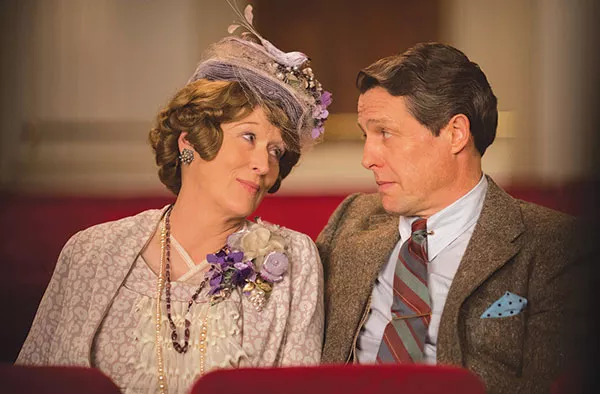
“Music is and has been my life,” avers Florence Foster Jenkins, a seventysomething New York City socialite. The real-life Jenkins, portrayed here with gusto by a padded and wrinkled-up Meryl Streep, dreams of singing. And so she does, for one memorable night at the Carnegie Hall in 1944.
The joke — which we already know — is that she is a catastrophically bad singer. In Florence Foster Jenkins, director Stephen Frears spins nearly two hours of light comedy out of Jenkins securing the Carnegie gig in spite of her lack of talent. Chiefly, her “husband,” a failed British actor named St. Clair Bayfield (Hugh Grant), keeps her in a protective bubble of praise, while paying off patrons, vocal coaches and press.
Frears builds slowly to the film’s first big laugh, when we hear Jenkins sing. We’re joined by Jenkins’ eager new piano accompanist, Cosme McMoon (Simon Helberg), who about has a nervous breakdown when the caterwauling begins. His bug-eyed reactions are expected, but not half as funny as Grant’s as he cycles through facial expressions bestowing warm praise on Florence and yes-I-know-but-keep-playing warnings to McMoon. Terrible singing is billed as this film’s entertainment, but it’s mugging among the leads that matters.
It’s a tragicomedy played quite broadly, with a darker angle that gets turned into heartwarming fluff: Is it really a kindness to perpetrate a falsehood upon a loved one? Florence makes the elaborate subterfuge seem like an act of true love, but left unchallenged is the cruelty of it (and the financial benefits, particularly for Bayfield). We can adore this vintage Florence while conveniently forgetting how much of today’s entertainment involves openly mocking the deluded and talentless (TV talent shows, viral videos, Trump’s campaign).
But Florence doesn’t demand deep thought — it’s a fine August diversion, if you don’t mind comedies on the slower, fustier side. And like all people blissfully convinced of their own greatness, Florence gets the last word: “People may say I can’t sing, but no one can ever say I didn’t sing.”
This article appears in Aug 17-23, 2016.






It is both alarming and heart-rending to recognize what we’ve morphed into over the last several decades. TV shows soliciting cheap laughs by ridiculing those of us who might be somewhat different or eccentric or even a bit self-deluded now abound. Think Two and A Half Men, or The Big Bang Theory or American Idol for starters. The sort of programming devoted to, as you say, “openly mocking the deluded and talentless.”
Yet you have no difficulty praising a film devoted to precisely that sort of thing, someone’s idea of a “delightful comedy” based on the very very sad story of pathetic Florence Foster Jenkins, an easily manipulated innocent, cruelly mocked by the sort of people who’d probably have enthusiastically cheered at those Roman festivals where Christians were fed to the lions. I’m sorry but I have no desire to watch such a spectacle. I’ve heard recordings of her singing and it’s no worse than what comes out of the mouths of the great majority of would be “rock stars” of our own era. What a heartless, bitter and cruel society we’ve become.