

Deprecated: mb_convert_encoding(): Handling HTML entities via mbstring is deprecated; use htmlspecialchars, htmlentities, or mb_encode_numericentity/mb_decode_numericentity instead in /var/www/html/wp-content/plugins/super-cool-ad-inserter/inc/scaip-shortcode-inserter.php on line 37
[iamge-1]
Chatham Village is a paradoxical place. Tucked on the backside of Mount Washington, not so far from outward-looking Grandview Avenue, it still seems unfamiliar to most locals. “Where is it?” they ask — even while some out-of-towners purposefully visit and study it.
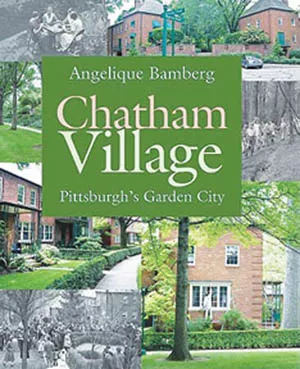
Among the latter was Angelique Bamberg, who arrived in 1997 as a Cornell University student with Chatham Village as the topic of her master’s thesis. For eight years, she was Pittsburgh’s preservation planner; she’s now an independent preservationist and consultant who teaches at Pitt. (She and husband Jason Roth are also City Paper‘s restaurant critics.) Bamberg’s new book, Chatham Village: America’s Garden City (University of Pittsburgh Press), is the first book on the complex.
“Why is this place so special?” people often ask. Chatham Village is, after all, an inward-focused grouping of 197 red-brick townhouses around common greenspaces, paths and gardens, with automobile traffic limited to the perimeter. It’s almost disarmingly peaceful — hardly the stuff of great dramas.
In 1931, the Buhl Foundation, led by Charles Fletcher Lewis, aimed to address the crisis in Pittsburgh housing, which was in short supply and of low quality. Lewis, a former editorial-writer for the Pittsburgh Sun, believed “physical and social planning solutions could help to address complex social problems,” Bamberg recounts.
His team included noted urban planners Clarence Stein and Henry Wright. Influenced by planner and utopian Ebenezer Howard, they also embraced advancing technologies and new economic practicalities, employing a limited-profit model. Ultimately, the complex met its (modest) financial goals, retained its tenants/owners and maintained its tidy design through eight decades.
Critics on the left cite the now-horrifying residency restrictions barring blacks, Jews and other minorities — rules eliminated by the Fair Housing Act of 1968. Critics on the right bemoan the limitations upon private ownership and profit that were necessary to make Chatham Village work. And the project served only a sliver of Pittsburgh’s middle class, without aiding needier groups. As some later low-cost housing shows, Chatham Village poorly imitated is as bad as Chatham Village ignored.
Bamberg’s history, though, is admirably lucid and thorough. Only a concluding discussion of the seemingly tangential New Urbanism movement seems out of place. Otherwise, the history is not a nostalgic yearning for imagined simplicity, but a recounting of the often-forgotten economic, social, topographical and architectural skills needed to create a housing complex that, though imperfect, has proven satisfactory and lasting.
This article appears in Sep 1-7, 2011.





I agree with the author of this article that Chatham Village is indeed a paradoxical place. Most people that I mention this architectural gem to, have never heard of it before and have no idea where it is. However, to those who seek it out, it is a beautiful enclave to behold. On one hand, I prefer that Chatham Village remain one of Pittsburgh’s best kept secrets, on the other, it is sad that more people don’t know about this unique and special place.
I initially found out about Chatham Village as a curious teenager perusing the reference section of my high school library back in the late 1970s. There was a copy of a pamphlet about Chatham Village and also an article about it that had been removed from an “Architecturel Record” magazine covering the story of its development and opening back in the 1930s. I remember being absolutely mesmerized by its charm and beauty just from reading about it and seeing it in photographs. I just knew that I had to see it in person and eventually did in the early 1980s after acquiring my first car. I found my way to Mt. Washington and parked my car just outside the perimeter of Chatham Village and then I spent a couple of hours canvassing the verdant environs of this oasis. I was captivated by the understated elegance of the Georgian architecture and how the architects and developers had beautifully ensconced these townhomes into the landscape. I returned several more times to visit Chatham Village over the years and the residents never seemed to mind.
Eventually I was able to see the inside of these lovely homes when I attended a tour and lecture about Chatham Village given by Mr. David Vater, an architect and longtime resident of this community. Over the years Mr. Vater has done several of these tours and I have attended most of them. I can never get enough of seeing it and would love to live there someday.
I am astonished at how well preserved Chatham Village is after 80 years. A vigorous adherence to yearly maintenance and the quality of materials it is constructed of, have been instrumental in maintaining the original exterior appearance of Chatham Village. Angelique Bamberg explores this and more in her fascinating new book. Of course I have a copy of my very own and will always cherish it. It has a special place in my architectural library. Thank you, Ms. Bamberg, for this fine book.