
Deprecated: mb_convert_encoding(): Handling HTML entities via mbstring is deprecated; use htmlspecialchars, htmlentities, or mb_encode_numericentity/mb_decode_numericentity instead in /var/www/html/wp-content/plugins/super-cool-ad-inserter/inc/scaip-shortcode-inserter.php on line 37
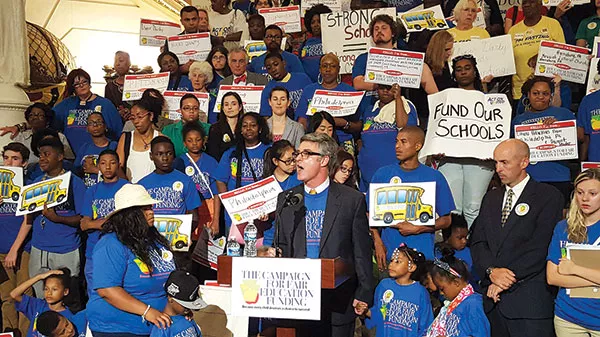
Montgomery County, Montour County, Northumberland County, Allegheny County and Philadelphia. Shoulder to shoulder, hundreds from across the state stood on the white steps of the rotunda of the Pennsylvania Capitol in the Harrisburg last week.
Clad mostly in blue T-shirts, the diverse crowd formed a backdrop with signs that read: “Fund Our Schools,” “All PA Kids Are Our Children,” “Strong Schools = Strong Communities” and “Every Baby Needs a Laptop.”
Among them were teachers and librarians, preschoolers and high schoolers, parents and recent graduates. Along with the line of speakers who graced the podium one by one, the riser of Pennsylvanians 10 rows high formed a patchwork quilt of concern.
“We are all here today because we have a problem in Pennsylvania,” said Susan Gobreski, executive director of Education Voters Pa. “That problem is that every child does not have access to an education that allows them to learn what we expect someone to learn to graduate from high school. Why? Because we are not providing it. The primary cause of this is unfair and insufficient funding, resulting in disparities in opportunity from community to community.”
At the June 23 rally in Harrisburg, hundreds called for a basic education funding formula that would ensure a transparent and equitable distribution of state funds to school districts.
Pennsylvania is one of only three states that does not use a funding formula to divvy up funds to school districts. As a result, the state has the widest gap in per-student funding between wealthy and poor districts. According to data from the National Center for Education Statistics, poor districts spend 33 percent less than wealthy districts across the state.
But there’s reason to be hopeful. Days before the rally, the Basic Education Funding Commission released recommendations for a funding formula that would take into account the student population and needs of each district.
“Just last week, the bipartisan Basic Education Funding Commission reached unanimous agreement on recommendations for a new funding formula,” says Patrick Dowd, executive director of Allies for Children, a local advocacy organization. “It is now time for all of our lawmakers to finish this work and enact a fair, sustainable and predictable public-school funding system that provides sufficient funding so every student has an opportunity to succeed.”
While many champion the commission’s efforts, others aren’t quite ready to celebrate. A more equitable funding formula will surely aid struggling districts, but some worry whether the state will be able to come up with the additional dollars necessary to even the scales.
“New dollars are going to have to be put into the system in order for the formula to have an effect,” says Dowd. “We think in order for basic education to be accurately funded, the state needs additional dollars.”
Funding in Pennsylvania hasn’t always been so disparate. During former Gov. Ed Rendell’s administration, the state had a basic education funding formula that granted a base level of funding to each district, and additional funding based on factors like the number of students living in poverty and population changes.
This formula was eliminated under former Gov. Tom Corbett. The current system allocates funding to districts without taking into account demographic changes from year to year.
“Pennsylvania’s funding system is broken. We don’t have a fair method of providing 500 school districts with funding,” says Dowd. “It’s not accurate. Currently, the state doesn’t even count kids in a school district. Everybody would agree you have to know how many kids are being served.”
For districts throughout the commonwealth, this disparity has manifested in different ways.
Librarians, air conditioning, smart boards, gym class, art class or a full-time music teacher are just some of the things school districts across the state say they are missing as a result of disparate education funding.
Nearly all school districts in the state have reduced staff in recent years. Half have furloughed teachers or other staff; 74 percent have eliminated or reduced one academic program or more; and 57 percent have increased class sizes.
Additionally, less than half of the 1.8 million students across the state have access to a school librarian. And only 3 percent of school libraries are funded at the recommended level.
On the buses traveling to Harrisburg last week were parents, teachers, and education advocates, each with a different story that illustrated how unequal and insufficient education funding has hurt their school district.
“When our district loses out, our kids lose out,” says Sara Nevels, a Pittsburgh mother of four, with two school-aged children. “My daughter is in classes with more than 30 kids.”
The road has been especially bumpy for Nevels and her children as they’ve bounced between public schools, charter schools and magnet schools. Two of her children are no longer in the school system. One finished without graduating and she now worries about the other two.
Nevels says additional funding should be allocated to help districts deal with unique populations like students with special needs.
“I’ve actually pulled them out of public school and put them in charter schools. They didn’t even have textbooks,” Nevels says. “The reason they were in charter [schools] is because the system failed my other two. They just didn’t get the support they needed.”
According to the Education Law Center, high-poverty public schools in Pennsylvania spend an annual average of $3,000 less per student than do wealthy schools. In boroughs like Wilkinsburg, the cost of disparate education funding is especially apparent.
While property taxes, which feed the school district’s budget, are high, the number of vacant properties in the area keeps the district’s coffers low.
“The taxes are just not there,” says Josie Bryant, a social worker who lives in the borough, and who also went on the bus trip. “You go down some of the blocks and every house is empty.”
Eighty percent of the district’s students live in poverty. According to data from the most recent U.S. Census, the median income for a Wilkinsburg family is $33,412.
“For some of these kids, that [education-funding] formula has the power to bring a district back to life,” says Bryant.
The new funding formula, currently proposed by the Basic Education Funding Commission, would allocate dollars based on factors like the number of students a district has, charter-school enrollment, the number of English-language-learning students and the percent of students living in poverty.
“Education finance is some of the most compelling and challenging area of public policy,” says state Sen. Pat Browne, a Republican who co-chairs the commission. “Compelling, because the people it serves, our state’s most valuable resources — our primary- and secondary-education students — and challenging because of the diversity of the state. But with this recommendation, I believe this commission has met its charge, on a unanimous basis, to promote more equity, fairness and sustainability in education finance.”
Putting dollars behind the new formula could prove to be less of a nonpartisan decision. For instance, education advocates are calling for a tax on Marcellus Shale to supplement the state’s budget.
“The status quo is unacceptable. I’ve toured schools across the state, and I’ve seen firsthand how massive cuts to education have left schools with fewer teachers and increased class sizes. Programs have been eliminated and families are hurting from huge property-tax increases,” Gov. Tom Wolf said in a statement. “Our schools are struggling. Yet, Pennsylvania is the only gas-producing state in the country without a severance tax. Texas does it. Oklahoma. North Dakota. Alaska. Louisiana. West Virginia. I’m proposing we do it. It’s time for gas companies to pay their fair share, so we can fix our schools. With a commonsense severance tax, my proposed budget makes historic investments in education at all levels.”
Republicans in the legislature, however, adamantly oppose such a measure. Even legislators who support a more equitable funding formula argue that natural-gas drillers already pay a form of tax through impact fees, which totaled $223.5 million in 2014. They worry additional taxes could lead drillers to leave Pennsylvania, and argue that the amount of funding the state devotes to education is adequate.
“Pennsylvania stacks up pretty well in terms of funding for education,” says Charlie O’Neill, legislative director for state Sen. Randy Vulakovich (R-Shaler), who met with a group of parents and activists following the rally last week. “The problem is, it’s not being evenly distributed.”
Education advocates disagree. On June 27, the Pennsylvania House of Representatives passed a $30.1 billion budget proposal that critics say does not include enough funding for education to restore cuts made under the Corbett administration.
The budget includes an $8 million increase in education funding, $400 million short of what several organizations who are part of the Campaign for Fair Education funding have called for. According to a statement, Gov. Wolf says he would veto the bill.
“While there is progress in the legislature on moving forward a fair education-funding formula, no formula will work without the necessary resources,” says Charlie Lyons, spokesperson for the Campaign. “That must start with an investment of at least $410 million to help restore past funding cuts, targeted at bringing districts back to the 2010 funding level as base year — and to begin implementation of the new funding formula as unanimously adopted by the Basic Education Funding Commission.”
This article appears in Jul 1-7, 2015.