
Deprecated: mb_convert_encoding(): Handling HTML entities via mbstring is deprecated; use htmlspecialchars, htmlentities, or mb_encode_numericentity/mb_decode_numericentity instead in /var/www/html/wp-content/plugins/super-cool-ad-inserter/inc/scaip-shortcode-inserter.php on line 37
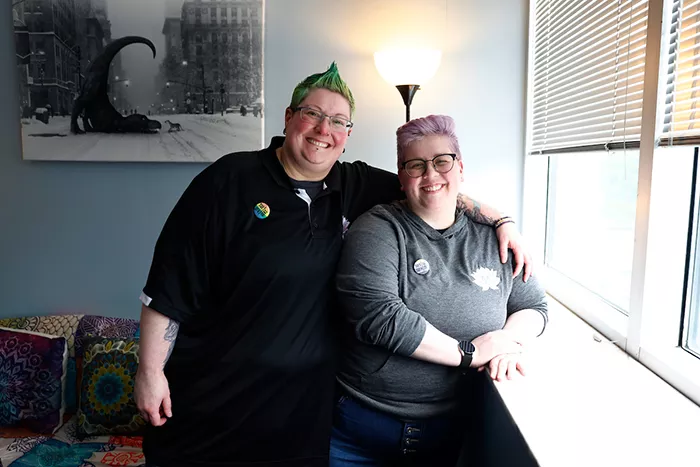
Meggan Hudspeth had been working in the community mental health field for 15 years and was feeling frustrated by the limitations of their professional role. Interested in holistic healing, Meggan says they wanted to find a way to connect with clients more deeply, noting that there are “lots of restrictions” in what they were able to do as a case manager. Instead, they wanted to incorporate activities they enjoy, like yoga, into the more traditional talk-therapeutic context.
“I enjoy learning about how we hold emotions in our body,” Meggan adds. “We stay stagnant if we’re not moving.”
Meggan, a certified yoga therapist, is half of Meet Me In the Middle Counseling, which they run with their wife, Brittany Hudspeth, out of Wilkins Township, just east of Pittsburgh. Brittany was a therapist first, and it was she who suggested that Meggan make the switch from case management.
“There aren’t a lot of LGBTQIA therapists in Pittsburgh,” Meggan says, “and I wanted to do more for the community.”
Meggan was inspired by the work Brittany was doing. “I mean I’m biased, but my wife is the best,” Meggan adds. “She’s a confident queer person, and it’s easy to be confident in your own skin around her because she’s so accepting.”
This includes Brittany coming out as nonbinary 10 years into their marriage. Now, Brittany often works with trans adults who are in the midst of transition, or who have been out, while the majority of Meggan’s work is with trans teens.
“Working with a teen is great,” Meggan says, “but putting them back in the environment that is maybe not so supportive as the hour I spend with them is hard.”
Meggan tries to help teens set and keep boundaries with their parents, often doing work to help parents understand what it is to be trans or nonbinary while making sure to “always get permission from the kid” about what to tell the parents.
“With teens, it’s a nice connection” as a nonbinary therapist, Meggan adds. “They always ask about coming out,” and Meggan says they’re happy to share about their experience growing up in a small town without much queer or trans representation, and of coming out late in life and doing self-work.
“It’s all fluid,” Meggan says. “If it doesn’t fit, or starts to feel uncomfortable or damaging, what else might fit in that space?” But while Meggan says they try to give clients an hour of freedom and an honest, accepting connection, they are quick to note that structural support is lacking.
Many of the teens they work with live in rural Wesmoreland, Fayette, or Butler counties, a far distance from support services, especially for those seeking medical transition. And parents aren’t always on board. Plus, while Meggan says their former field in community mental health “was not always the most accepting” of queer people, they acknowledge those services were affordable and accessible to people insured by Medicare or Medicaid.
As a licensed mental health professional, Meggan notes, they are unable to accept that insurance. Trans adults, however, are more than four times more likely than the cis population to be living below the poverty line, according to a report by the Movement Advancement Project, and Black and Latino trans people are one-and-a-half times as likely to qualify for Medicaid as white trans people.
Even for trans therapists with a professional degree, things are not always easy. Izzy, 30, who requested their last name be withheld, describes a culture of genteel transphobia and anti-Blackness inside the MSW program from which they recently graduated.
“I’m seen as unprofessional because of how I look, what my life is like,” they say.
Izzy describes the paradox of objectification they experienced in their clinical placements where, despite not being the only trans therapist on staff, they found “expertise projected onto me once I was visibly trans — white, straight sized, on T,” but that their projected expertise was also routinely dismissed.
“There’s this feeling of salivating, an almost sadistic desire” from cis clinicians “to get to know” about trans clients “that’s totally disconnected from what the human person in front of you needs,” they add. Izzy describes “detransition shit, overstatement of medical regret, and fear of litigation” as reasons they’ve witnessed clinicians deny and delay supporting trans clients in seeking medical transition.
But the assessments don’t stop with cis therapists.
“One of the criticisms that’s often levied against someone working in their own community is the critique of overidentification with the patient,” Izzy says. “It’s hard to access some of the depth of feeling of sameness and difference in transness. ‘Are you my client? Are you my family?’ Even speaking some of those really important beautiful feelings could create a situation with a supervisor that’s inappropriate.”
Izzy describes a particular wariness in working with young people due to living in a culture that often characterizes queer and trans people as predators and violators. And yet, they also describe working with young people who share their identities as a profoundly moving and worthwhile experience, while emphasizing that even the best therapeutic relationship is not the same as material support.
Izzy says they initially went looking for a therapist themself to access a letter for top surgery and then found the therapeutic relationship beneficial enough to stay.
“I think, in the beginning, I was so disconnected from my body and my experience, all I knew was that I needed to get my tits off to make it through the day,” they say. “I was lucky that I was able to have a therapist who could balance, ‘You need this thing and this could be a space for other things but it doesn’t have to be.’”
Meet Me in the Middle Counseling. 300 Penn Center Blvd., Wilkins Twsp. meetmeinthemiddlecounseling.com
This article appears in Jun 1-7, 2022.