
Deprecated: mb_convert_encoding(): Handling HTML entities via mbstring is deprecated; use htmlspecialchars, htmlentities, or mb_encode_numericentity/mb_decode_numericentity instead in /var/www/html/wp-content/plugins/super-cool-ad-inserter/inc/scaip-shortcode-inserter.php on line 37
There is still time for you to visit She Who Tells A Story: Women Photographers from Iran and the Arab World more than once. This is good, because this is one of the most important and imperative exhibitions on view of late, and not only deserves your complete attention but deserves it multiple times.
The touring show was curated in 2013 by Kristen Gresh for the Museum of Fine Art in Boston. In many of the numerous works on exhibit, the subject of the story is female, with images exploring their lives, difficulties, hopes, obstacles and happiness. In all instances, the storyteller is female; there are dozen artists in all, each with a woman’s eye peering through her lens to preserve, within a frame and an embrace, the world surrounding her — worlds including Iran, Iraq, Morocco, Yemen, Jordan, Egypt, Palestine and Lebanon.
Gazing upon their images from a city in the West, we might at first fall to sweeping generalizations and stereotypes that have crossed one border after another. What each world means to each exhibitor as a woman and as an artist — and what she means within it — varies from nation to nation, and this collection aptly demonstrates the differences in circumstance, whether from a documentary or a creative perspective.
This is all significant, whether culturally, societally or interpreted with a bias toward gender politics. But what makes this exhibition required viewing goes beyond the political. The images displayed are stirring, stunning, lush, humorous, evocative, disturbing and revelatory, even if viewers disregard any of the weight attached to who has captured them.
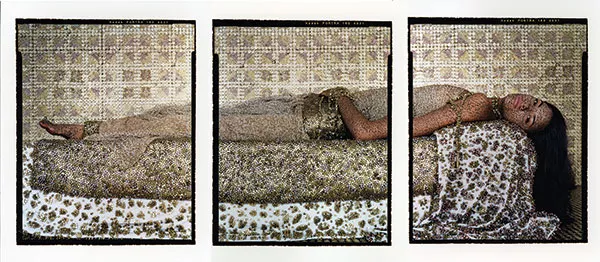
Lalla Essaydi’s “Bullets Revisited #3” is the most immediately arresting work, grabbing your attention from across the vast expanse of the gallery and commanding that you come closer. This larger-than-life triptych introduces a beautiful young woman lying on a platform, in neutral repose, her hair cascading over the edges and her head turned to face the viewer with an open and unwavering regard. Her skin is covered with calligraphy, as is the sheet that covers her; in other works, Essaydi has decorated flesh, fabric and paper with this writing, traditionally an art permitted only to men. The photo’s subject is also surrounded with glittering, shimmering metallic elements, which at first appear to be jewelry or precious ornaments, but which upon closer inspection are revealed to be bullet casings. Essaydi weighs freedom, protection and oppression with choices of materials and embellishment, and creates something spellbinding.
Newsha Tavakolian of Iran offers perhaps the most heartbreakingly lovely, and just plain heartbreaking, collection within the exhibition. Her subjects are Iranian singers who, due to Islamic law, are prohibited from recording albums or singing in public, quieted. In the series Listen, she imagines them not confined to silence. Covers from albums never recorded show them standing immovable in the surf, or in the street with boxing gloves. Performance stills with backdrops of glittery curtains style them with mouths open, eyes closed, brimming with emotion at the height of expression. A series of videos in which they silently lip-sync with repression is almost too painful to watch. Though they remain soundless, we can almost hear their voices in our heads.
Yemen-born Boushra Almutawakel’s entry is the powerfully simple series of portraits, Woman, Daughter, Doll, in which a family is identically posed. The change in each progressive image is not in the sitters themselves, but in what covers them. At first, they’re in colorful, vibrant clothing. Bit by bit, this is replaced with scarves, shawls, pieces of fabric, all coal black. The garments first cover their bodies fully, then their faces, then finally obscure them entirely. By the final picture, we can’t even be certain they’re underneath.
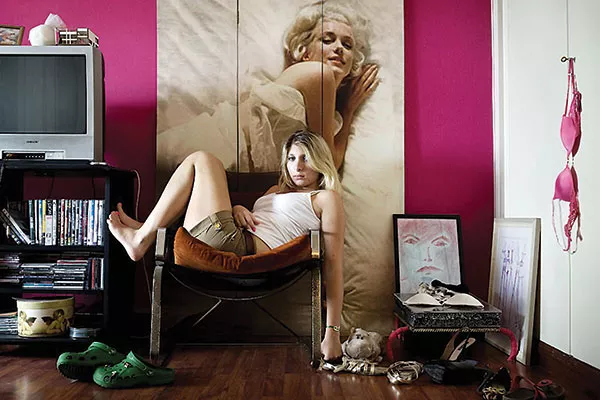
Tehran-based Gohar Dashti photographs elaborately staged and styled domestic scenes transported to battlefields, featuring a pair of newlyweds attempting to navigate their lives together within the context of their environment, owning what they control within a landscape that is uncontrollable. They sit for meal and prayer amidst a sea of empty, abandoned helmets; they take tea and calls as a tank looms behind; they watch television behind a wall of sandbags. They seem at peace, but simultaneously on hold, as if the peace of the present were not to be trusted to continue into the next moment: briefly at rest, but always concurrently at the ready.
This is but a handful of the artists represented, though all of the work is worthy of lauding, and all of it takes turns resonating in the memory of the viewer, who is likely to feel compelled to go see it all again. Other artists in the show include: Jananne Al-Ani, Rana El Nemr, Shadi Ghadirian, Tanya Habjouqa, Rula Halawani, Nermine Hammam, Rania Matar and Shirin Neshat.
This is an exhibition of works by women from a very specific geographic area, one that we as Westerners tend to believe limits women’s voices and expression, with the implication that this doesn’t happen elsewhere. But if we do focus on She Who Tells a Story as the work of women, and on the under-representation of women’s voices, we can’t relegate that under-representation to the countries highlighted on the map on this gallery wall. The voices we hear telling stories here at home — visual artists, novelists, playwrights, screenwriters, essayists, you name it — are predominantly male as well. It is not potentially dangerous for a female to speak her piece here, as it can be in other parts of the world. But the fact that a woman is not forbidden to speak does not mean that she will have a chance to be heard. It doesn’t mean that anyone’s listening.
If you have a daughter, this show is essential viewing not only for what it is in and of itself, but as a means to explore the position of women as storytellers. If you are a woman, will grow to be a woman, will become a woman or know a woman, the same applies.
This article appears in Aug 19-25, 2015.