
Deprecated: mb_convert_encoding(): Handling HTML entities via mbstring is deprecated; use htmlspecialchars, htmlentities, or mb_encode_numericentity/mb_decode_numericentity instead in /var/www/html/wp-content/plugins/super-cool-ad-inserter/inc/scaip-shortcode-inserter.php on line 37
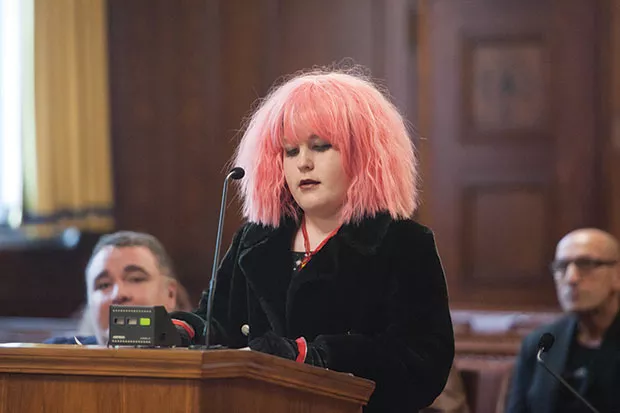
Last week, on the same day the British island territory of Bermuda revoked same-sex marriage rights for its citizens, a dozen people went to Pittsburgh City Council to speak in support of legalizing drag performances.
Among the attendees was Max Busch, an 11-year-old drag artist from Mount Lebanon who performs under the name Honey Chuckles.
“I just want to say that drag is for everyone,” said Busch. “Drag is art. Art is what you choose to show about yourself and reveal truth.”
Under Pittsburgh’s current zoning code, drag performances are included in the category of adult cabaret which is relegated to specific areas of the city. Those in the drag community say placing drag in this category is limiting. The city ordinance currently being proposed would eliminate the words “male or female impersonators” from the code. And as a result, drag artists would be given more latitude to perform throughout the city.
“When you change this law, you will help end bias against this community,” Busch said. “You will allow space for me to perform and to see other artists. You will help end dangerous, untrue ideas about gender. Drag is part of the culture, history, politics and art of the LGBTQIA+ community. Drag is important.”
Amending the law is largely a symbolic gesture; the code hasn’t been enforced in recent years. But for members of the drag community, city council’s action signals greater acceptance of drag performers and the LGBTQ community as a whole.
“As other members of council have said, this was a very easy thing for us,” Council President Bruce Kraus said at the Feb. 8 public hearing, before praising Busch for his testimony. “I was impressed by your courage. … It took a lot of courage for you to come out today and speak for who you are, what you believe in and what you are passionate about.”
The change is part of ongoing efforts to expand drag beyond the bar scene and into the mainstream. Members of the drag community want to make drag more accessible for children and teens like Busch who are often barred from nightlife venues. They say it’s important for younger drag performers and those exploring gender expression to see people whom they can relate to.
“Not being able to do this in places outside of bars makes it really hard for trans kids and kids exploring their gender to have a place to do that and to see people who are like them — other drag queens and drag kings,” says Kitt Kavanaugh, a local drag king. “A lot of the drag community is in bars. We’re trying to pull drag out of bars, so it’s more welcoming and more accessible, so other folks can see it, like kids and teens.”
Under Pittsburgh’s zoning code, drafted in 1958, adult cabaret is only allowed to take place in “urban industrial” areas. This includes areas like the Strip District, home to venues that host drag performances regularly.
Under the current code, adult cabaret is defined as “a cabaret which features topless dancers, go-go dancers, exotic dancers, strippers, male or female impersonators, or similar entertainers which characterize an emphasis on matter depicting, describing or relating to specified sexual activities or specified anatomical areas as defined herein.” But advocates say drag differs from some of the other performance genres included in the definition.
“We applaud city council and the mayor for updating language in our zoning code that hasn’t been changed since the 1950s, a time when the American public began to really crack down on the LGBT community,” said Gary Van Horn, president of the Delta Foundation of Pittsburgh, an LGBTQ advocacy organization, at last week’s public hearing.
Van Horn presented council with a petition signed by more than 300 people supporting the change. He said that although drag performances have gone on largely unimpeded in Pittsburgh in recent years, it’s important for the policy to be put in writing.
“While hearts and minds continue to change, those that hate, and even despise, the LGBT community are more determined than ever. They see that we are winning the fight for equality. We are more comfortable telling our stories, and at the end of the day, people are understanding that we just want to love who we want to love. And really, this world could use a little more love,” Van Horn said. “While strides have been made, our fight is far from over. In Portland, Tennessee, they are trying to do an outright ban on drag shows. We must continue to fight the fight, tell our stories, and remove any law that would discriminate against a community that has been marginalized for way too long.”
Last year, legislators in Portland, Tenn. put forth an ordinance aimed at prohibiting drag shows in the city. Like Pittsburgh, that ordinance would have listed male and female impersonators under the category of “adult cabaret.” According to the American Civil Liberties Union, the ordinance “sought to define male or female impersonation as inherently erotic in order to regulate it as adult entertainment and effectively zone drag shows out of existence in Portland.”
After the ACLU intervened on behalf of the local drag community, the ordinance that eventually passed clarified that “adult cabarets are businesses that offer erotic entertainment with the performers exposing certain anatomical areas.” The ACLU says this criterion doesn’t apply to drag performers.
But despite changes to the ordinance, the controversy was enough to stifle Portland’s drag community. Just last week, Elite Productions, the company responsible for hosting drag shows in Portland, announced it would be moving its shows to the nearby town of Gallatin.
This is exactly what Pittsburgh advocates want to avoid.
“It’s ridiculous to try to tell adults that you can’t perform your art because of some preconceived idea of what it represents,” says Ace Phoenix, a local performer. “People don’t understand the importance of the art and what the art means to performers and people who understand it.
“We need to stay together to see all kinds of gender performance and queer performance supported in the city of Pittsburgh.”
According to the Human Rights Campaign, a national LGBTQ advocacy organization, 26 percent of LGBTQ youth say their biggest problems are not feeling accepted by their family, being bullied at school and fear of being out or open. And LGBTQ youth are twice as likely as their peers to say they have been physically assaulted, kicked or shoved at school.
Additionally, four in 10 LGBTQ youth say the community they live in is not accepting of LGBTQ people. And 92 of LGBTQ youth say they hear negative messages about being LBGTQ. The top sources are school, the internet and their peers.
Advocates say changing the city’s code will help to eliminate stigma around the LGBTQ community.
“If it’s not changed, it could cause problems for people who own certain venues where drag is performed,” says Kavanaugh, who has been performing drag in the city for more than three years. “It’s outdated and needs to be changed. It’s something that’s concerning to us because even though it hasn’t been enforced, it always could be enforced. It’s not something that should be in the code, because it’s not something that’s wrong.”
Kavanaugh says it’s inaccurate to view drag as an adult or sexual art form. For practitioners, drag is about performing and exploring gender expression.
“I’ve always been a very performative person, but [I] always wanted to do the guy roles and I finally found something I was able to do that in,” Kavanaugh says. “I really love the community here. I’ve gone through my own gender journey doing drag and felt really comfortable doing that here. I’ve felt very supported. I like being able to show who I am, and getting to show folks who might be struggling, that there’s people like them.
“I always go in drag at Pride, because you never know who’s going to see you and think, ‘It’s good that there’s people out there like me.’”
This article appears in Feb 14-20, 2018.