

Deprecated: mb_convert_encoding(): Handling HTML entities via mbstring is deprecated; use htmlspecialchars, htmlentities, or mb_encode_numericentity/mb_decode_numericentity instead in /var/www/html/wp-content/plugins/super-cool-ad-inserter/inc/scaip-shortcode-inserter.php on line 37
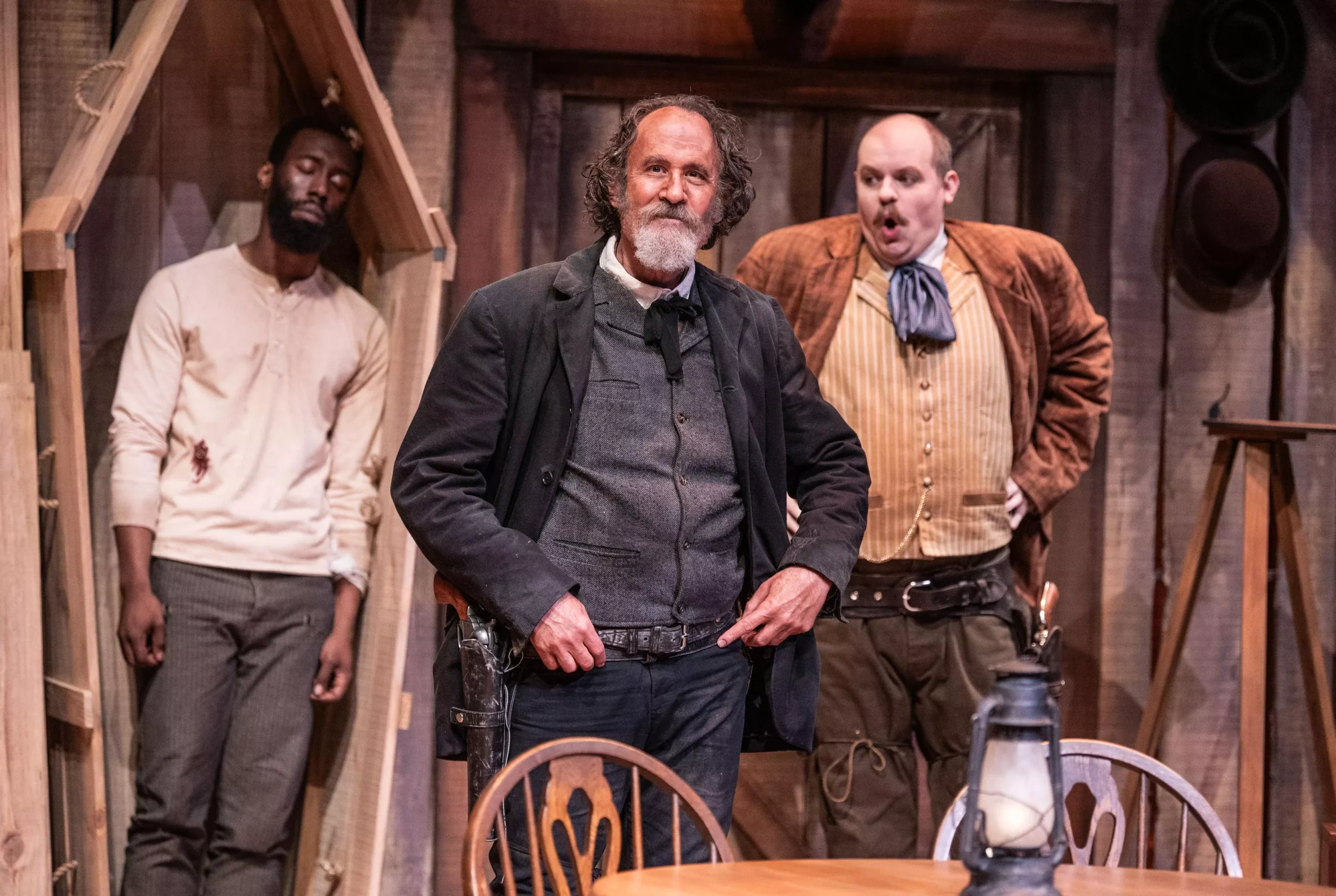
In Pittsburgh Public Theater’s description of the world premiere of Mark Clayton Southers’ new play The Coffin Maker (now showing at the O’Reilly Theater until June 16th), they warn that this play is intended for adult audiences. Set in Oklahoma in 1849, the play tells the story of a mixed-status couple (the wife is still enslaved) who work together to respectfully prepare bodies for burial. Their lives are turned upside down, though, when a bounty hunter brings in the (ostensibly dead) body of a fugitive runaway slave who has taken it upon himself to avenge his father’s violent death.
Indeed, PPT says, “The Coffin Maker dramatizes circumstances, characters, and themes inspired by true events from American history.” Given America’s history of slavery, this means that the play contains “adult situations, explicit language, racial slurs, depiction of death, violence, the use of prop guns, and depiction of blood on the stage.”
It is not surprising that Southers, who was mentored by August Wilson, does not sugarcoat the realities of slavery. The overarching theme of the play, after all, is a commentary on what kinds of vengeance and violence are justified in light of American slavery. What did (pleasantly) surprise me, however, was his treatment of sex workers.
While there are no sex workers in the small cast of five, sex work and sex workers play an integral role in the plot, in both large and small ways. The first mention of a sex worker comes from Lawrence Ebitt, the coffin maker himself, who early on — in talking about the importance of giving folks a proper burial — comments that he has buried all kinds of folks, including one of the most well-known whores in their town.
At first blush, it would seem that the role of the whore in this instance is a way of demonstrating how compassionate Ebitt and his wife are, and how seriously they take their work. After all, in a more modern context, it has been common practice for police to unofficially use the acronym NHI (No Humans Involved) to justify not investigating the murder of sex workers (and other folks deemed unimportant). Moreover, you don’t have to look too hard at our media landscape to know that “dead hooker” tropes abound, and they always work to dehumanize sex workers. Southers could have used Ebitt’s respectful burial of her as a way of demonstrating the character’s moral superiority.
In the play, though, Ebitt goes out of his way to demonstrate that’s not what he’s doing. Right after saying that he buried her, he goes on to describe it as one of the most elaborate burials he’s done, commenting something like, “And why not? After all, she gave a lot of people joy.” Rather than dehumanizing the “dead hooker” he buried, he works to characterize her as someone who brings joy into the world. Not just pleasure, but joy.
More integral to the plot is another sex worker, who plays no small role in saving the fugitive’s life. As mentioned earlier, the bounty hunter brings the fugitive’s body into the couple’s workshop, a body he believes to be dead. Indeed, the fugitive (this character has no name) is unconscious and has a bloody shirt from what the bounty hunter thinks is a gunshot wound he inflicted. We learn when the fugitive awakens, though (apologies for the spoilers), that under his shirt is a bulletproof vest.
He was shot, but he injured. The blood? The fugitive casually explains that he was shot at the brothel, where moments earlier he was having sex with one of the workers when she unexpectedly started menstruating. The blood was not his — it was hers!
The use of menstrual blood as a plot device is interesting enough on its own. Certainly, there could have been any number of explanations for why he had blood on his shirt; they were, after all, in the Wild West. But the fugitive doesn’t leave it at that. Instead, he goes on to talk more about their encounter. He tells the coffin-making couple that when she realized she was bleeding she was embarrassed, but that he assured her it wasn’t a big deal.
While I am not usually one to praise men for granting the most basic consideration to women when choosing to have sex with them, I do think this commentary is significant in this case. In a story that is about the fugitive’s own life and death — about being hunted down and shot by a bounty hunter — Southers ensures the character takes time to humanize the whore he was having sex with right before he is shot. He makes sure to normalize not only his relationship with her in the matter-of-factness with which he tells the story, but also the reality of having sex with women who can’t always predict or control their menstrual flow.
This story is told from the perspective of someone who doesn’t stigmatize sex work, but who instead understands that the relationship between sex workers and their clients is as real and normal as any other sexual relationship. Indeed, as I watched the play, I was reminded of the time I was in a fancy hotel room and looked down at my client to see that he had blood all over his face. This was particularly surprising to me given that I rarely menstruate — I’ve spent more than 20 years of my adult life with IUDs that stop my periods. Like the fugitive, my client wiped his face off and told me it was no big deal, and we went on to enjoy the rest of our time together.
It would have been easy for Southers to tell this story without mentioning sex work at all. It is a story about slavery, vengeance, and liberation. There are all kinds of “undesirable” folks the Ebitts could have buried, and certainly, there are lots of ways to soil a shirt with blood. And yet, in both cases, Southers takes the opportunity to humanize sex workers. Instead of using a dead sex worker as a throwaway character, she is granted dignity. And the feelings of an off-stage sex worker become center stage as the fugitive talks about caring for her rather than shaming her.
As I watched the play I was reminded of the oft-cited mantra that you cannot have liberation for one unless there is liberation for all. This is ultimately a play about liberation from slavery, and that is of course the central theme. But it should not go unnoticed that, in not-so-subtle ways, liberating sex workers from shame and stigma is also a part of that story.
Jessie Sage (she/her) is a Pittsburgh-based sex worker and writer. Her freelance writing has appeared in a variety of publications including TheWashington Post, Men’s Health, VICE, The Daily Beast, BuzzFeed, Hustler Magazine, and more. At the beginning of 2024 she launched a new podcast: When We’re Not Hustling: Sex Workers Talking About Everything But. You can find Jessie on Twitter @sapiotextual & Instagram @curvaceous_sage. You can follow her new podcast on Twitter & Instagram @NotHustlingPod. You can also visit her website jessiesage.com.
This article appears in Jun 5-11, 2024.