
Deprecated: mb_convert_encoding(): Handling HTML entities via mbstring is deprecated; use htmlspecialchars, htmlentities, or mb_encode_numericentity/mb_decode_numericentity instead in /var/www/html/wp-content/plugins/super-cool-ad-inserter/inc/scaip-shortcode-inserter.php on line 37
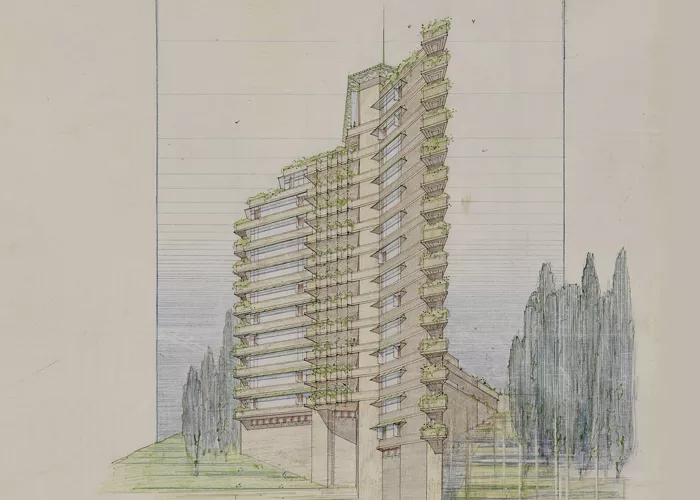
A UFO-shaped civic center looming over the Point. A towering apartment building atop a wooded ridge. A fully-automated parking garage hulking next to Kaufmann’s. These are just some of the visions Frank Lloyd Wright had for Southwestern Pennsylvania in the later years of his career, and a new exhibition brings these visions to life with a combination of animation, architectural drawings, and 3-D modeling.
Co-organized with Fallingwater, Frank Lloyd Wright’s Southwestern Pennsylvania explores never-built projects that would have irrevocably altered the local landscape — for good or for ill.
“This exhibition celebrates the genius of Frank Lloyd Wright’s design in a new and approachable way, but it also asks visitors to question how these projects might have changed the Pittsburgh region as we know it, for better or for worse,” Justin Gunther, Fallingwater Director and Western Pennsylvania Conservancy Vice President, said in a press release.
The exhibition was four years in planning and gives visitors a deep look at the full breadth of Wright’s genius and ambition.
Much of Wright’s work is characterized by harmony with nature. Both Fallingwater, built in 1935, and nearby Kentuck Knob, built between 1953 and 1956, seem almost to emerge from wooded hillsides with their rough-hewn stonework and low-slung shapes. The 1957 Duncan House, another Wright design that was built in Chicago and reassembled in Polymath Park, also fits these criteria.
But Wright wasn’t afraid to dream big. In one example, he planned a mile-high skyscraper for what’s now Chicago’s Millennium Park. His utopian — or dystopian — vision for the confluence of the Allegheny and Monongahela shares this idealist approach.
Just as the Civic Arena required the destruction of a vibrant neighborhood, Wright’s Point Park Civic Center would have remade the Point into a blocks-wide, car-centric hub that feels out of proportion with its surroundings. His Kaufmann’s garage would have similarly required the leveling of a large swath of Pittsburgh’s Firstside (and thus Pittsburgh City Paper‘s current newsroom). Given the fate of the Arena and other projects such as Penn Circle and Allegheny Center, it’s hard to imagine these grand visions aging well.
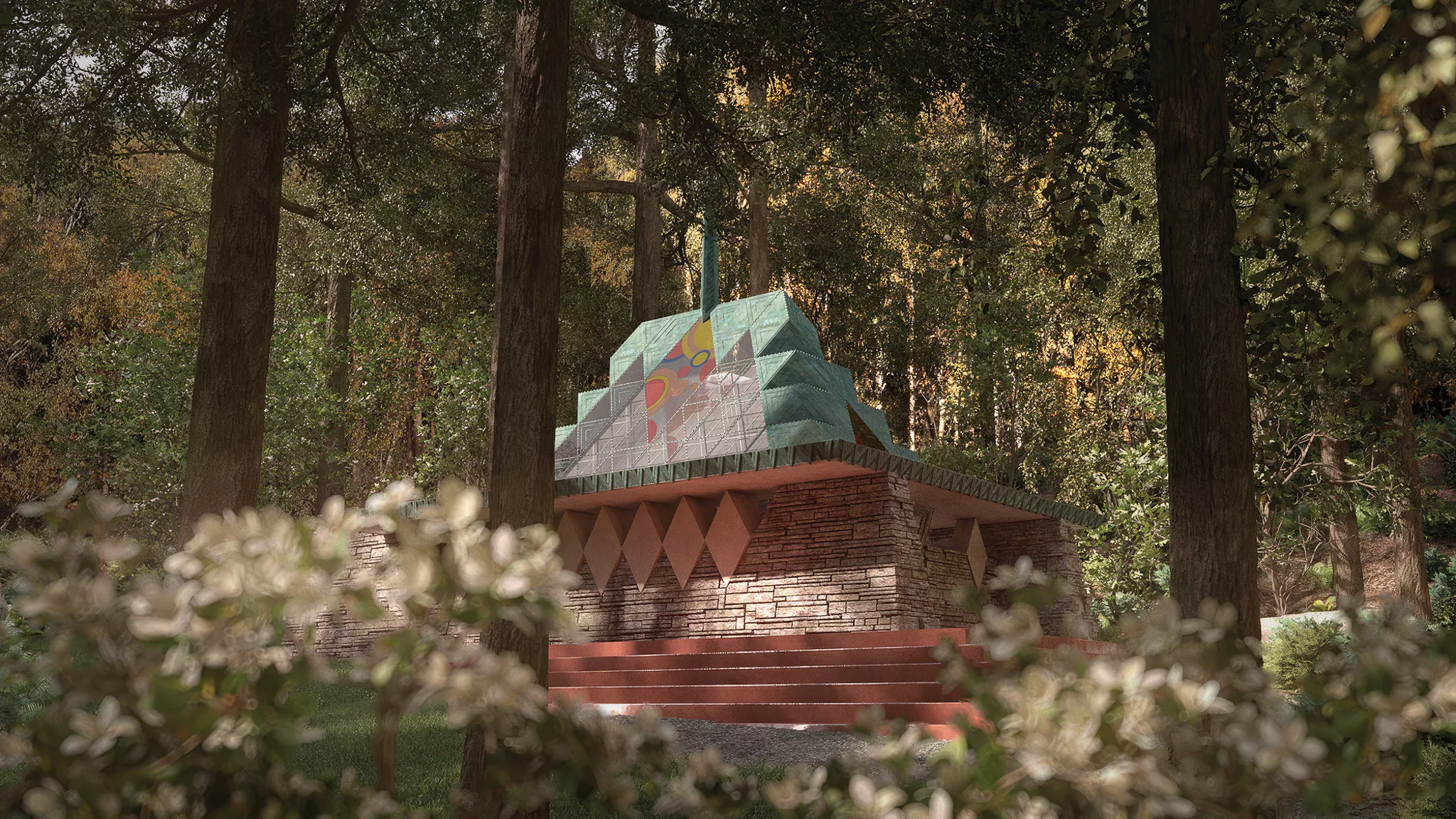
Not all of Wright’s dreams for the region were so sweeping. His never-realized Rhododendron Chapel, presented at Fallingwater’s visitor center, would have been a jewel-toned tribute to Pennsylvania vegetation. But the Kaufmann family, for whom Wright designed the chapel, had the idealism and deep pockets necessary to fuel Wright’s more aspirational side. The exhibition explores Wright’s relationship with patrons such as the Kaufmanns and organizations such as the Allegheny Conference.
It also places Wright’s legacy in contemporary context. An adjacent exhibition in the Westmoreland’s Paneled Rooms, Toshiko Mori & Frank Lloyd Wright: Dialogue in Details, uses half-scale models to showcase the dialogue between Wright’s Martin House and Mori’s Greatbatch Pavilion in Buffalo, N.Y.
“Dialogue in Details is an exhibition that asks: what about the past should we be carrying forward, and what about that past should we leave behind? In the times in which we find ourselves, Toshiko Mori’s project feels more relevant than ever,” Jeremiah William McCarthy, the Westmoreland’s chief curator, said in a statement.
Like other artists, Wright has come under scrutiny in recent years for his chauvinism. Frank Lloyd Wright’s Southwestern Pennsylvania explores this tension between the original starchitect’s bombastic side and his pastoralism by presenting both in full color. Models offer viewers a glimpse at the profound impact Wright might have had on Pittsburgh, and animations by Skyline Ink showcase smaller details of Wright’s big plans to a score produced by MCG Jazz.
These realizations provide insights into the ways Wright was both a forward-thinking and overly zealous shaper of the urban landscape, particularly when viewed through the lens of 21st-century city planning. The juxtaposition of old and new is appropriately staged in the Westmoreland’s Cantilever Galleries, which jut out from the museum’s more staid original building.
Wright had an indelible impact on Southwestern Pennsylvania, and it’s fascinating to consider the much bigger impact he might have made. Visitors can see for themselves through the end of the year at Fallingwater and through Jan. 14, 2024 at the Westmoreland, which is planning a slate of special events in Greensburg, including special tours, gallery talks, and a “culinary event” inspired by longtime Fallingwater chef Elsie Henderson.
Frank Lloyd Wright’s Southwestern Pennsylvania opens at the Westmoreland Museum of American Art and Fallingwater’s Speyer Gallery Sun., Oct. 15. 221 N Main St., Greensburg. thewestmoreland.org. 1491 Mill Run Road, Mill Run. fallingwater.org
This article appears in Oct 4-10, 2023.