
Deprecated: mb_convert_encoding(): Handling HTML entities via mbstring is deprecated; use htmlspecialchars, htmlentities, or mb_encode_numericentity/mb_decode_numericentity instead in /var/www/html/wp-content/plugins/super-cool-ad-inserter/inc/scaip-shortcode-inserter.php on line 37
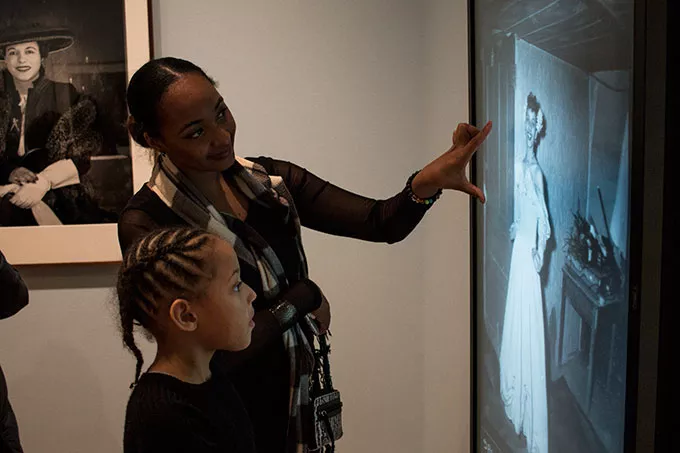
In Sharp Focus, the new Charles “Teenie” Harris gallery at the Carnegie Museum of Art (CMOA), is not the first time the iconic photographer’s work has been shown in Pittsburgh, but it’s likely the most comprehensive. Thanks to an interactive touchscreen installation designed in partnership with faculty and students at the Frank-Ratchye STUDIO for Creative Inquiry, the research laboratory at the Carnegie Mellon University (CMU) School of Fine Arts, visitors can browse through roughly 60,000 images from Harris’ archives.
The recently unveiled technology is the result of a years-long collaboration between CMU and CMOA to make searchable Harris’ vast collection, which covers his work as a photojournalist for The Pittsburgh Courier, as a portrait artist working in his own studio, and as a documentarian of life for Black Pittsburghers in the 20th century. Using the large main installation screen, as well as two iPads, the newly installed permanent gallery gives museum visitors access to a majority of CMOA’s Harris archive of 80,000 photos, spanning from the 1930s up through the 1970s.
CMU School of Art professor and Frank-Ratchye STUDIO director Golan Levin, believes the project — made possible in part by a National Endowment of the Humanities grant — is an important development for the archive, which was acquired by CMOA in 2001 and has since been in the process of being scanned and cataloged.
“[The images] were not in particularly good order, they were sort of shuffled … and they were also not labeled very well,” says Levin.
Levin says the installation started four years ago as part of a class he was teaching at CMU. He and his students needed to visualize a large database of images, so fellow principal investigator David Newbury, and then-CMOA curator Lulu Lippincott, got permission to access the vast Harris archive. From there, students used machine learning, facial recognition tools, and other technology to better organize the collection and enable users to search based on a number of factors, from the approximate year an image was taken to specific visual details such as the number of people pictured and luminosity.
The complementary iPads were designed to search for images based on certain tags, such as “baseball” or “wedding.”
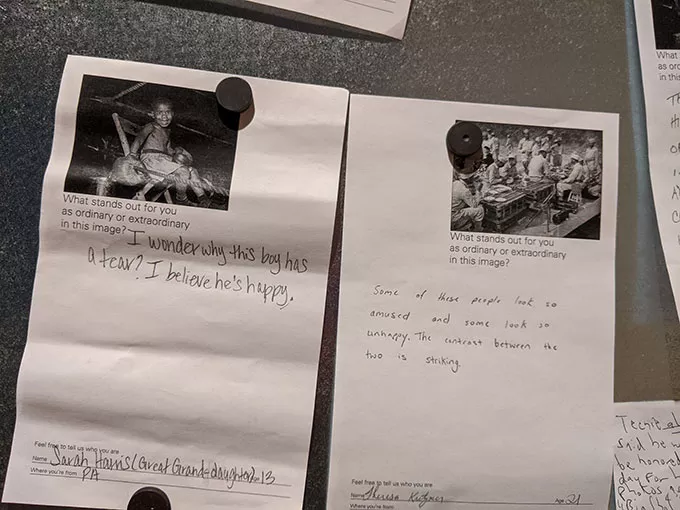
Besides paying tribute to a major Pittsburgh artist, one of the main goals of the display is to enhance the collection’s historical significance by identifying specific people, places, and objects in the photos. The CMOA website states that around 12,000 images have been positively identified with help from the community, and through research conducted by archivist Dominique Luster and Charlene Foggie-Barnett, an archive specialist who was photographed by Harris and has made significant contributions to understanding the collection.
“They basically made captions for almost all of the images, which is amazing,” says Levin.
Even so, many of those captions contain vague descriptions, and the museum wants visitors to help identify unnamed subjects while interacting with the installation. The touch-screen capabilities and the ultra-high resolution quality of the images even let users zoom in to more accurately discern facial features or spot certain figures in crowd shots.
“It’s much more a combination of a microscope and a telescope,” says Levin, explaining that the microscope aspect allows users to “actually look at the individual images way up close and see the film grain” while the telescope aspect allows users to see a block of 60,000 archival images “at a glance.”
The hope is the technology will then try to match faces across the collection, as Harris seemed to use the same people in many of his photos. While this could be helpful, Levin cautions that, as an experimental platform, the installation is not a perfect system, and many factors, including the logic of the computer and the quality of the image, can affect the outcomes.
“We’re not judging whether these are the same people,” he says. “We’re just saying that using our tools, these are the best matching faces. And sometimes it’s great, and sometimes it could even be offensively bad, like an old woman being matched with a young boy.”
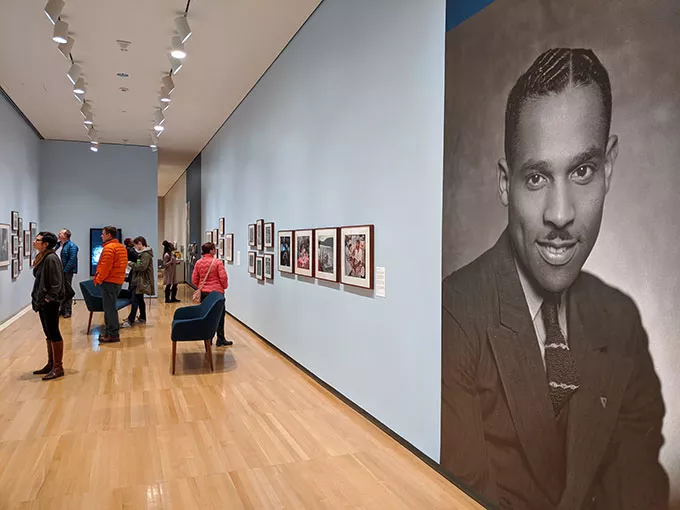
Overall, he sees In Sharp Focus as a huge step for the museum. While the Harris archive has appeared in various CMOA exhibitions over the years, he believes the iconic photographer deserved a dedicated gallery, especially since his work accounts for a huge portion of the museum’s overall collection and connects it to the city “in both historic and living ways.”
Levin also sees the project as demonstrating the potential for machine learning both artistically as a way to produce new works and analytically as a way to understand a massive dataset like the Harris archive. He points out how students designed the installation using mostly free, open-source tools created by artists, for artists, like Frameworks, ML4A, and ml5.js. As technology becomes more accessible, Levin says people “shouldn’t be surprised to see artists who can write code, and are writing computationally, and are working with machine learning and these kinds of tools to understand and create a culture.”
“I think this represents a leading edge of the present or, potentially, a common future for people who are working in the arts and working with cultural artifacts,” he says.
This article appears in Jan 29 – Feb 4, 2020.