

Deprecated: mb_convert_encoding(): Handling HTML entities via mbstring is deprecated; use htmlspecialchars, htmlentities, or mb_encode_numericentity/mb_decode_numericentity instead in /var/www/html/wp-content/plugins/super-cool-ad-inserter/inc/scaip-shortcode-inserter.php on line 37
When Pittsburgh City Council passed a marijuana-decriminalization ordinance in December 2015, it was seen as a victory on many fronts.
Local governments would see fiscal savings thanks to fewer resources being used to arrest and prosecute individuals. Progress was promised in reducing the disproportionate arrests of black people in the city. And, hopefully, vulnerable populations would avoid entering the criminal-justice system for marijuana possession in small amounts.
“From a social perspective, it will really help a lot of young men and women’s lives from being destroyed or caught in sort of the hamster wheel of prosecution through governmental means,” Pittsburgh City Councilor Daniel Lavelle told City Paper in 2015.
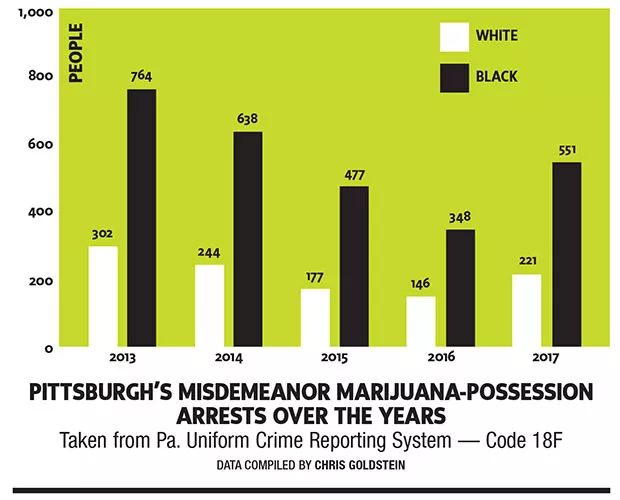
But after a decrease in marijuana-possession arrests in 2016, those numbers actually jumped significantly in 2017. Chris Goldstein of marijuana-advocacy group Philly NORML compiled statistics from the Pennsylvania Crime Reporting System over the past few years. Goldstein counted the arrests filed under Pennsylvania statute 18F, which signifies misdemeanor possession of less than 30 grams of marijuana.
In 2016, the first year of decriminalization in Pittsburgh, marijuana-possession arrests dropped to 494 for the year (down by 160). But in 2017, marijuana-possession arrests increased to 772. In fact, 2017 arrests for possessing less than 30 grams of marijuana even surpassed the 2015 totals by 118 arrests (before a decriminalization ordinance was in place but recognized as necessary by city officials).
Without comprehensive data available, Pittsburgh marijuana-reform advocates aren’t sure exactly why the arrests rose in 2017. However, they say some actions left the door open for officers to ignore the ordinance, which could be a factor, along with others, in the rise of arrests. Advocates are also upset that the ordinance has had virtually no effect on shrinking the disproportionate gap in which black and white people are arrested for marijuana possession.
Pittsburgh officials say they’re aware of the increase and are looking at steps to meet their commitments to decriminalize small amounts of marijuana. But advocates say arrests will only drop again if changes are made to the ordinance and attitudes are altered among Pittsburgh police officers. And in an age of conflicting law-enforcement priorities handed down from federal, state and local officials, that may be a difficult feat.
Patrick Nightingale, of marijuana-advocacy group Pittsburgh NORML, isn’t happy about the increase in arrests. He says the decriminalization ordinance, which essentially issues tickets and a small fine to violators, was used about 200 times in 2017. But Nightingale says that number should be higher, considering most of the misdemeanor marijuana-possession charges end up being withdrawn anyway.
“You are still bringing 700 people into the court and fingerprinting them, and that is 700 people that still need their records expunged,” says Nightingale. “All of these cases are still being withdrawn. Why are these people getting fingerprinted?”
Nightingale is also upset that possession arrests are still overwhelmingly affecting African Americans in Pittsburgh. Out of the 772 people arrested on misdemeanor marijuana-possession charges in 2017, 551 of them were black. That means in a city where African Americans make up just 24 percent of the population, black residents made up 71 percent of these marijuana arrests. That percentage has seen virtually no annual change since 2013.
In February, Nightingale met with Pittsburgh officials and high-ranking police officers to discuss the increase in arrests. He says officers complained some marijuana consumption in public has increased due to a presumption marijuana is quasi-legal now. Nightingale says this claim may have some merit, given some might not fully understand the decriminalization ordinance, as well as the proliferation of headlines about the start of Pennsylvania’s medical-marijuana program and California’s new legal recreational cannabis status.
But Nightingale thinks the increase in arrests has more to do with a flaw in the ordinance and a memo sent to Pittsburgh police officers. Nightingale says Pittsburgh Deputy Chief Thomas Stangrecki issued a memo advising officers that they had the discretion to use the decriminalization ordinance. However, the memo told officers they “may” follow the ordinance but stopped short of telling them that they “shall” use the ordinance. The ordinance also states: “This Chapter shall not be construed to supersede any existing Pennsylvania or Federal law.” State and federal law classify marijuana possession as a misdemeanor.
“It is a policy, it is not a law, and the policy is weakly worded,” says Nightingale. “All I want to do is change the word from ‘may’ to ‘shall.’”
Nightingale says the Pittsburgh ordinance was modeled after Philadelphia’s decriminalization ordinance, except for some minor changes, like using the word “may” instead of “shall.” But he says that makes big difference. Philadelphia’s marijuana-possession arrests have dramatically dropped since the city passed its decriminalization ordinance in 2014.
Dan Gilman, chief of staff for Pittsburgh Mayor Bill Peduto, says Peduto still deeply believes in the decriminalization of small amounts of marijuana. In fact, Peduto announced in a tweet on May 11 that he supports Pennsylvania legalizing and taxing recreational marijuana.
Gilman doesn’t downplay the marijuana-arrest numbers, but he says those figures could be a bit misleading since some marijuana-possession arrests could be tied to more serious crimes. However, Gilman says officials are working closely with the law department to make possible adjustments to the policy and should be meeting this week.
“It is something very much on the front burner and once we get through that, then training will reflect the new policy,” says Gilman.
Gilman says he “would have hoped to see the numbers drop by now” but notes the decriminalization ordinance is not a “silver bullet” solution for fixing the issues surrounding marijuana, including the racial gap in those arrests. Gilman says he has faith in the ability of Pittsburgh Police officers to adjust to these figures. Gilman also says the police department’s ongoing implicit bias training should continue to tackle the racial-disparity gap in all arrests.
Jesse Wozniak is a West Virginia University criminology professor who advocated for Pittsburgh’s decriminalization ordinance as part of the local Alliance for Police Accountability. He’s not surprised that marijuana-possession arrests grew last year because he says the ordinance’s language isn’t strong enough.
“Without some teeth in the ordinance, it probably won’t make a difference,” says Wozniak. And without a mandate in the policy, Wozniak says Pittsburgh is reliant on officers to choose to enforce the ordinance when confronting people possessing marijuana. He says some city officers have embraced the ordinance, but understands conflicting law-enforcement priorities are sending mixed messages.
“There are some officers that have really taken [the decriminalization ordinance] to heart,” says Wozniak. “But, in the current political environment, you also have rhetoric and policies of [U.S. Attorney General] Jeff Sessions.”
Sessions is a well-known opponent to all things marijuana. In January, Sessions announced that federal prosecutors can decide for themselves whether to press cases against growers, sellers or users for violating federal law, including in states where the drug is legal. Wozniak says it’s not too farfetched to believe Pittsburgh police officers could be following Sessions’ lead.
Either way, Wozniak says police culture doesn’t change quickly and Pittsburgh officers still have the ability to issue misdemeanor marijuana-possession arrests without breaking city rules. He says stricter local policies are needed to combat the culture of police officers and priorities laid out by people like Sessions.
“Without strict language,” says Wozniak, “then it just goes back to the way it was before.”
This article appears in May 16-22, 2018.



Those who believe in limited government, personal responsibility, free markets, and individual liberty should embrace the ending of this irrational, un-American cannabis prohibition. It should be the cornerstone of current GOP policy.
About half of the U.S. population has tried cannabis, at least 15% use it regularly, over 80% of high school seniors have reported cannabis “easy to get” for decades. Those who really want to use cannabis heavily already are. Prohibition does little or nothing to prevent problematic use. In many cases prohibition makes cannabis usage problematic where it would not have been otherwise, be it light, moderate, or heavy usage. For the most part, cannabis prohibition only successfully prohibits effective regulation.
A few issues created by prohibition: there are no quality controls to reduce contaminants (harmful pesticides, molds, fungus, other drugs), there is no practical way to prevent regular underage sales, billions in tax revenue are lost which can be used for all substance abuse treatment, underground markets for all drugs are empowered as a far more popular substance is placed within them expanding their reach and increasing their profits, criminal records make pursuing many decent careers difficult, police and court resources are unnecessarily tied up by pursuing and prosecuting victimless ‘crimes’, public mistrust and disrespect for our legal system, police, and government is increased, which can be devastating to our country.
Prohibition is also very expensive, though, a cash cow for a number of powerful groups such as those related to law enforcement and the prison industry. These organizations have powerful lobbies and influence that perpetuate a failed drug policy through ignorance, fear, disinformation and misinformation. This ensures an endless supply of lucrative contracts and grants from the government and its taxpayers to support their salaries, tools of the trade, and other expenses. Cash, property and other assets from civil forfeiture laws also significantly fatten their coffers while often violating civil rights.
America was built on the principles of freedom and liberty. In some cases there are extreme circumstances that warrant intervention with criminal law. In the case of mind-altering drugs we have already set this precedent with alcohol. Cannabis is less harmful than alcohol to the consumer and especially to others. If we are to have justice, then the penalties for using, possessing and selling cannabis should be no worse than those of alcohol.
City Paper is now just a vehicle for the racist, fundamentalist, fascist agenda of Daryl Metcalfe. BOYCOTT PGH CITY PAPER!
My nephew offered me a free house in PA. I said no ty. I live in Colorado, the happiest, healthiest state in the country.
Half a century ago, we’d pretty much concurred: the inbred tag-team kleptocracy would legalize cannabis, once it became impossible to cultivate polyploid strains oneself. We’d figured cops needed smelly bud to pull asset forfeiture, and stop & frisk incarceration, to keep CRIMINAL lawyer, prison-industrial and bailbonds services feeding off Black city kids and po’-ass suburbanites. It helps get folks’ indentured, puts their cars, homes, livelihoods into perpetual circulation; so our 9.99% Creative Class can replace their Audi Q7 with Porsche Macans and feel they’ve EARNED it? Now, that THC will come from patented GE strains of brewer’s yeast, they’ll be able to take upscale substance abusers to civil court for intellectual property infringement?