

Deprecated: mb_convert_encoding(): Handling HTML entities via mbstring is deprecated; use htmlspecialchars, htmlentities, or mb_encode_numericentity/mb_decode_numericentity instead in /var/www/html/wp-content/plugins/super-cool-ad-inserter/inc/scaip-shortcode-inserter.php on line 37
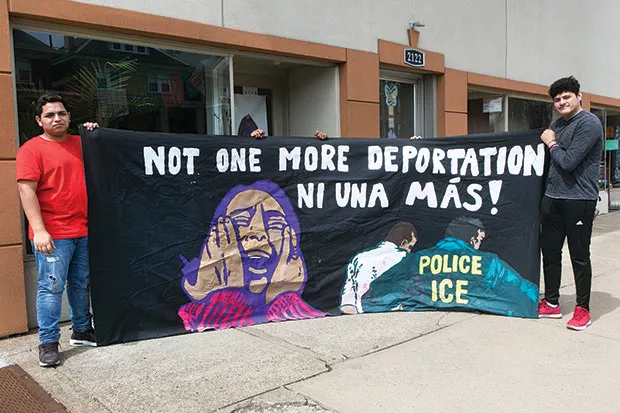
Since January 2017, when President Donald Trump was inaugurated, 20 undocumented immigrants have been prosecuted in Western Pennsylvania federal courts for immigration offenses, most for illegally entering the U.S. multiple times.
Of those 20, only six immigrants had criminal records in the county where they were detained. The charges include DUI, illegal-firearm possession, and having false identification. Only one, Mexican immigrant Rolando Velez Latorre of East Pittsburgh, had a conviction for a violent offense (simple assault and making terroristic threats in 2014).
This ratio contrasts with the portrayal of undocumented immigrants by politicians like Trump, who has claimed these individuals are making the U.S. unsafe. Studies have shown that immigrants, undocumented and documented, commit fewer crimes on average compared to U.S. citizens. And even in Western Pennsylvania, the majority of undocumented immigrants charged with federal immigration offenses have committed no local crimes at all.
But this hasn’t stopped the Immigration and Customs Enforcement (ICE) from increasing enforcement nationwide since Trump was elected. ICE has even increased detainments in some Rust Belt areas, such as Allegheny County, which tend to have smaller percentage of immigrant residents than the national average.
In response, a growing chorus of progressives and immigration advocates are calling for defunding and even abolishing ICE. They claim ICE isn’t making communities safer and is forcing immigrants to live in a constant state of fear. ICE has defended its actions and says agents are targeting criminal immigrants. But one longtime immigrant lawyer, Cleveland-based David Leopold, says ICE’s increased enforcement, especially in the Rust Belt, goes beyond enforcing current laws and is meant to showcase a broader hostility toward immigrants.
Pennsylvania advocates agree. “I think it is about politics,” says Sundrop Carter, of Pennsylvania Immigration and Citizenship Coalition (PICC), a statewide immigrant-advocacy group. “I think ICE is purposely going after places where immigrants used to be invisible. If they are coming after immigrants in a small town like Gettysburg, where they have to drive around and look for immigrants, then it spreads the feeling that no one is safe.”
Monica Ruiz of Casa San Jose, a Brookline-based immigrant-support service group, has been working with Pittsburgh’s undocumented community for several years. She says ICE’s increased enforcement creates the perception that all undocumented immigrants in Pittsburgh are being targeted for deportation. According to statistics compiled by Syracuse University, ICE’s 2017 Allegheny County detainments increased by 15 percent from 2016.
“It has driven fear into everyone,” she says. “The fear is real, it is so bad. They are afraid to drive, and they are afraid to report crimes.”
Ruiz says she supports defunding ICE, not only to stop sweeps of Pittsburgh neighborhoods, but also to continue the momentum of immigrants moving to and investing in Pittsburgh. According to a 2016 study from the New American Economy, a pro-immigrant business group, immigrants made up 7.6 percent of Allegheny County’s gross domestic product, even though foreign-born individuals only comprised around 5 percent of the county population.
“[Immigrants] aren’t going to invest in the community, because they don’t know how long they are going to be here,” says Ruiz.
Leopold agrees that increased immigration enforcement will hurt the economies of Rust Belt cities like Cleveland, Youngstown and Pittsburgh. But, he says, immigration hawks like those working for Trump are driven more by ideological factors than economic ones.
“The restrictionist folks may say increased enforcement is great since immigrants are here illegally,” says Leopold. “But they don’t understand that by deporting a businessman from Youngstown, that is less money for going after national-security threats.”
Leopold represented Amer Adi, a Jordanian immigrant who owned convenience stores in downtown Youngstown. This January, Adi’s deportation story made national headlines thanks to its sympathetic nature. Adi had lived in the U.S. for 39 years and had family living legally in the country. Adi had also received the support of U.S. Rep. Tim Ryan (D-Youngstown) and Ohio business groups. Regardless, Adi was deported in January.
Leopold couldn’t say for certain why Adi wasn’t given leniency to stay in Ohio, but he notes that Adi’s humiliation sent a strong message to other immigrants. In Mahoning County, where Youngstown is located, foreign-born residents make up only 2.8 percent of the population, far less than the 13 percent U.S. average. Even so, according to Syracuse University, detainments in Mahoning County more than quadrupled in 2017 compared to 2016.
Leopold says that by making Adi’s case a national story, ICE was able to showcase that immigrants in any community are at risk for deportation, regardless of their history.
“It was kind of like the perfect storm of messaging for ICE,” says Leopold.
ICE active director Thomas Homan has publically responded to the increasing calls to abolish ICE by saying the agency’s critics should talk to victims of crimes carried out by undocumented immigrants. “These politicians, they need to talk to the victims of alien crime, talk to the parents that I talk to that lost children at the hands of criminal aliens,” Homan said March 12 during Fox News’ Tucker Carlson Tonight.
Leopold isn’t calling for the complete abolishment of ICE, but thinks ICE should be put into receivership, meaning that another public or private group should take over its functions.
On March 9, progressive columnist Sean McElwee, writing in The Nation magazine, called for the end of ICE. He detailed the growing list of political groups calling for ICE to be defunded. In an interview with City Paper, McElwee notes that ICE has only existed since 2003 and has become an “increasingly authoritarian institution.” ICE’s only tasks are to investigate Homeland Security issues and to identify and remove undocumented immigrants. Before ICE, the Immigration and Naturalization Service (INS) department dealt with all facets of immigration.
Though ICE has rejected claims that it’s acting merely to carry out the political goals of immigration hawks like Trump, McElwee said that the union of ICE agents endorsed Trump in 2016, and that many agents acted “openly insubordinate” to former President Barack Obama.
He says there is no reason that more Democrats across the country shouldn’t be running campaigns calling for the end of ICE, even those in Rust Belt areas where immigrant-rights groups are less powerful.
Western Pennsylvania politicians haven’t been outspoken in criticizing ICE. Pittsburgh police don’t initiate communication with ICE officials, but some area Democrats have allied with Republicans in trying to make it easier for ICE to deport immigrants. (According to an August 2017 ICE document obtained by PICC, there are even seven law enforcement agencies in Western Pennsylvania that have expressed interest in further cooperating with ICE, including McKees Rocks and Castle Shannon police departments.)
“ICE is actually not an organization that is compatible with the vision of society the Democratic Party has,” says McElwee. “Therefore, funding ICE is actually a concession and should be acknowledged as such.”
Sara Innamorato, a Democratic candidate for Pennsylvania’s 21st state House District, believes Western Pennsylvania should be more critical of ICE and the “inhumane way” the agency is ripping apart families.
State representatives don’t have the power to defund ICE, but Innamorato does support House Bill 1302, which would limit state law-enforcement agencies from participating in any federal immigration-enforcement activity. In a statement to CP, Innamorato wrote: “By supporting [this] bill, I would be joining the fight for a stronger economy, safer neighborhoods and creating a city and commonwealth for us all.”
This article appears in Apr 4-10, 2018.





driven more by ideological factors than economic ones?
Nothing has done more to diminish the quality of life for the United States middle class through higher housing (land) costs, competition for jobs, low wages, greater poverty, mortgage fraud, medicare fraud, crime, disease, cost of public schools, degradation of the military, cost of college, depletion of resources, burden on the taxpayer and overall congestion than the INCREASE of and change in the nature (more poor, more criminals, e pluribus multum) of the POPULATION since 1965, driven almost entirely by late 20th century immigration (immigrants, h1b visa holders, visa overstays, refugees, etc) their families and descendants.
That’s a pretty bold claim, without any sources and/or references to data that support it. Collectively, and in their own proportions they have all diminished quality of life, obviously. But to say ‘the INCREASE of and change in the nature of immigration’ not only exceeds in effect any others you mentioned but exceeds all others in total is well, absurd. I support the law and a legal transition to citizenship – but these are legal and political issues that can be solved, or at least managed with such means if we (and our leaders) act beyond the short-sighted polarization we are seeing now. Immigration isn’t the problem – seeking opportunity and a higher quality of life is a right for any human being. So if you make it really, really easy, for anyone, then what consequences do you expect? Not everyone is going to immigrate here and work their asses off, start a business, gain employment and carry their share of the collective weight. But I see plenty of lazy Americans as well- rich and poor, white, black, brown, whatever. We need to address the difference between giving someone the opportunity of earning citizenship, and granting citizenship itself because they are very different topics.
We should abolish police officers, too, because all those pigs do is kill black people and eat doughnuts. But first, can Ryan Deto please attend one writing class?