

Deprecated: mb_convert_encoding(): Handling HTML entities via mbstring is deprecated; use htmlspecialchars, htmlentities, or mb_encode_numericentity/mb_decode_numericentity instead in /var/www/html/wp-content/plugins/super-cool-ad-inserter/inc/scaip-shortcode-inserter.php on line 37
Earlier this month, a few videos were posted to Facebook depicting something out of a scary movie or a nightmare. One local video showed thousands of bees gathered along a chain-link fence. Another, taken from inside a South Side home, showed thousands of bees pressed to a window.
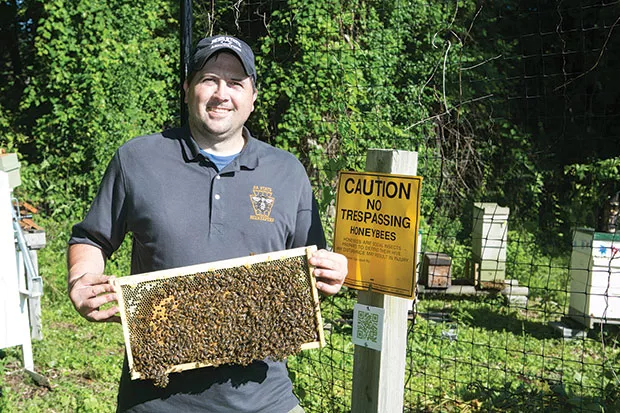
Stephen Repasky, president of Burgh Bees, an organization that promotes honey bees and the beekeeping industry, gets calls about this kind of bee activity often. But the swarms are mostly harmless, he says. They’re just looking for a new home.
Repasky is a second-generation beekeeper who grew up on a farm in Armstrong County and started learning about the process from his father at age 4. As part of his work with Burgh Bees, he strives to make people less afraid of bees and to give them an understanding of the insects’ many contributions to our ecosystem.
“Honey bees are very gentle, they’re docile. They’re not going to bother anybody unless someone bothers their hive,” Repasky says. “Honey bees are responsible for over one-third of the food we eat. One out of every three bites of food can be attributed to pollination by honey bees. There’s so many things they do, from building their own wax to producing honey.”
But unfortunately this year, bees were officially added to the list of endangered species in the United States. According to the U.S. Fish and Wildlife Service, there has been an 87 percent decline in the species population since the 1990s.
“We’re losing approximately 40 percent of our bee population every year,” Repasky says. “We’re able to recover that 40 percent in the spring by dividing hives, but when we’re losing 40 percent of our population every winter, it’s not sustainable.”
The process of dividing hives is what creates the very swarms some were afraid of earlier this month, and it’s key to helping bees replenish their numbers. During the process, a queen leaves the hive with half of the population to create a new colony. The remaining bees at the hive then choose a new queen through a process reminiscent of the HBO series Game of Thrones: The potential queens fight it out, and the surviving bee reigns.
“Swarming occurs in the springtime because that’s when there’s a lot of nectar available. If they split up and swarm, that swarm has a greater chance to survive because there’s lots of food sources out there,” Repasky says. “It’s a natural occurrence. It’s as natural as a robin building a nest on your porch.”
But since this process isn’t enough to save the bees alone, Repasky focuses his efforts on the manmade causes of bee decline
“Call an expert before you spray anything,” Repasky says. “You don’t want to destroy a honey-bee colony if you can prevent it.”
This article appears in Jun 28 – Jul 4, 2017 and Animal Issue (2017).





ABSOLUTELY FALSE!! – Beekeepers lost nowhere near 33% of their colonies last year or any other year for that matter. Since 2006 when the misnomer CCD was trotted out – by an environmental “journalist” who didn’t do their fact checking, the number of colonies in the US has soared from 2.1 million to 3.1 million in 2016. A 50% increase. For several years running, the 4 major metrics for the beekeeping / honey production / pollination industry have been on the rise. 1-number of colonies, 2-total pounds produced, 3-pounds per hive, 4-price per pound. The average losses for commercial beekeepers who operate 98% of the colonies in the US has averaged 8% – 12% every year for many decades. Steven Lechner, Busy Bee Farm, Larkspur, Colorado. https://www.facebook.com/busybeefarm.online/ #fakebeenews #beenews #fakenews