
Deprecated: mb_convert_encoding(): Handling HTML entities via mbstring is deprecated; use htmlspecialchars, htmlentities, or mb_encode_numericentity/mb_decode_numericentity instead in /var/www/html/wp-content/plugins/super-cool-ad-inserter/inc/scaip-shortcode-inserter.php on line 37
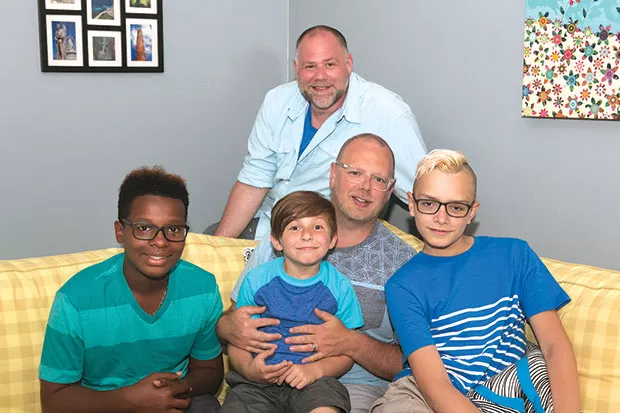
As a gay couple, Sean O’Donnell and Todd Collar always wanted to adopt kids, but it wasn’t something they initially thought possible.
“We have been together for 20 years,” says O’Donnell. “We have wanted kids for as long as we can remember. We didn’t think that this was something we could do.”
However, Pennsylvania has been a leader in adoptions by LGBTQ individuals for the past decade, thanks to a 2002 state Supreme Court decision that gave same-sex couples equal adoption rights as non-same-sex couples. Adoption by same-sex couples didn’t become legal nationwide until June 2015.
When the Pittsburgh couple realized nothing was holding them back, they were delighted and began fostering their now-son, Chris, in 2014. They then brought Elijah into their home in 2015, and they’re currently finalizing paperwork for their soon-to-be son, A’Sean, whom they have been fostering for months. All told, O’Donnell says he and Collar are happy with their family and they’re glad they pursued adoption.
“That was the only option that we considered,” says O’Donnell. “We knew we wanted to give a home to children that were already out there. We have not encountered any negativity. [Everyone] is just happy that these kids have a home. … People always say the kids are so lucky. No, we are the lucky ones. They bring us so much joy and love; it’s endless what they bring to us.”
But proposed federal legislation introduced by U.S. Rep. Mike Kelly (R-Butler) is looking to alter the national landscape for LGBTQ adoption, potentially limiting options for LGBTQ people to participate in the process. The Child Welfare Provider Inclusion Act of 2017 seeks to “ensure that organizations with religious or moral convictions are allowed to continue to provide services for children,” and continue to receive federal funds even if those organizations refuse to work with people who run counter to their “moral convictions.”
For LGBTQ-rights advocates, this bill is a dog whistle to Kelly’s far-right base, suggesting that it’s acceptable to discriminate against LGBTQ people. Furthermore, they say, it could add barriers for children looking for homes and enable religious adoption agencies to practice unpopular programs like conversion therapy.
Kelly and his conservative backers say the bill would merely protect the rights of religious organizations, and maintain the longstanding relationship between the government and religious adoption agencies. But Kelly’s LGBTQ constituents hope the congressman will also consider their rights and, ultimately, the future of the kids and parents of all backgrounds looking to create families.
According to the U.S. Department of Health and Human Services, more than 400,000 children and youth are in foster care, and more than 100,000 of them are waiting to be adopted. O’Donnell says this figure is what drove him and his husband to adopt.
“There are 100,000 kids that need a home and I don’t see anybody else stepping up,” says O’Donnell.
O’Donnell says he’s fortunate to live in Pittsburgh, where there are many agencies, like Three Rivers Adoption Council, that will work with LGBTQ people. But he also recognizes the difficulties in rural areas, where there are typically fewer such adoption agencies. For example, Pittsburgh City Paper searched through the state-certified adoption agencies of Western Pennsylvania and found that rural counties tend to have one county-run adoption agency and one or two nonprofit adoption agencies each, and that most of these are religion based.
Because of this, O’Donnell says Kelly’s bill could limit adoption access for LGBTQ and non-faith individuals. These potential parents looking to use a nonprofit agency would most likely have to go through one in a city, which would mean traveling to and from the city to take adoption-preparation classes and fill out paperwork.
“You are cutting them off, and you are forcing them to drive hours to the city to take classes,” says O’Donnell. “You are making it more difficult for the kids to be placed and sentencing these kids to a life in the [county-run] foster system.”
Adoption agencies throughout the U.S. must be certified by state governments to receive funding. A few states, like Massachusetts and California, have refused to funnel federal funds to religious adoption organizations, unless those organizations promised to follow the state’s civil-rights laws, which prohibit discrimination on the basis of matters like race, gender, religion and sexual orientation.
It was these states’ refusals that motivated Kelly to introduce legislation (H.R. 1881), which he first did in 2014. “Faith-based organizations have long played a heroic role in caring for our country’s most vulnerable kids,” wrote Kelly in a statement to CP. “There is no good reason why any of these care providers should be disqualified from working with their government to serve America’s families simply because of their deeply-rooted religious beliefs. When it comes to helping kids and making families stronger, all service providers — religious or otherwise — should have a seat at the table.”
But David Stacy, government affairs director of nationwide LGBTQ-rights group the Human Rights Campaign, says there is good reason to deny funding to religious organizations that discriminate. He says religious organizations can also negatively impact the lives of LGBTQ youth in their foster-care systems.
“They could subject kids to conversion therapy, and the federal government would have no recourse,” says Stacy, noting that Kelly’s bill would provide religious organizations with federal protections that would override local conversion-therapy bans, like Pittsburgh’s. “And many states have passed LGBTQ protections. Normally when a bill is associated with funding a program, it doesn’t also try to undercut civil rights.”
Kelly rejects the assertion his bill would negatively impact potential LGBTQ parents and LGBTQ kids, calling it “100 percent inclusive and 100 percent child-focused.” His office said in an email to CP that the bill “does nothing to prevent any organization from working with any LGBT couple, nor does it compel any organization to stop serving LGBT families.”
But Stacy of the HRC doesn’t buy Kelly’s insistence that his bill is merely about protecting religious organizations. He notes that Catholic Charities, which tends to shun prospective LGBTQ parents, has a large presence in Pennsylvania. In fact, in many parts of Kelly’s own district, which stretches from Erie County south to Butler County, the only private, nonprofit adoption agencies are faith-based organizations, and many are Catholic Charities branches.
“If you have a same-sex couple that has an open heart and wants to take in a child, we need to allow that,” says Stacy. “The fact that we are trying to cut people out based on biased beliefs, we shouldn’t be doing that. It’s not like we are willy-nilly placing people. If there are LGBT people who are qualified, why throw up barriers? … It is not supposed to be about the best interest of the provider, it is supposed to be about the best interest of the child.”
Stacy also notes that Kelly has an abhorrent LGBTQ record, which HRC tracks. In 2014, Kelly was inducted into HRC’s inaugural “Hall of Shame” for his anti-LGBTQ record. In 2014, Stacy wrote that Hall of Shame legislators “proactively work to undermine existing legal protections and promote anti-LGBTQ discrimination.”
“He has consistently scored a zero on our scorecard,” says Stacy. “He really has not demonstrated any support for his LGBTQ constituents.”
One of those constituents is Sabrina Schnur, who is part of the Butler branch of Parents, Families and Friends of Lesbians and Gays. She says Kelly has never met with the organization and he has a bad reputation in the Butler LGBTQ community. “Everyone in this community knows he is not a friend of the LGBT,” says Schnur.
Kelly’s bill has been introduced three times and has never even seen a committee vote. But Schnur says that this is more about sending an anti-LGBTQ message throughout Kelly’s district.
“For the people who are religious or the more bigoted, it is kind of like a dog whistle, to go ahead and discriminate,” says Schnur.
Additionally, Kelly’s assertion that the bill isn’t meant to affect LGBTQ individuals runs counter to statements from a group aligned with him, and which is looking to politicize the bill. Ryan Anderson, of the Heritage Foundation, a conservative think tank, wrote a statement supporting the Child Welfare Provider Inclusion Act.
It read, in part: “Shutting down agencies or disqualifying them from government programs because they believe kids deserve both a mom and a dad does nothing to help children in need. All it does is score a point for LGBT activists using children as pawns in their culture war. We need as many adoption and foster-care agencies working for kids as possible. But there is no need to force them to embrace LGBT orthodoxy.”
Furthermore, Schnur, who came out as a trans woman several years ago, says legislation like this is a step backward for places around the country like Butler, where acceptance of LGBTQ people is growing. She says Butler City Council will soon be voting on a non-discrimination ordinance, and many in her community have begun to embrace her. “I work in a steel mill,” says Schnur. “I work on the floor. Even they don’t care what I do. Even they are not that anti-LGBT.”
Another one of Kelly’s constituents in Erie also says the area is increasing its LGBTQ friendliness. Mike Mahler, of the LGBTQ newsite Erie Gay News, says Erie has had 25 years of successful Pride parades, and that an openly trans man is running for school board this year.
Mahler says Kelly and the Erie LGBTQ community have “no relationship,” but adds that it might be helpful for Kelly to meet with LGBTQ groups. He thinks this could give Kelly perspective on bills like the Child Welfare Inclusion Act, and even make him more moderate on LGBTQ issues.
But Mahler isn’t optimistic this will happen. “He hasn’t shown any signs of support,” says Mahler. “I am not exactly holding my breath.”
Schnur knows that in many parts of Kelly’s district, there is still a struggle for LGBTQ rights, made even harder by Kelly’s lack of support. But in the end, she worries about the kids who might not get parents due to potential restrictions if Kelly’s bill were to become law.
“This bill is just alienating a bunch of parents, not just LGBT, but even a couple that is unmarried,” says Schnur. “A child not loved is kind of the ultimate harm to a child. As long as they are going to be loved by people, then who cares who they are?”
This article appears in Jun 7-13, 2017.