
Deprecated: mb_convert_encoding(): Handling HTML entities via mbstring is deprecated; use htmlspecialchars, htmlentities, or mb_encode_numericentity/mb_decode_numericentity instead in /var/www/html/wp-content/plugins/super-cool-ad-inserter/inc/scaip-shortcode-inserter.php on line 37
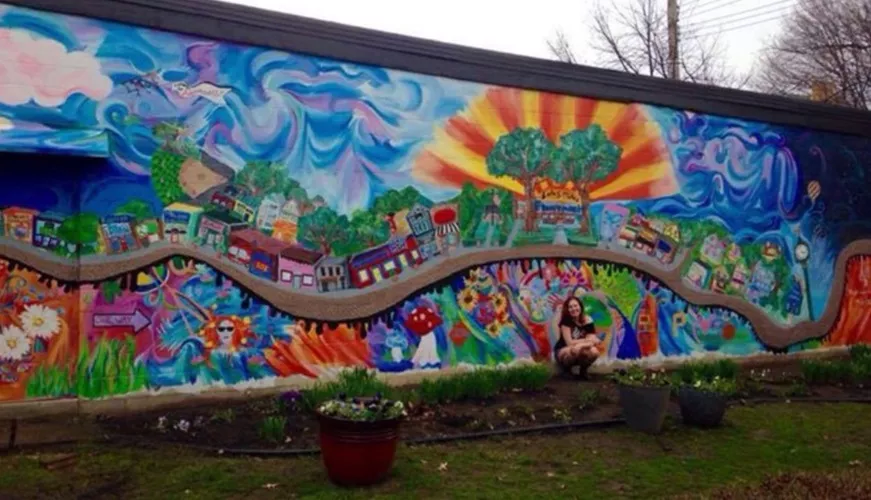
The promise of a great salmon salad led to a young artist’s first commission, creating a vibrant mural celebrating the area’s small businesses and cherished memories.
In 2014, then-18-year-old artist MK Noonan and her father ate dinner at the Aspinwall restaurant Luke and Mike’s Frontporch Grille. Noonan’s dad had become a regular at this restaurant and introduced his artist daughter to co-owner Sheri Rice. The encounter led to Noonan creating a mural on the restaurant’s facade.
“I hadn’t ever been commissioned for anything. So I was, you know, very new, very fresh, and very excited,” Noonan tells Pittsburgh City Paper. That night, she went home and drew up a design. “And so I brought it down to her the next day, and [Rice] said, ‘This is exactly what I want.'”
From there, Noonan conceived the 575-square-foot mural “Sunset Over Aspinwall.” Inspired by the iconic cover for The Beatles’ album Sgt. Pepper’s Lonely Hearts Club Band, the work became a canvas for community stories, incorporating elements that residents contributed as she painted.
“Because Aspinwall is such a walkable area, families were passing by throughout the entire process,” Noonan recalls. “I was able to sort of invite passersby to come over, and ask, ‘Do you want to paint a little bit here?'”
Families strolled by, children added their handprints, and the mural became a beloved landmark. As the mural took shape, it transformed not only the restaurant’s exterior but also the lives of those who witnessed its creation. It was a moment of pride for Noonan, who felt deeply connected to the community where she grew up.
Noonan will celebrate the 10th anniversary of completing her first public art piece and becoming a professional artist. But that significant milestone may also mark the day Noonan and the neighbors of Aspinwall say goodbye to her vibrant sunset.
Luke and Mike’s officially closed its doors in December 2024, and, under a new owner, has become AVVA, a Mediterranean-style restaurant. Noonan learned that the current proprietor “intends to paint over the mural to align with his branding.” The news found Noonan grappling with her rights as an artist, and without a formal contract in place, she is faced with the prospect of losing her work to a new vision that leaves no room for what she created in 2014.
Noonan sought a lifeline in the Visual Artists Rights Act (VARA). Passed in 1990, the federal law “Amends the copyright law to define a ‘work of visual art.’ Grants the author of a work of visual art the right to claim authorship of such work when publicly displayed, independent of other exclusive rights, and to disclaim authorship of such work because of substantial distortion or alteration that harms his or her reputation. Grants such an author the right to prevent any destruction, distortion, mutilation, or other modification of that work which would harm his or her reputation or honor.”
Sallyann Kluz, executive director for Shiftworks Community + Public Arts (formerly The Office For Public Art), tells City Paper, “There’s sometimes some misconceptions about what the Visual Artist Rights Act does and doesn’t do or protect. I can’t speak to the specifics of this particular project, but sometimes people think that VARA provides more protection than it actually does.”
Removing an artwork protected by VARA is not illegal, but it may provide artists with possible alternatives. These can include removing one’s name from the artwork because it was altered without permission. In rare situations, financial compensation may be due.
As with most legal matters, what is and isn’t protected by VARA can be tricky to navigate. Not all artworks are protected by VARA.
“Many artist contracts for public art specifically waive or modify artists’ rights under VARA in order to avoid these types of situations,” Kluz says. “In my experience, the best way to address these types of scenarios is to have a good contract to begin with, which includes the artist understanding under what conditions artwork may be altered or removed, and the building owner understanding their responsibilities as well.”
Removing a mural isn’t always just a case of aesthetics, as the upkeep can get expensive. Proper maintenance and preservation of murals, especially when commissioned by smaller clients who may lack the resources to ensure their longevity, can heavily factor in the decision to remove them.
Pittsburgh muralists Shane Pilster and Max Gonzales touched on the complexities of creating public art. Starting as graffiti artists, both have learned that once you give your art to the world, it no longer belongs to you.
“If you are coming from that world, then it’s kind of like you already sort of embrace the like, ephemeral nature of graffiti,” Gonzales tells CP. “One of the things with muralism specifically is that, personally, I see it as existing between this space of being a trade and an art. So every time you’re painting a mural, usually you’re servicing some sort of function.”
Noonan and her wife, fellow artist Madeline Boucher, now own and run MadKat Studios, an art studio located in Elizabeth. Noonan has since learned the business side of art, including the importance of a detailed contract. “As the years have gone on, I’ve established a business and know much more about how to properly protect yourself legally, and your work,” Noonan says.
Noonan says she obtained legal counsel through the Greater Pittsburgh Arts Council “for any future negotiations” about “Sunset Over Aspinwall.”
“The current status of the mural is that it is still up as of now,” Noonan tells CP via email. “There has been no agreement made, and no meeting set currently.”
This article appears in Apr 2-8, 2025.