
Deprecated: mb_convert_encoding(): Handling HTML entities via mbstring is deprecated; use htmlspecialchars, htmlentities, or mb_encode_numericentity/mb_decode_numericentity instead in /var/www/html/wp-content/plugins/super-cool-ad-inserter/inc/scaip-shortcode-inserter.php on line 37
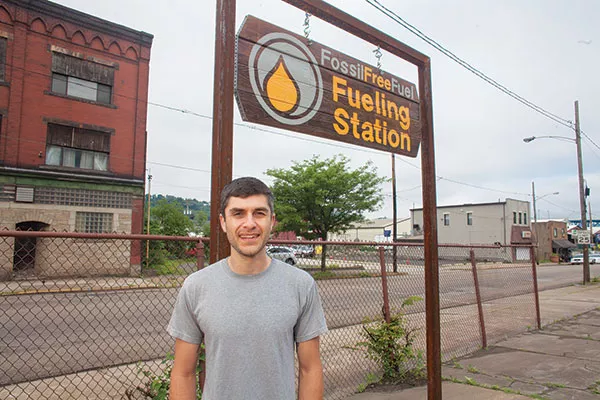
Years into selling local kitchens’ used cooking grease as fuel, Fossil Free Fuel, in Braddock, is adding a new component to its slick business model: operating a biodiesel filling station.
Any diesel-powered vehicle — from passenger cars to big rigs — can pull into this unassuming lot at 107 Braddock Ave. and fill up from a 4,000-gallon tank of biodiesel or a 1,000-gallon tank of regular petroleum diesel that can be accessed 24 hours a day with a self-serve card issued by the company.
“We have regular diesel to entice customers who may not be comfortable with using biodiesel right off the bat,” co-founder Dave Rosenstraus says. “Once they can see other similar vehicles running [on biodiesel], it will be a real-life testimonial for them to switch.”
Biodiesel is a mix of regular diesel and plant-based oil, like corn, peanut or soybean. The oil goes through a chemical process to make it conducive to existing fuel systems in cars and trucks, meaning that a diesel vehicle needs no modification.
“There’s a benefit of collecting and recycling vegetable oil and reusing it as fuel,” Rosenstraus says. “You’re not drilling somewhere thousands of miles away and don’t have the political ramifications that come with tar and oil. In a more scientific sense, you got less emissions out of the tailpipe.”
Fossil Free Fuel offers a blend that is anywhere from 50 to 99 percent plant-based oil in the summer and 20 percent in the winter. (Diesel fuels run the risk of thickening in colder temperatures.) The company keeps the price at the market rate for diesel — right now about $4 per gallon — and vehicle owners can expect the same mileage. The hope, Rosenstraus says, is to keep the biodiesel price the same as regular diesel to get more users to make the switch.
In 2008, Pennsylvania passed a law requiring 2 percent of all diesel fuel to be plant-based oil. Locals can find 100 percent biodiesel at Baum Boulevard Automotive, in Oakland, for a higher price: about $6 per gallon; just down the street from there, GetGo sells the state-mandated 2 percent blend. According to the National Biodiesel Board, the most commonly offered blends range from 5 to 20 percent, well below the mix used by Fossil Free Fuel.
Local construction and landscaping companies with multiple trucks and equipment as well as individual customers have been filling up since the station opened. The station has sold a couple hundred gallons of both regular and biodiesel so far.
“The future [goal] is to bring the station to full capacity over the next few months and serve all the local businesses and area residents that have diesel-powered vehicles and equipment,” Rosenstraus says. “Once the station is up and running and costs are recouped, we will look into expanding our self-serve station model to other areas.”
Rosenstraus says they chose Braddock because the borough’s mayor, John Fetterman, actively sought them out to start the business there. Over the past several years, the Mon Valley town has been working to rebuild businesses and population after a drastic decline following the steel industry’s collapse.
“Dave and Fossil Free Fuel, they’re great; they’ve consistently worked hard since they set foot in town,” Fetterman says.
“You can look at us in three ways,” Fossil Free’s chief operating officer Garrett Reeves says. “We provide [the fueling station] with diesel and biodiesel, we process and provide vegetable oil as a fuel, and we are a waste-service provider.”
As a “waste service,” Fossil Free Fuel buys used cooking grease from local kitchens to process and sell to customers with modified fuel systems that can run on straight vegetable oil. Their biggest suppliers include the University of Pittsburgh, Carnegie Mellon University and local chef Kevin Sousa’s former and current restaurants, including Salt of the Earth, Union Pig and Chicken, and Station Street. Sousa’s latest venture is building a new restaurant in Braddock called Superior Motors.
“They operate like a really high-functioning business,” Sousa says. “They’re always on time. I always joke that they have a sixth sense to know when our oil barrels are full.”
“A lot of our interests cross,” he adds. “They’re interested in community. They started off on a shoestring, like all of us. They’re crazy smart.”
Rachel Filippini, executive director of the local advocacy organization Group Against Smog and Pollution (GASP), says Fossil Free’s work “is really the kind of innovation our region needs to tackle our air-pollution problem.”
According to GASP, diesel’s black smoke and particulate matter causes asthma, chronic bronchitis, decreased lung function, heart attacks and strokes, among other health difficulties for vulnerable populations. According to the EPA, biodiesel is a renewable fuel source that reduces greenhouse gas emissions — like carbon monoxide and particulate matter — and weans the U.S. off of imported oil.
Rosenstraus says his company keeps the price of biodiesel on par with the market rate of regular diesel, even if it means making less profit.
“The main hope is that [biodiesel] becomes price competitive with diesel,” Rosenstraus says. “Despite the environmental intentions of businesses and individuals, everyone has a bottom line, and if biodiesel isn’t cost-effective, then it will not be used by the masses, just as [with] any other alternative-energy technology.”
This article appears in Aug 20-26, 2014.