
Deprecated: mb_convert_encoding(): Handling HTML entities via mbstring is deprecated; use htmlspecialchars, htmlentities, or mb_encode_numericentity/mb_decode_numericentity instead in /var/www/html/wp-content/plugins/super-cool-ad-inserter/inc/scaip-shortcode-inserter.php on line 37
Even the most hardcore horror fans will tell you the 1990s was a rough time for the genre. The decade’s biggest hits (see: Scream) were less concerned with originality and more focused on smugly deconstructing the slasher tropes that made them possible, starting with Hitchcock’s Psycho. American viewers were stuck with tired sequels in franchises far past their prime, mildly entertaining teen screams, and bad remakes, with the occasional bright spot mixed in (Candyman, for one).
Cut to 1999. I’m spending a summer weekend with my friend at her dad’s cabin. I find an issue of Entertainment Weekly left on a table while visiting a nearby lakehouse snack bar. I flip through the magazine until a full-page ad grabs my attention. White text against a striking black background reads: In October of 1994, three student filmmakers disappeared in the woods near Burkittsville, Maryland while shooting a documentary… A year later their footage was found. My 16-year-old mind was blown.
From then on, the impending release of The Blair Witch Project received my full attention. My equally morbid girlfriends and I speculated over cafeteria lunches: Was it real? Would they ever find the bodies? How far away is Burkittsville, and should we skip school to drive there? A Sci-Fi channel “documentary” titled Curse of the Blair Witch, with its archival-looking footage and other markers of authenticity, added to the theory that something was indeed amiss in Maryland.
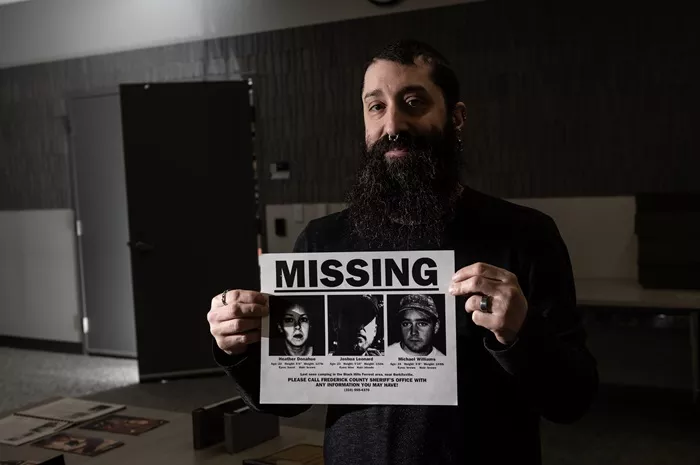
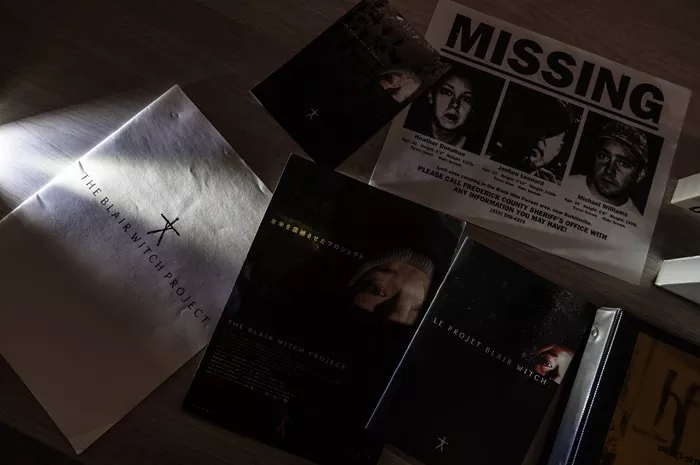
Over 25 years after its theatrical release, The Blair Witch Project joins the University of Pittsburgh Library System’s Horror Studies Collection, which acquires and preserves scripts, photos, props, and more from projects by George A. Romero and other influential horror directors. According to a press release, The Blair Witch Project producer, Gregg Hale, donated “marketing and promotional items like missing person posters and production materials,” and “reviews, articles, games, comics, and other tie-in media demonstrating the film’s impact.”
“We’re thrilled to find a permanent home for our collection of records, memorabilia, and ephemera from a little horror film that lucked its way into cinema history,” Hale stated in a press release.
The film’s impact reached far beyond scaring the pants off rural teens like myself, who wondered if the surrounding Pennsylvania wilderness also held deadly secrets. Besides giving horror a jolt of much-needed creative energy, it launched a new subgenre in found footage, and, as Ben Rubin, Horror Studies Collection coordinator at the Hillman Library, states, it revolutionized marketing by leveraging the then-burgeoning internet. It bears mentioning that one of the most influential horror films of all time was also co-written/directed by a Cuban American filmmaker, Eduardo Sánchez.
As Rubin points out, The Blair Witch Project was a lightning-in-a-bottle phenomenon that would be nearly impossible to pull off today.
“They took a huge gamble on producing and marketing a film on the internet at a time when nobody else in the industry was doing that,” Rubin tells Pittwire. “It showed you could do viral internet marketing, which now is hand-in-hand with any other marketing technique for films.”
The gamble paid off as the ultra-low-budget film — made for an estimated $60,000 — went on to gross nearly $250,000,000 worldwide from moviegoers, many of whom, like myself, went into the theater still wondering if what they were about to see was real. When the film came out on VHS, I took my birthday money to a mall FYE and snagged a copy.
Not only was The Blair Witch Project my introduction to found footage, but it was also my introduction to film as I’d never seen it before — instead of the slick 35mm blockbuster features I grew up with, here was a tiny square on a big screen, as the projector ran the 16mm and Hi-8 camcorder footage. A few years later, I’d make my own horror projects in film school using the same stock and technology.
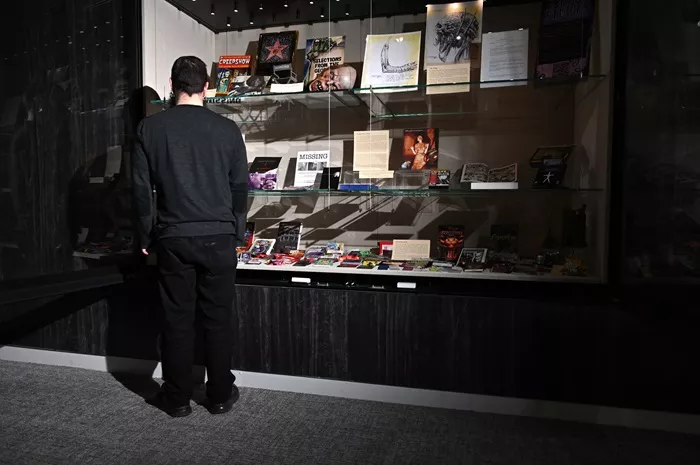
Pitt will begin processing The Blair Witch Project collection in the spring. However, fans can now see select materials displayed on the third-floor Archives and Special Collections Exhibit Gallery in the Hillman Library.
This article appears in Feb 26 – Mar 4, 2025.