
Deprecated: mb_convert_encoding(): Handling HTML entities via mbstring is deprecated; use htmlspecialchars, htmlentities, or mb_encode_numericentity/mb_decode_numericentity instead in /var/www/html/wp-content/plugins/super-cool-ad-inserter/inc/scaip-shortcode-inserter.php on line 37
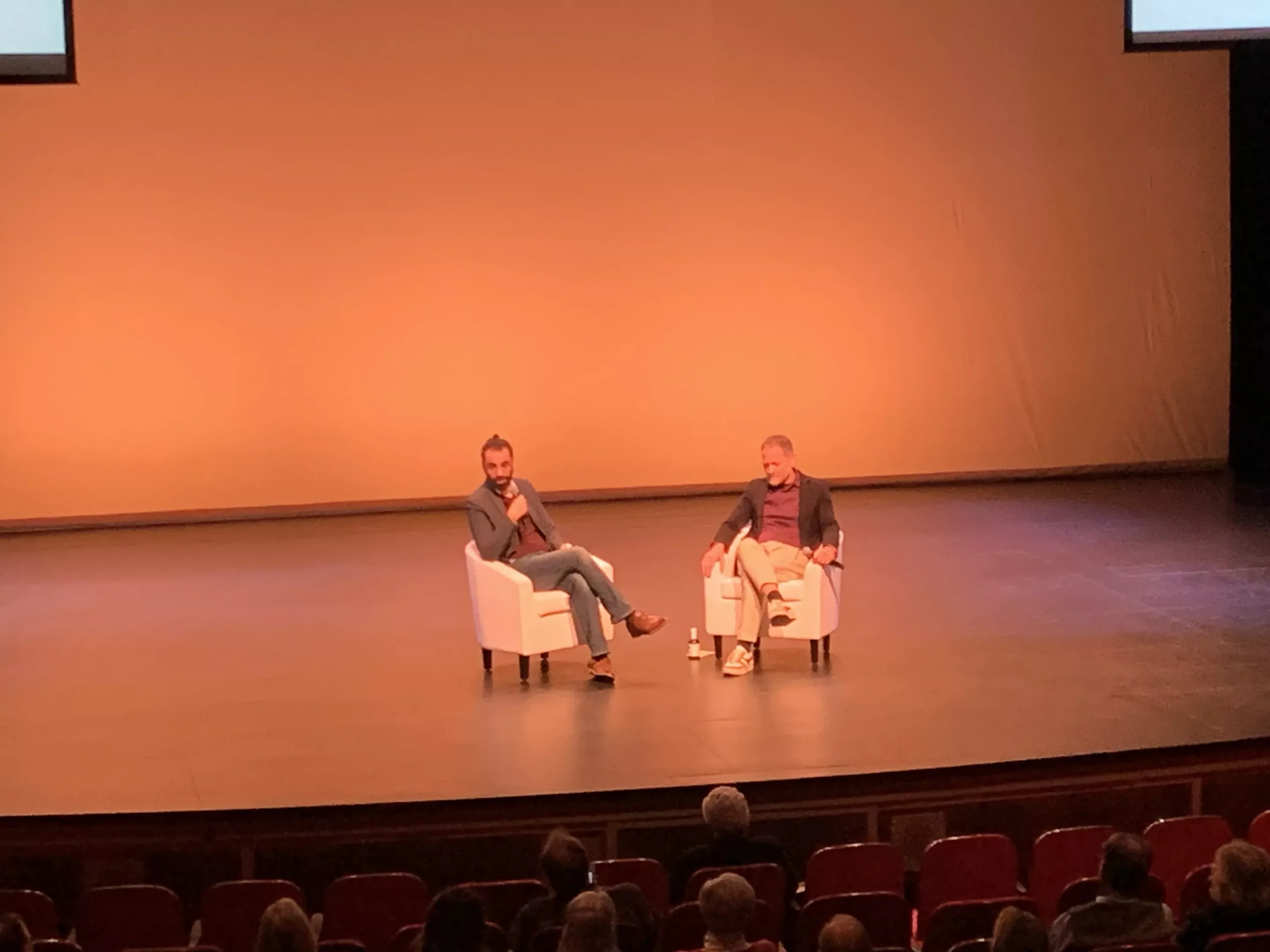
On Jan. 12, Israeli and Palestinian peace advocates came together at the Kelly Strayhorn Theater for a discussion about how ongoing violence in the region has affected their lives and to call for resolution and reconciliation. The event was scheduled before Jan. 15’s announcement of a tentative ceasefire in the Gaza Strip that was brokered in part by Qatar and supported by the U.S.
Longtime friends Aziz Abu Sarah, a Palestinian activist and journalist, and Maoz Inon, an Israeli entrepreneur, have been traveling the U.S. on a “Peace is Possible” tour, sharing their personal stories, meeting with local representatives, and laying out their vision for achieving lasting peace by 2030.
In Pittsburgh, the pair, who are also co-authoring a book, spent the day with Mayor Ed Gainey.
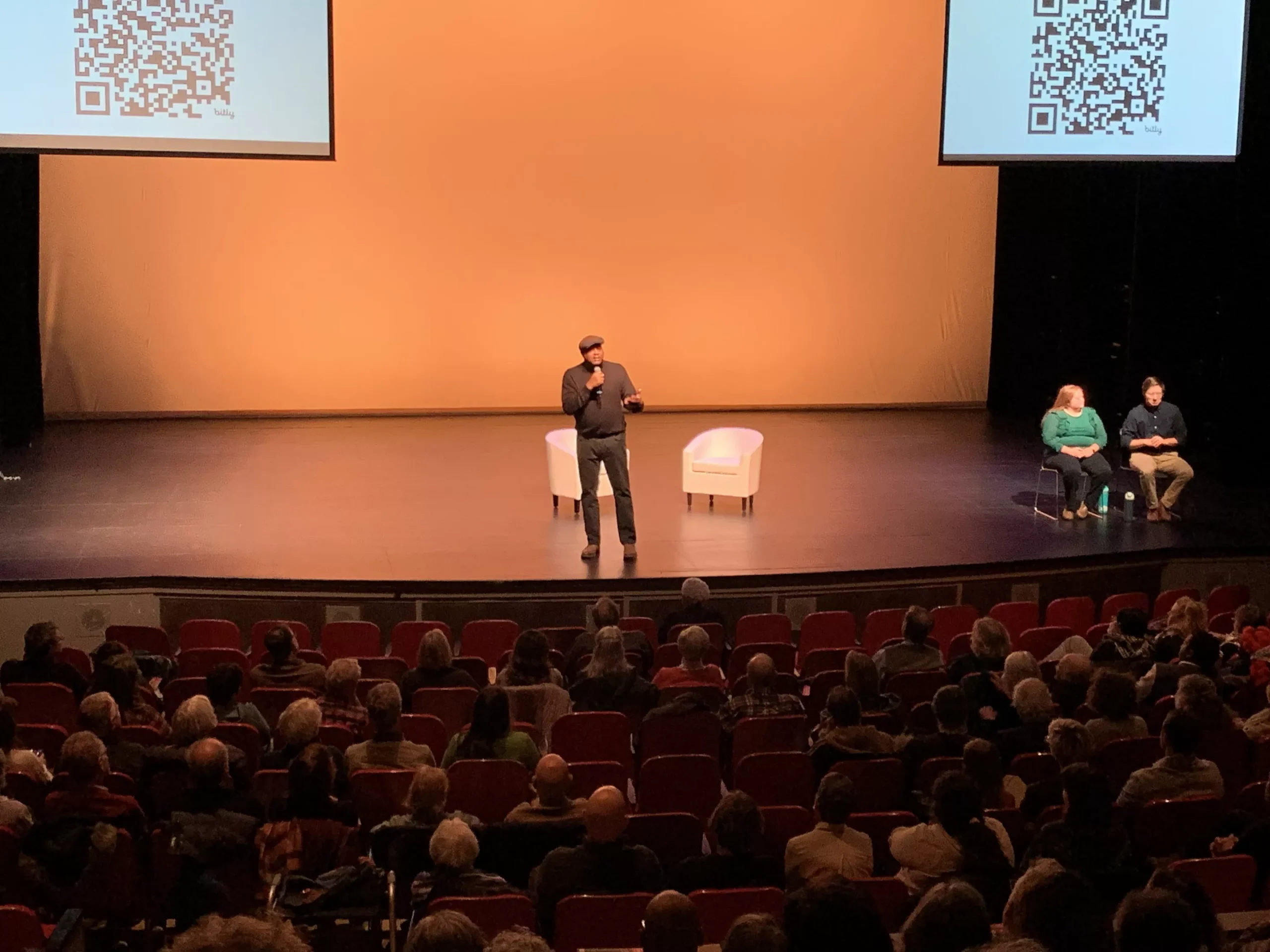
“I had to do a lot of listening, a lot of hearing,” Gainey said in an introduction to the Jan. 12 talk, “Building Bridges.”
A grim reminder of the conflict’s contentiousness and potential for violence — and more than six years after the Tree of Life synagogue shooting — Kelly Strayhorn audience members passed through security and were fully searched before entering.
“I want to have the safest city in America,” Gainey declared.
“Building Bridges” began with a hug. Usually, Abu Sarah explained, the conversation goes smoothly and the two friends hug after; but if not, it’s best to begin with a loving gesture.
Abu Sarah and Inon spoke to a nearly full auditorium for 90 minutes with elected officials including District 5 Councilor Barb Warwick, students, and community members.
Both speakers have experienced what the event rightfully described as immeasurable tragedies, solidifying their commitment to peace.
Inon’s parents, Yakov and Bilha Inon, were killed in the Hamas-led attacks of Oct. 7, 2023 when their home near the Gaza Strip was hit by a close-range missile.
“What made me believe peace is possible,” Inon said, was that “Aziz [Abu Sarah] reached out to me” and offered his condolences. On Oct. 10, 2023, the family’s third day of sitting shiva (the Jewish period of mourning), Inon’s younger brother Magen gathered the siblings “to send a universal message,” Inon said. “We are seeking no revenge, that we don’t want to revenge the death of our parents, because by revenging their death, we are just going to escalate the cycle of bloodshed, of hate, of fear that didn’t start on October 7 [but] started about a century ago.”
The family’s conversation resulted in an op-ed in The Guardian calling for peace and “not revenge” 12 days after the attack.
Abu Sarah stated his “introduction” to Israeli occupation began at eight years old when he was shot at going to school. When he was 10, his brother was arrested on suspicion of stone-throwing and later died of injuries sustained in Israeli prison.
“When you’re 10 years old, and someone kills your brother, how would you react?” Abu Sarah asked the audience directly. Despite his peace advocacy, he’s recently lost family members. Gathering accounts for his and Inon’s forthcoming book, a friend working as a doctor in Gaza for the last two years shared such “horrific” experiences that “I couldn’t stop crying,” Abu Sarah said.
“You hear so many stories around you, and if you don’t respond with anger, at least initially, something is missing. And if you don’t respond with, ‘what in the world can we do to stop this?’ Then also something is missing.”
Both speakers acknowledged their advocacy for peace “doesn’t mean ignoring the reality of anger.” Much of the talk and explanation of future peacemaking was framed as prioritizing “reconciliation over revenge.”
They highlighted the importance of upending narratives, and finding a way to build community given the lack of interaction between Israelis and Palestinians. Abu Sarah said that, until he was 30, he’d never met an Israeli who was not a soldier, a settler, or his employer. The pair invoked the phrase “from the river to the sea” to describe their vision of a single unified state. “We need to come with a new dream, a much [more] powerful dream. The dream of the Israeli government is Jewish supremacy from the river to the sea, and for the last 30 years, those in the government were the only ones that [were] dreaming, that [were] envisioning anything,” Inon said. “And that’s what we want to do here, to envision a better future for both people — the 14 million Israelis and Palestinians, seven million Palestinians, seven million Jews that live from the river to the sea. No one will go anywhere, no one will disappear.”
Speaking to the audience’s own frustrations about the ongoing conflict, the biggest applause line came not for the speakers’ visions of reconciliation, but when Abu Sarah criticized the United States’ involvement and ongoing arms sales to Israel.
“If you think peace can come on the top of a tank, you must be joking,” he said. “I think the U.S. is so oblivious, so out, often. I think if the U.S. was not involved, it would be better than it being involved.”
As it stands, much of the pair’s steps to peacemaking remain to be hashed out, and some attendees took issue with a peace process that characterizes Palestinians as seeking revenge rather than resisting Israeli occupation.
Inon seemed to lose several audience members when he said of Israeli violence, “Is it a genocide? Is it a war? Is it a war crime? Is it ethnic cleansing? I’m saying, What does it matter? It must be stopped. We need to win lives, not to win the argument.”
Abu Sarah affirmed that many Palestinians — in addition to international organizations including the United Nations — view Israel’s actions as genocide, and emphasized the critical need for further discussion.
The Pittsburgh Palestine Coalition, which advocates for justice and an end to genocide, distributed flyers after the talk, and apparently offended some attendees.
“Beware of the ‘peace’ industry and its culture of normalization. There is no symmetry between the oppressor, Israel, and the oppressed indigenous Palestinians,” flyers left in the theater’s lobby read. “Responsibility is not equal. Resistance to apartheid, occupation, and genocide is not ‘revenge’ but rather a right under international humanitarian law.” The organization also offered its own roadmap to peace, which includes an embargo on U.S. arms to Israel, accountability for war crimes, and an end to occupation.
In looking toward a peaceful future, personal transformation remained at the fore for the speakers.
“When I look at Maoz [Inon], I don’t see an enemy, I see a brother,” Abu Sarah told the audience. “And through the last 25 years since I’ve had my change in focus, some of my closest allies, people who’ve fought with me, people who’ve helped me, have been what’s considered ‘the other.'”
This article appears in Jan 8-14, 2025.