

Deprecated: mb_convert_encoding(): Handling HTML entities via mbstring is deprecated; use htmlspecialchars, htmlentities, or mb_encode_numericentity/mb_decode_numericentity instead in /var/www/html/wp-content/plugins/super-cool-ad-inserter/inc/scaip-shortcode-inserter.php on line 37
It wasn’t the type of response that union organizers typically get from management.
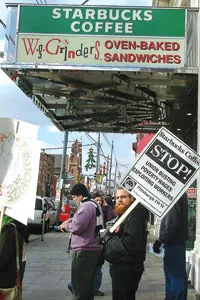
On Dec. 2, a dozen or so protesters from the Industrial Workers of the World assembled in front of the Starbucks on Liberty Avenue in Bloomfield — part of a national IWW campaign to organize the coffee giant and protest the firing of five New York baristas, allegedly for union activity. Very soon after, out came two members of Starbucks management to offer free samples of pastry and hot coffee — to picketers and passersby alike.
Kevin Farkas, a local IWW organizer and spokesman, took the small red cup from the tray and drank it.
“They did this in Squirrel Hill a couple of weeks ago,” Farkas says of a picket on Nov. 24 at the Starbucks at Forbes and Shady avenues. “Some people take the coffee, some don’t. Some take it and then dump it out on the sidewalk. It’s all about playing the game” of killing protesters with kindness.
When the group first approached the store, managers even held open the door for them. It was a very cordial scene — until demonstrators started belting out an anti-Starbucks ditty.
“I’m sorry, you’ll have to leave,” one manager told the group. “You’re welcome to do this outside, but not in here.”
His message fell on tone-deaf ears. But after the song, the group began an hour-long picket on the sidewalk.
Similar union actions have occurred at Starbucks across the country, as the IWW has sought to unionize the company to secure higher wages, increased staffing, guaranteed hours and safer working conditions for employees. The IWW contends that $7.25 to $7.50 an hour is not enough for an average person to live on, and that the hourly wage becomes effectively lower because schedules are inconsistent and workers are often not given all of their promised hours.
Starbucks offers benefits to even half-time employees — a rarity in its industry — as well as retirement plans and company stock purchases. But critics contend that the pay is so low that baristas can’t afford to pay for these benefits after they shell out for living expenses.
Bloomfield Starbucks management declined comment but offered a written statement from the company. Valerie O‘Neil, spokesperson for Starbucks in Seattle, noted in an e-mail that “the IWW is a union with a small number of members nationwide. A handful of the IWW members call themselves the ‘Starbucks Workers Union.’ They are not an official union recognized by the NLRB” — the National Labor Relations Board.
The Starbucks letter says the company is “committed to providing a flexible and progressive work environment,” and points to its recent inclusion, for the eighth consecutive year, in Fortune magazine’s list of “100 Best Companies to Work For.” (Fortune cites Starbucks’ benefits as one reason for its inclusion on the list.)
“While Starbucks respects the free choice of our partners [i.e. employees],” the statement concludes, “we firmly believe that our work environment coupled with our outstanding compensation and benefits, makes unions unnecessary at Starbucks.”
Starbucks has long touted what it calls a “generous” wage-and-benefits package, which starts baristas at $7.25-$7.50 an hour. While the company bests other coffeehouses, IWW’s Farkas allows, he says it could certainly afford to enhance its compensation further.
Last year, Starbucks posted revenues of nearly $6.4 billion, while maintaining 12,000 locations worldwide. According to the June 11 Los Angeles Times list of the top 10 coffeehouse chains in the U.S., Starbucks has 8,000 locations, while its nearest competitor, Caribou Coffee, has only 322. The remainder of the top 10 together total slightly more than 1,500 locations nationwide — just over 10 percent of Starbucks’ size.
“It’s all about perspective,” Farkas says. “A mom-and-pop coffeehouse or smaller chain coffeehouse can’t afford to pay their workers a lot of money. They’re just trying to survive. You can’t get blood from a turnip, but Starbucks is not a turnip. They’re a multi-billion dollar company, and the profits they make should be reflected in the pay of their employees.”
According to an article in the March 21, 2006, Wall Street Journal, 42 percent of Starbucks workers currently receive benefits — slightly less than the 43 percent of employees with benefits at oft-criticized Wal-Mart, as reported in a Feb. 23 Bloomberg News article.
And Starbucks has been accused of playing hardball when its practices are opposed. “I’m out here to protest the firing of five workers who lost their jobs because they tried to organize,” said protester Jonah McCallister. In March 2006, Starbucks reached a settlement with the National Labor Relations Board regarding unfair labor practice complaints made for alleged union-busting activity in New York.
Although the company made no admission of wrongdoing, terms of the settlement included a prohibition against promising promotions or other incentives to employees who do not support the union, as well as allowing employees to share pro-union literature and wear pro-union pins.
Two of the fired employees were reinstated with back pay.
Starbucks’ statement says union activity played no part in the five employees’ dismissal, although the company did not discuss the reasons for the firings. “[P]artners who are separated will not always acknowledge their responsibility and may even try to rationalize their behavior by distorting the facts and publicly attacking the company,” the statement says.
Farkas, for one, isn’t satisfied.
“After the way that I’ve watched them treat their employees, it amazes me that they can call them ‘partners’ with a straight face,” he says.
This article appears in Dec 7-13, 2006.




It’s good to see a union sticking up for underpaid service workers. I’d certainly be happy to see them all go union! $7.50’s just doesn’t cut it when you figure the company’s making money hand over fist. Keep it up.
Great to unions hitting the streets again in this town!
This was a nice article–It should be noted that the IWW/Starbucks Union is a recognized labor union and, in fact, Starbucks has been hauled before the NLRB for unfair labor practices for refusing to admit it. The company was forced to settle and is now in court for unlawfully breaking the terms of settlement–in part because Starbucks continues its union-busting tactics. Pretty Slezy Stuff for a company presenting itself as progressive and socially conscious.
I am not opposed to higher wages, however I am not sure that unionizing is the answer here. We all love our daily dose of Starbucks and the coffee is pricy. Once a union is in place prices will increase dramatically. I would recommend that everyone place a healthy tip in the tip jar as this is split by all staff at the end of the shift. Also, Starbucks is very open to providing jobs to individuals with severe disabilities and this should be recognized as well.
I am tired of the ‘mom and pop’ rant that they can not afford to pay people a good wage. starbucks and other companies may be able to do better, but ‘mom and pops’ usually fall into two categories:
greedy franchise owners, too lazy to do an honest day’s work, while paying others minimum wage, allowing the owner to live well on someone else’s sweat, or,
the family business owner that also depends on plentiful cheap labor while they play hard with toys bought as business expenses.
if these businesses and jobs can’t support a good wage, why would someone operate such a business to begin with?
gone are the days of true family businesses where the people that own the business actually work in the business.
The rules that govern large business should apply to these ‘mom and pop’ sweat shops too. Mom and pop shouldn’t get a pass on treating and paying employees well.
Well, yes, there are many Mom & Pop sweatshops. But there are economies of scale. If you’ve ever looked at employers’ books while negotiating labor contracts then you know that not all employers are hoarding pots of cash in the basement. Many small employers legitimately go out of business because they can’t make a profit relative to their economic environment. Like it or not, unions have to deal with such realities–of which, is companies like Starbucks and Wal-Mart are corporate giants that rearrange and destroy local economies that allow Mom & Pop places to survive.