
Deprecated: mb_convert_encoding(): Handling HTML entities via mbstring is deprecated; use htmlspecialchars, htmlentities, or mb_encode_numericentity/mb_decode_numericentity instead in /var/www/html/wp-content/plugins/super-cool-ad-inserter/inc/scaip-shortcode-inserter.php on line 37
Pittsburgh’s Gilded Age history is everywhere, from Downtown’s ornate towers to the museums, libraries, and parks bearing the names of deceased industrialists. However, many of these same industrialists specifically had their Point Breeze homes demolished — the Westinghouse and Mellon estates are now public parks, and the former Heinz estate is now a block of housing behind the walls that once surrounded the Heinzes’ gardens.
Not so with the estate of Henry Clay Frick. Clayton, the ancestral Frick home, stands as an enduring reminder of industrial wealth, good taste, and stark income inequality. However, visitors to Clayton won’t have seen fully half of the mansion. That will change in November, when the Frick Pittsburgh will, for the first time, open Clayton’s third and fourth floors to curious visitors as part of a multi-phase $10 million preservation effort.
It’s largely thanks to Helen Clay Frick, who, per Frick Pittsburgh staff, “adored” her childhood home, that the mansion still stands. “This house was her home. It was her baby,” Frick Pittsburgh collections and exhibitions assistant Bella Hanley told media during a recent sneak preview of the forthcoming tour. “I think she’d be really glad to see that we are still making the effort to take care of it and to make sure it lasts another 150 years.”
If nature had its way, the house might not still be here. Clayton has been victim to the forces that plague countless other Pittsburgh homes: water damage, lack of modern HVAC, and deteriorating masonry have all posed challenges. The tour of the upper floors is partly a bid to change that with help from visitors. While the exterior undergoes a loving restoration, Frick Pittsburgh staff has worked to stabilize the interior ahead of a fuller restoration.
Much like Henry Clay Frick himself, Clayton stands as a flawed reminder of Pittsburgh’s past, present, and future. As we did following the award-winning Gilded, Not Golden tour, Pittsburgh City Paper staff sat down following the tour to discuss what we saw — and what visitors can expect when public tours begin later this fall. The following conversation has been edited for length and clarity.
Colin Williams, news editor: I thought the upper floors revealed a lot about the family, but they also revealed a lot about the house.
Rachel Wilkinson, staff writer: That was the first thing I wrote down — and I felt like you were feeling this way, too, Colin — was they were listing off all the various home projects they have to complete for preservation, and it just sounded like an old Pittsburgh house. I heard paint stripping, box gutters, water damage, creating access panels to do further repairs. And I was like, I empathize, and feel a bit triggered, honestly. Whereas the downstairs definitely feels more like a museum, almost like a bug frozen in amber in 1892, this did feel like an old Pittsburgh house that still looks like an old Pittsburgh house, which is sort of surreal to think about because it’s the Fricks.
Colin: The water damage in particular was pretty extensive, right? There were some rooms that were pretty thoroughly destroyed, and clearly there’s a lot of work to be done to remediate that stuff. When it comes to things like the box gutters, I don’t envy them having to deal with that. But I also think it speaks to the fact that this wasn’t touched for so long.
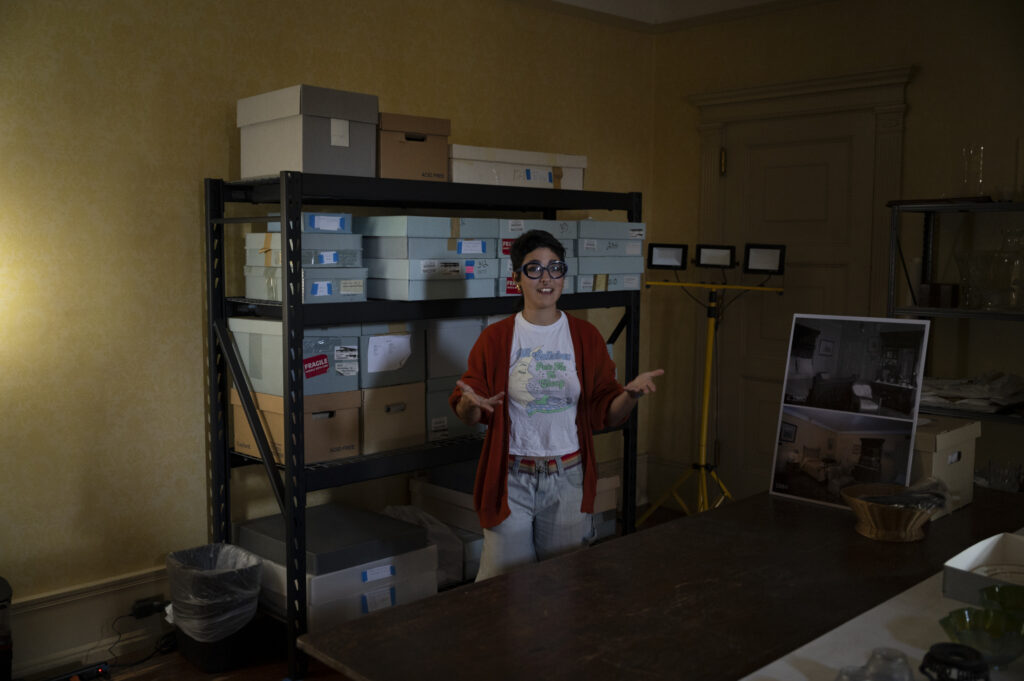
Rachel: Not only did Helen Frick live out the end of her life there in the course of Clayton being a museum, but the staff used it to take breaks and store Christmas decorations!
Colin: It was interesting how much the upper floors were function over form compared to the lower two floors.
Mars Johnson, staff photographer: I was curious what their plan was, if they’re going to try to completely restore it, or if they’re just kind of doing preventative measures so it doesn’t get worse than it is. It sounds like their budget is also not crazy.
Colin: One thing I think is really remarkable about historic preservation — and even Pittsburgh homeownership — is that you’re just constantly having to fight the elements and fight the passage of time. I also thought it was really remarkable that, even for a family that was this wealthy, that had this much power, that they still just made awful renovation choices in the ’70s. One thing that I was left thinking is that I hope they keep at least one room not restored to the 19th century because it really does speak to the history of the house, and also the history of architecture in America.


Rachel: I really liked the chauffeur’s room in that respect, because I feel like with Gilded, Not Golden, they went to these great lengths to incorporate the stories of people who were not just the Fricks, not only people and staff that came through the house, but the life of working Pittsburghers who worked in Frick’s mills. I think the intention is to keep some of that and not just completely go back in time to whatever it was when they first built the mansion, but I like incorporating the life of the staff that were also in the house.
Mars: They touch on it pretty immediately in the regular Clayton tour, how much the staff is factored into the living quarters and the call buttons and and everything. I don’t know if you guys saw it on the first tour, but they had a painting that Frick put up that was basically taunting the workers as they came in. At the top of the stairs, there was a painting of a donkey that was basically calling them lesser-than. I forget exactly what the message was, but it was basically ‘you’re down here, and we’re up here, and don’t try to get better pay.’
Colin: As we all know, Frick was not a big fan of organized labor! To that point, as well, it’s hard to kind of imagine that level of dependency on other people. It also really speaks to, not only was there a lot of income inequality in America at the time, but there were just so many people cheek by jowl that you could pretty easily afford to have five-plus people in your employ. These days, you don’t really hear about butlers and maids and governesses and stuff in the same way. But there was an entire business being run out of their home, where they had a school and a transit system and maintenance staff.
Rachel: I think on the last tour, they said they had someone whose job it was just to beat the soot out of those big velvet curtains.
Mars: It’s a weird dynamic to have people that aren’t your family around just so that you have clean laundry all the time.
Colin: As far as the rooms, what stuck with you the most?
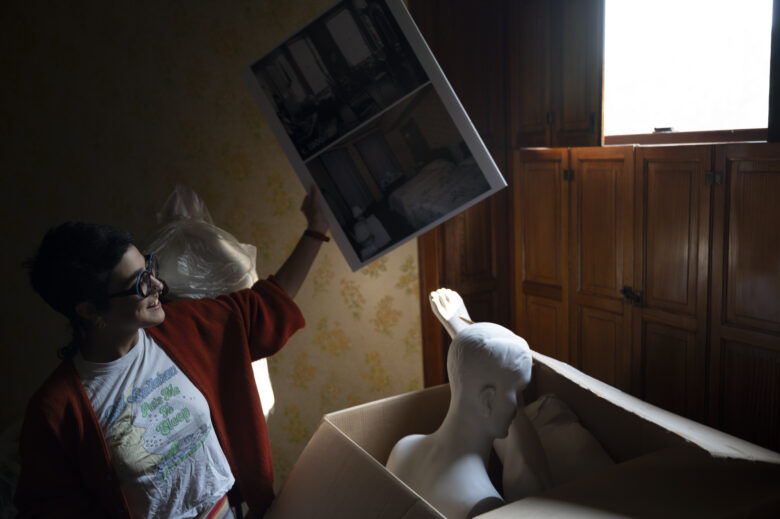
Mars: [Referring to a pair of decaying shoes found in a crawlspace] The room where they found the shoes, that was a really cool room. I also liked the room that has the half-painted, half-floral wallpaper and a bunch of archival photos.
Colin: Yeah, the playroom with the big bay window — that was such an oddly shaped room. The way they built additions to the house, it felt very ramshackle. When I’ve been in other mansions or palaces, there’s a real logic to the layout — when you think about Versailles or something, it’s all very symmetrical and orderly. This house was kind of hodge-podgy.
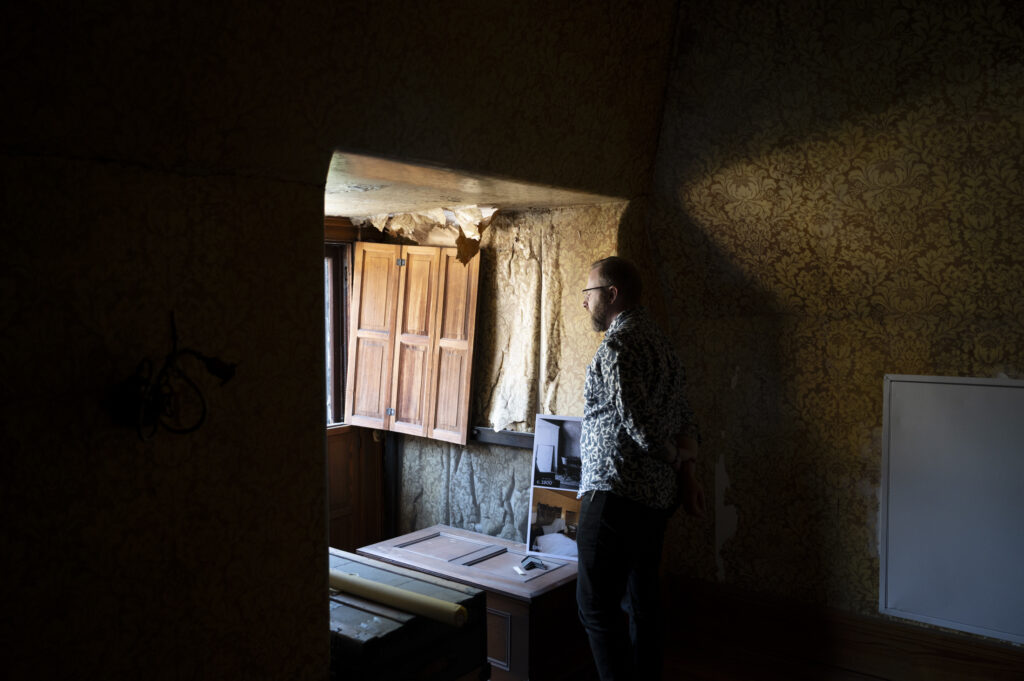
Rachel: The schoolroom in the attic with all the trunks in it was really cool.
Colin: That stuck with me the most because, for some reason, it made me think of The Secret Garden. I pictured these kids spending all day in this house with so many little hidey-holes, and I could just imagine being bored during your lessons, and you’re up in this hot attic, but there are all these little nooks and crannies you can kind of disappear into. It gave me an image of kids leading their governess on a chase through the upper floors.
Rachel: Like, “Get back here! It’s time for your German lessons!” Classic Pittsburgh is that her only fellow pupil was Virginia Frew. Of course, it’s the Frews who have a street named after them in Oakland near Carnegie Mellon. All the names are really from 20 families and recur over and over and over and over again.
Colin: You’ve got to think, for all that they were this really cosmopolitan family and were traveling all over the place, that their day-to-day world was pretty small, especially for the kids. They’re not being socialized in a public school with hundreds of other people. They’re in a room with one other person who’s also as blue-blooded as they come, just learning about the world literally from on high, four stories up above everybody else.
Rachel: One thing we know about Helen Frick is she was completely devoted to curating a certain image of her family and preserving the less unsavory parts of its legacy. So I love this question of, how would she feel about opening up this part of the mansion? I feel like there’s this very concrete divide between the museum as we know it and the behind-the-scenes of the museum that will now become part of the museum. If you want the full sweep from the Gilded Age in 1892 to the nadir of Pittsburgh’s steel industry in 1980, maybe this is the best way to do it.
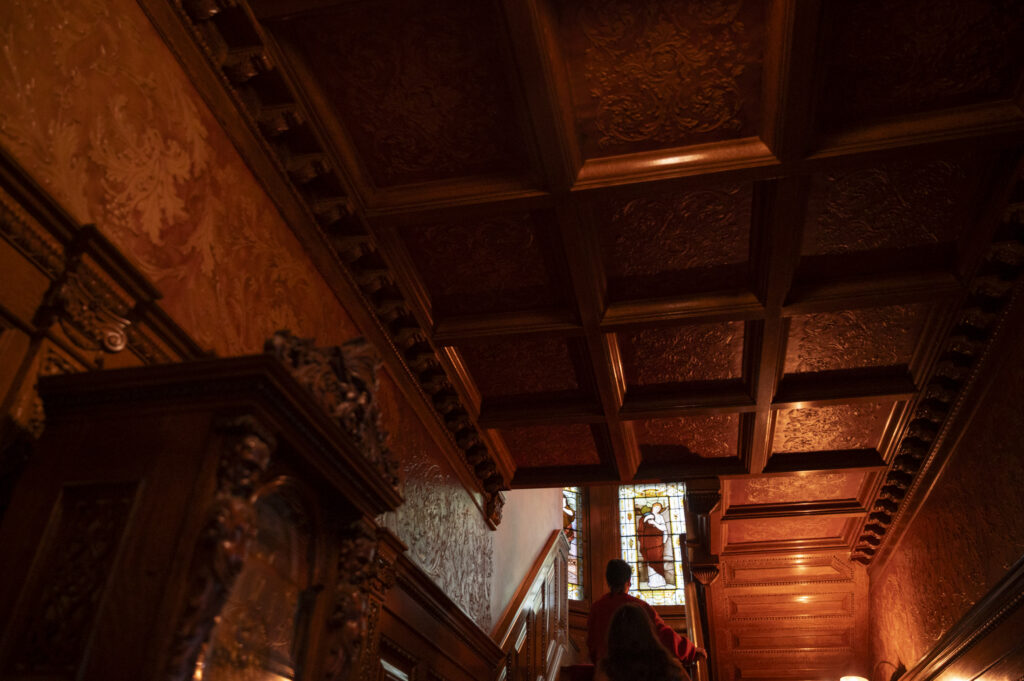
Mars: This might not be totally accurate, but I feel like there was a lot more sentimental value for people back then wanting to continue to stay in their family’s houses.
Rachel: I wonder why she did love it so much, because that’s repeated a lot: “she adored the house; she loved the house.”
Colin: One of the things that history is clear about is when they built that house in New York City that’s now the Frick Collection, the house was kind of built to be a museum. I can’t remember if it was Helen or if it was Henry who described it as being like a mausoleum. The house in New York is huge. It’s stone. It’s very cold. There’s marble everywhere. It’s very, very different from Clayton, which is warm wood, cozy. There are a lot of really small rooms in Clayton for a mansion.
I actually found myself wondering if Helen felt any pressure from the fact that a lot of other wealthy families in Pittsburgh actually demolished their estates. Helen really fought for a private space to remain. I don’t know that she wanted the public to see their sitz baths or know details about the assassination attempt, but it was clearly a deliberate choice to preserve this that other people didn’t make.
Rachel: It makes me wonder — with her father being probably the greatest villain of Pittsburgh history, maybe it was worth it to try to humanize the family as much as possible, and maybe the house did that in a way that other things couldn’t?
This article appears in Oct. 15-21, 2025.